Asexual Pride: The Ace Flag, Symbols, History, and Coming Out
What the asexual pride flag stripes mean, where the ace ring and cake came from, a dated ace timeline, acephobia facts, and how to come out as asexual.
General education, not medical advice. If something here worries you, talk with a clinician.
Table of Contents
Asexual pride rests on a black, grey, white, and purple flag that ace communities voted for in 2010. Around it sit a handful of quieter signals, like a black ring or a slice of cake, plus two yearly events that put ace people in the spotlight. Ace is the everyday short form of asexual, meaning someone who feels little or no sexual attraction. If you want the basics first, start with what asexuality is.
This guide explains what each symbol means and where it came from. It also walks through a dated timeline, the debate over the A in LGBTQIA+, and what acephobia looks like in daily life. The last part is practical: a step-by-step plan for coming out, with sample words you can adapt.
The asexual flag, stripe by stripe
What each stripe stands for
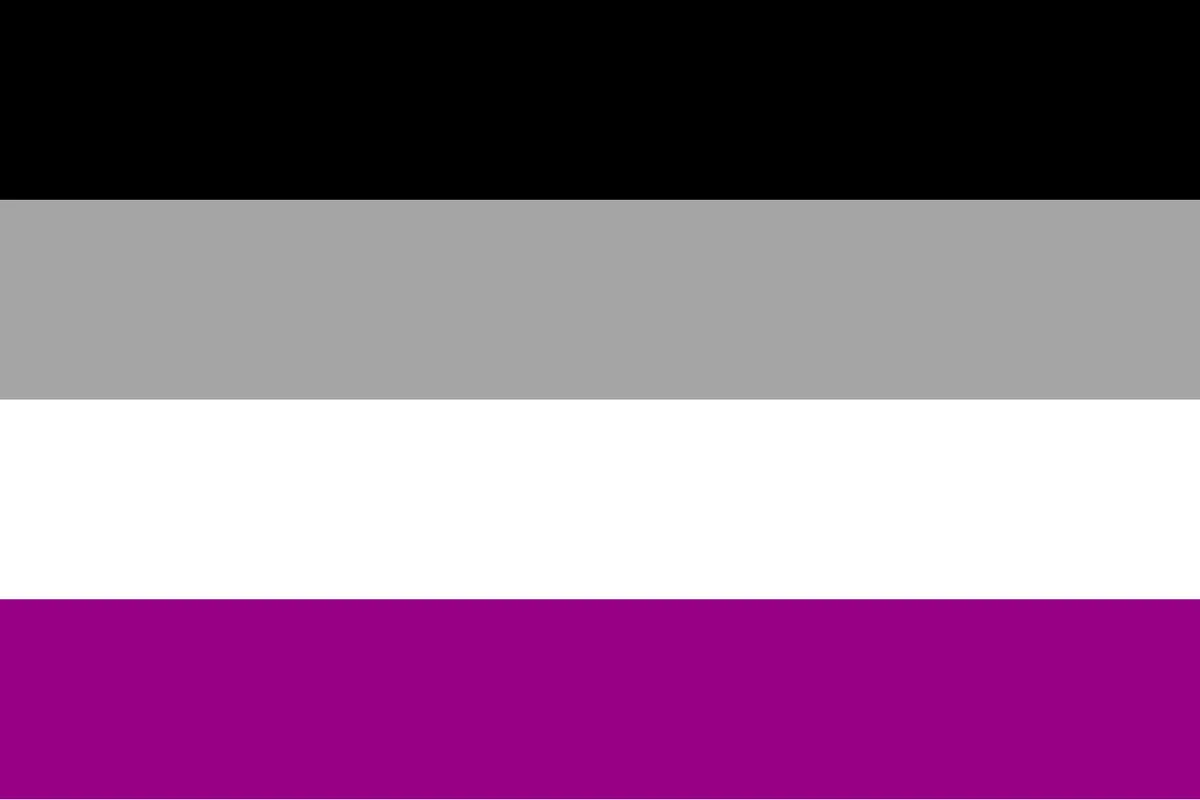
The asexual flag has four equal horizontal stripes, which matches the striped style of most other pride flags. From top to bottom the colours are black, grey, white, and purple. AVEN’s community wiki gives the meanings most people use:
| Stripe | Common meaning | In plain words |
|---|---|---|
| Black | Asexuality | People who feel little or no sexual attraction |
| Grey | Grey-asexuality and demisexuality | People in the “grey area,” including those who feel attraction only after a close bond |
| White | Sexuality | People who do feel sexual attraction |
| Purple | Community | The ace community as a whole |
The Asexuality Handbook reads the purple stripe a little more broadly, as the whole a-spectrum community. Those small differences are fine. AVEN’s wiki says nothing about the meanings is official, and anyone can assign their own meaning to each colour, or none at all. If the grey stripe describes you, the guide to asexual spectrum labels explains grey-ace and demisexual in more depth.
How the 2010 flag was chosen
Nobody handed the community a finished flag. In the summer of 2010, several asexuality websites, led by users on AVEN, proposed designs and then ran a vote in several rounds. The winning design came from an AVEN user known as standup and was first posted on June 30, 2010. Organisers also asked for input from aces outside AVEN and from non-English-speaking areas, and the final vote in August 2010 was held on a site that was not AVEN.
Why plain stripes? Before 2010, people borrowed the AVEN triangle, which was one website’s logo, or a half-filled heart. The heart suggested romance, so many aromantic aces were uncomfortable using it. Simple bars avoided those problems, carried no hint of a national flag, and sat comfortably next to other pride flags. From 2011 onwards, the flag began appearing in pride parades.
Rings, cake, cards, and dragons: the other ace symbols
The black ring on the right middle finger
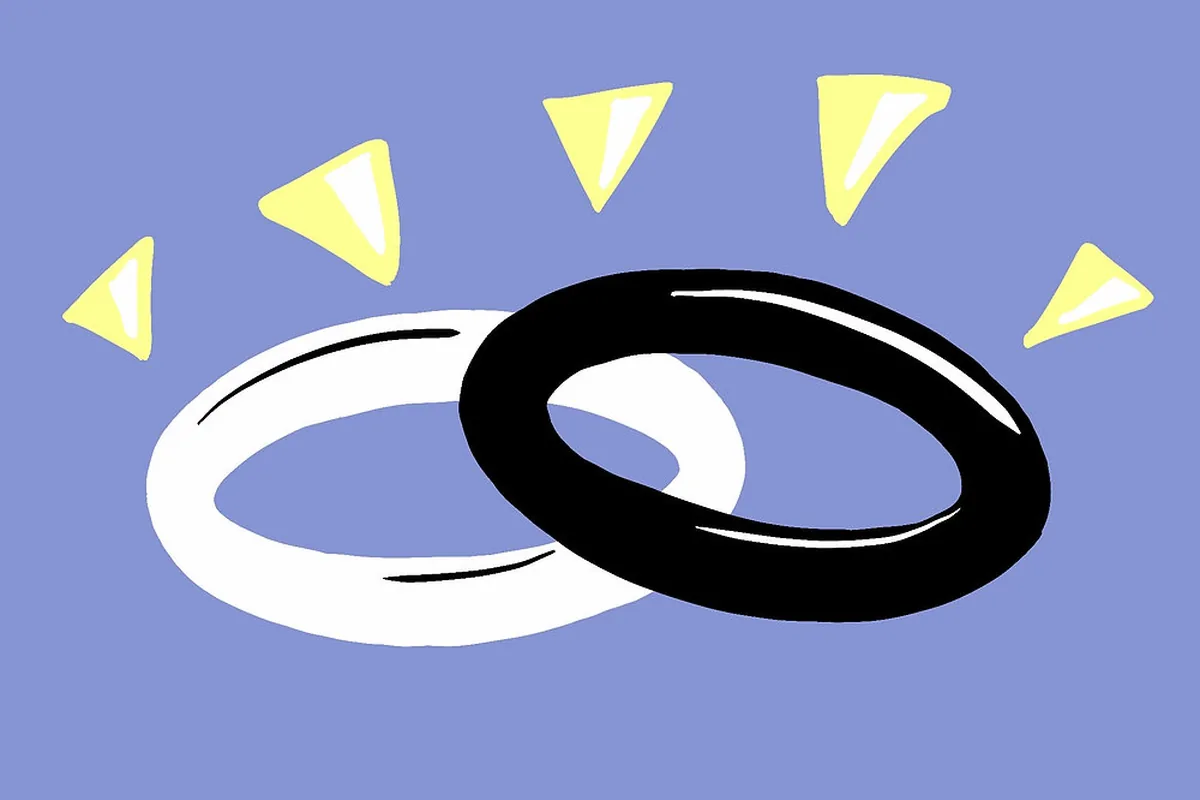
A plain black ring on the middle finger of the right hand is a common everyday ace signal. The material and style do not matter much, as long as the ring is mainly black. Its appeal is that it is discreet. Other aces may notice it, while most people will see an ordinary piece of jewellery.
The idea traces back to a 2005 thread on AVEN, where it began as a twist on the wedding band. That first framing rejected traditional relationships, but the wider community never adopted that message. Today the ring simply signals that the wearer is ace. Some people also wear one privately while they are still deciding whether the label fits, which the Asexuality Handbook describes as a low-key way to try an identity on.
Do not read every black ring as a statement, though. Plenty of people wear black rings for style alone.
Cake, the in-joke that stuck
Cake started as a joke that ace people would rather have cake than sex. On AVEN, newcomers are often welcomed with cake, and the wiki lists it as an informal symbol. The joke also makes a gentle point: for many aces, sex is about as ordinary as eating dessert. Garlic bread sometimes stands in for cake with the same meaning. You will mostly see cake in memes, meetup snacks, and Ace Week posts rather than on badges or flags.
Ace of spades and ace of hearts
The playing cards are a pun. “Ace” is slang for an asexual person, so the ace of hearts and the ace of spades both turned into ace symbols. Spades is the usual pick because it is the card most people picture when they think of an ace. Some people attach extra meanings to one card or the other, but those uses are informal and vary from person to person, so ask rather than assume.
Fan-art favourites and deep cuts
You may spot dragons in ace fan art online. They are much less established than the ring or cake, though. AVEN’s own list of asexual symbols does not include dragons at all. Treat a dragon as a playful in-group nod. The same list includes some deeper cuts, like the AVEN triangle logo and a joke equation that reads as sex plus me equals no result.
A dated timeline of asexual visibility
Every date below comes from a named source. Where a popular story could not be confirmed, it is left out.
Research milestones before the internet
| Year | What happened | Why it matters |
|---|---|---|
| 1948 | Alfred Kinsey’s book on male sexual behaviour is published | It introduced a separate category, X, for people with no socio-sexual contacts or reactions |
| 1953 | Kinsey’s companion book on female sexual behaviour follows | The X category appears again in this second report |
| 1979 | Michael Storms first proposes a two-axis model of erotic orientation | Asexual becomes one of four mapped categories instead of a point off the scale |
| 1980 | Storms publishes the model in the Journal of Personality and Social Psychology | It gave researchers a way to place asexuality on the same map as other orientations |
Kinsey’s scale ran from 0, exclusively heterosexual, to 6, exclusively homosexual. People who reported no sexual contacts or reactions did not fit anywhere on it, so they were marked X. That label described behaviour rather than attraction, which is why it is a forerunner rather than a match for the modern idea of asexuality.
Storms solved part of the problem by putting same-sex attraction and other-sex attraction on two separate axes. Someone low on both lands in the asexual corner. The model still had gaps. AVEN’s wiki notes it ignores romantic orientation and fits non-binary people poorly.
The online community and its calendar
| Date | What happened | Source detail |
|---|---|---|
| 2001 | AVEN, the Asexual Visibility and Education Network, is founded | It now hosts the world’s largest online asexual community |
| 2005 | The black ring idea first appears in an AVEN thread | It later became an everyday ace signal |
| June 30, 2010 | The winning flag design is first posted by AVEN user standup | Part of a multi-stage community vote |
| August 2010 | The four-stripe flag is voted on and adopted | Input came from aces outside AVEN and outside English-speaking areas |
| 2010 | Asexual Awareness Week is founded, later renamed Ace Week | It now runs every year in the last week of October |
| 2011 | The flag starts appearing in pride parades | It became one of the main symbols of asexuality |
| April 6, 2021 | The first International Asexuality Day takes place | The 2022 event was described as the second ever |
International Asexuality Day is a joint effort by ace organisations in different countries, and the date was picked by an international committee. Its stated aim is to look beyond English-speaking and Western countries, which have had most of the attention so far. Ace Week, by contrast, focuses on education and celebration each autumn, with people sharing resources and holding events.
Is asexuality part of LGBTQ+?
Yes, in most current usage. The expanded acronym LGBTQIA+ uses the A for asexual, among other identities, and most aces surveyed agree they belong there. The details are worth knowing, because the question still sparks arguments online.
What the A stands for, and what it does not
In the longer acronym LGBTQIA+, the A can stand for asexual, aromantic, or agender. Ally is not part of it, although allies still play a real role in supporting the community. Aromantic means feeling little or no romantic attraction, and agender describes people who do not identify with any gender. Some groups also use LGBTQ+ or LGBT+ and let the plus sign cover ace people.
History adds a wrinkle that the slogan “A is not for ally” can hide. Ace activist Siggy points out that around 2010, student groups using LGBTQIA usually did mean ally, because few people had heard of asexuality. A psychology textbook from OpenStax still notes that the A sometimes stands for allies today. So when people say the A is for asexual, they are making a case that aces belong in the acronym. That case does not depend on the letter having always meant asexual.
The inclusion debate, stated fairly
Some people argue that ace people do not face the same oppression as lesbian, gay, or bisexual people, so they should not claim space in queer groups. Others answer that aces deal with their own stigma, and research backs that up. In a U.S. population-based study by Rothblum and colleagues, asexual respondents felt more stigma than non-asexual sexual minority men and women. They also reported more everyday discrimination than non-asexual men. That study had only 19 asexual respondents, so its numbers are a starting point rather than the final word.
The ace community itself leans firmly toward inclusion. In the AVEN Community Census, 88% said asexuality should be part of the LGBTQ+ umbrella. Yet only 11.5% felt unconditionally welcomed by the queer and LGBTQ+ community. That gap sums up the debate: most aces want in, and many still feel only partly at home.
What acephobia looks like day to day
Acephobia is prejudice, dismissal, or mistreatment aimed at people because they are asexual. It is often quieter than other kinds of bias. Much of it comes from the belief that everyone feels sexual attraction, so someone who does not must be broken, confused, or lying.
Everyday examples
Most ace people will recognise at least a few of these situations. None of them requires bad intent to hurt.
- “You just haven’t met the right person.” This treats asexuality as a waiting room rather than an orientation.
- “Have you had your hormones checked?” The Trevor Project notes that studies show asexual people have hormone levels within average ranges.
- “Maybe you’re depressed.” Early skeptics, including some mental health professionals, suggested aces were simply depressed or on medication.
- A partner who treats sex as a debt. Pressure to “prove” love through sex can strain a relationship, and the Trevor Project lists rejection by a partner as a specific coming-out risk.
- Jokes that aces are cold or robotic. These echo the research finding, covered below, that people rate aces as less human.
- Being left out of the conversation. Sex education, dating apps, and TV plots often assume everyone wants sex, so ace lives rarely show up at all.
Being ace does not mean anything is wrong with a person, nor does it mean they chose celibacy or cannot love. Psychology Today writer Bella DePaulo makes the same point plainly: asexuality is a sexual orientation, not a sexual dysfunction.
What the research shows
The best-known study is by researchers MacInnis and Hodson, published in 2012 and summarised by Bella DePaulo in Psychology Today. Across two groups of heterosexual participants, asexual people were rated the least warmly of all the groups tested. They were also rated as less uniquely human than heterosexual, gay, lesbian, or bisexual people. Participants felt less comfortable hiring or renting a home to asexual people than to heterosexual people.
Unfamiliarity did not explain it. Participants knew even less about a comparison group, yet they were still more biased against aces. The Rothblum study described earlier adds a health angle: fewer asexual respondents were out to all of their healthcare providers.
UK figures point the same way. Stonewall statistics reported by The F-Word say nearly 9 in 10 ace people have avoided being open about their sexuality. The same report says 1 in 10 have been offered or have undergone conversion therapy. Awareness is part of the problem. A 2019 poll cited in that article found 75% of people got the definition of asexuality wrong, even though 53% felt confident they knew it.
Coming out as asexual, one step at a time
You never have to come out, and there is no deadline. The Trevor Project’s Coming Out Handbook says there is no right or wrong way to do it, and that your safety and well-being come first. The steps below are a flexible plan you can reorder or skip. If you are still working out whether the label fits, the am I asexual guide is a gentler place to start.

Step 1: Decide what you want from telling someone
Start by naming your goal. You might want a partner to understand why you turn down sex. You might want family to stop asking about marriage, or simply to stop hiding. A clear goal helps you choose who to tell and how much to share.
Then check your safety. If a parent, landlord, or partner might react badly, the handbook suggests preparing a back-up plan for housing, food, school, or transport. You will know it worked when you can name one safe place and one safe person you could turn to if a talk goes wrong.
Step 2: Choose who to tell first
Think of people who back you no matter what, and start there. A supportive friend makes a good first listener because the stakes are lower. Practising with supportive people can help you work out what to say and how to say it. Online ace communities can play this role too. AVEN, for example, runs local meetups and resource projects alongside its forums.
Leave the hardest conversations for later. The best time and place may differ for each person you tell.
Step 3: Pick your words
Short and specific usually lands better than a long speech. You can speak in person, write a letter, or send a text, which the handbook lists as a valid option. These sample phrasings are only suggestions. Change them until they sound like you.
- To a friend: “I’ve worked out that I’m asexual. It means I don’t really feel sexual attraction. I’m still me, I just wanted you to know.”
- To a parent: “I’d like to share something about myself. I’m ace, which means sex isn’t something I feel drawn to. I’m happy, and I’m not asking you to fix anything.”
- To someone who likes clear labels: “I’m biromantic asexual. I can fall for people of more than one gender, but I don’t feel sexual attraction.”
- When you want them to read more: “Here’s a page that explains it better than I can. Can we talk after you’ve read it?”
The Trevor Project suggests pointing doubtful friends and family toward resources so they can research on their own. That takes pressure off you to answer every question on the spot.
Step 4: Expect a few common reactions
Think ahead about the range of reactions, good and bad. How a person handles other difficult news is a fair guide to what to prepare for. Here are reactions many aces hear, with short replies you could adapt:
- “It’s just a phase.” “Maybe my words will change one day. Right now this describes me well.”
- “You should see a doctor.” “I’m not unwell. Research shows asexual people have hormone levels in the average range.”
- “But you can still love someone, right?” “Yes. Being ace doesn’t stop me loving people.”
- “I don’t get it.” “That’s okay. You don’t have to understand it all today.”
Some reactions take time to soften. A first response is rarely the final one.
Step 5: Talking to a partner
Coming out to a partner carries its own risks, and the Trevor Project names rejection by a partner as one of them. Pick a calm, private moment, not the middle of a disagreement about sex. Explain what stays the same, such as your feelings, and what may change, such as how often sex happens or whether it happens at all.
Then talk about what closeness looks like for both of you. Some ace people enjoy certain kinds of touch, and some do not want sex at all. Mixed couples can work it out through honest talk about needs and limits. Healthy relationships rest on trust, honesty, respect, and open communication, and both people should feel safe.
Ace pride FAQ: quick answers on flags, rings, and identity
Are asexuals considered LGBTQ?
In most current usage, yes. The A in LGBTQIA+ can stand for asexual, aromantic, or agender. Most aces agree. In the AVEN Community Census, 88% said asexuality should be part of the LGBTQ+ umbrella. A minority of people still dispute it, so you may hear both views.
Which hand does an ace ring go on?
The ace ring goes on the middle finger of the right hand. It is usually plain black, and the material does not matter. Wearing one is optional. Plenty of aces never wear a ring, and plenty of people wear black rings with no ace meaning at all.
What represents asexuality?
The four-stripe flag in black, grey, white, and purple is the most widely recognised symbol. After that come the black ring, cake, and the ace of spades or ace of hearts playing cards. Each one is informal, so people pick whichever feels right.
Is asexuality caused by trauma or hormones?
Neither one explains it. Early skeptics, including some mental health professionals, wondered whether aces were avoiding sex after painful past experiences. DePaulo writes that this doubt has mostly been buried by the evidence since, and that asexuality starts early in life. On hormones, the Trevor Project notes that studies find asexual people have hormone levels within average ranges. Asexuality is a sexual orientation, not a dysfunction or something to be cured. If you have lost interest in sex suddenly and feel distressed about it, talking with a doctor is reasonable, since that is a different situation.
Is asexuality the same as celibacy?
No. Celibacy is a choice not to have sex, while asexuality describes a lack of sexual attraction. The Trevor Project stresses that being ace does not mean someone is celibate by choice. Some aces have sex for their own reasons, and some celibate people feel plenty of attraction.
Your next step with ace pride
Asexual pride can grow one step at a time, so pick the next step that fits where you are. If you are still questioning, take your time with the am I asexual guide and the asexual spectrum labels before choosing a word for yourself. If you already know you are ace, a black ring, a flag pin, or a post during Ace Week are low-pressure ways to show it.
If you are ready to tell someone, start with one safe, supportive person and a few sentences you have practised. And if you are an ally, the most useful thing you can do is believe ace people when they describe themselves. Pride does not have to be loud. For many aces it begins with a quiet “this is me” to one person who listens.
Related reading
- What Is Asexuality? Meaning, Spectrum, Myths and Research
- The Asexual Spectrum: Labels Grouped by What They Describe
- Asexual Representation: Famous Asexual People, Characters and Songs
- Finding the Asexual Community: Reddit, Dating, Meetups and Support for Ace and Demi People
Sources
- Asexual flag - AVENwiki - AVENwiki (Asexual Visibility and Education Network)
- Symbols of asexuality - AVENwiki - AVENwiki (Asexual Visibility and Education Network)
- Asexual symbols - The Asexuality Handbook
- The Asexuality Flag - Asexuality Archive
- 10.3 Sexual Behavior, Sexuality, and Gender Identity - Psychology 2e - OpenStax (Rice University)
- Kinsey scale - AVENwiki - AVENwiki (Asexual Visibility and Education Network)
- Storms’ model - AVENwiki - AVENwiki (Asexual Visibility and Education Network)
- About AVEN - Asexual Visibility and Education Network
- What is Ace Week? - Ace Week
- FAQ - International Asexuality Day (IAD) - International Asexuality Day
- Celebrating International Asexuality Day 2022 - The F-Word
- Allyship - LGBTQ+ Rolla
- I hate “A is not for Ally” - The Asexual Agenda
- Asexual and Non-Asexual Respondents from a U.S. Population-Based Study of Sexual Minorities - Archives of Sexual Behavior (Rothblum et al., via PubMed Central)
- Understanding Asexuality: FAQs & Supportive Resources - The Trevor Project
- Biased Against Asexuals? Let Me Count the Ways - Psychology Today (Bella DePaulo)
- The Coming Out Handbook - The Trevor Project