Vaginal Orgasm vs Clitoral Orgasm: What Anatomy and Research Show
What is a vaginal orgasm, and can women orgasm from penetration? See clitoral anatomy, the G-spot debate, survey data and tips for adding clitoral touch.

General education, not medical advice. If something here worries you, talk with a clinician.
Table of Contents
A vaginal orgasm usually means an orgasm reached through penetration, without direct touch to the clitoris. It is less common than many people assume. In a U.S. survey of 1,055 women, 18.4% said intercourse alone was enough for orgasm, while 36.6% said they needed clitoral stimulation during intercourse. Both patterns are normal, and neither is a better or more grown-up kind of orgasm.
The vaginal-versus-clitoral divide is also blurrier than the labels imply. Most of the clitoris sits inside the body and wraps around the vagina, so penetration can stimulate it from within. This guide walks through that anatomy, compares the two in a table, weighs the G-spot evidence and explains why orgasm from penetration alone is uncommon. It ends with practical, consent-centred ways to add clitoral touch during partnered sex and signs that it is worth seeing a clinician.
The clitoris is bigger than it looks
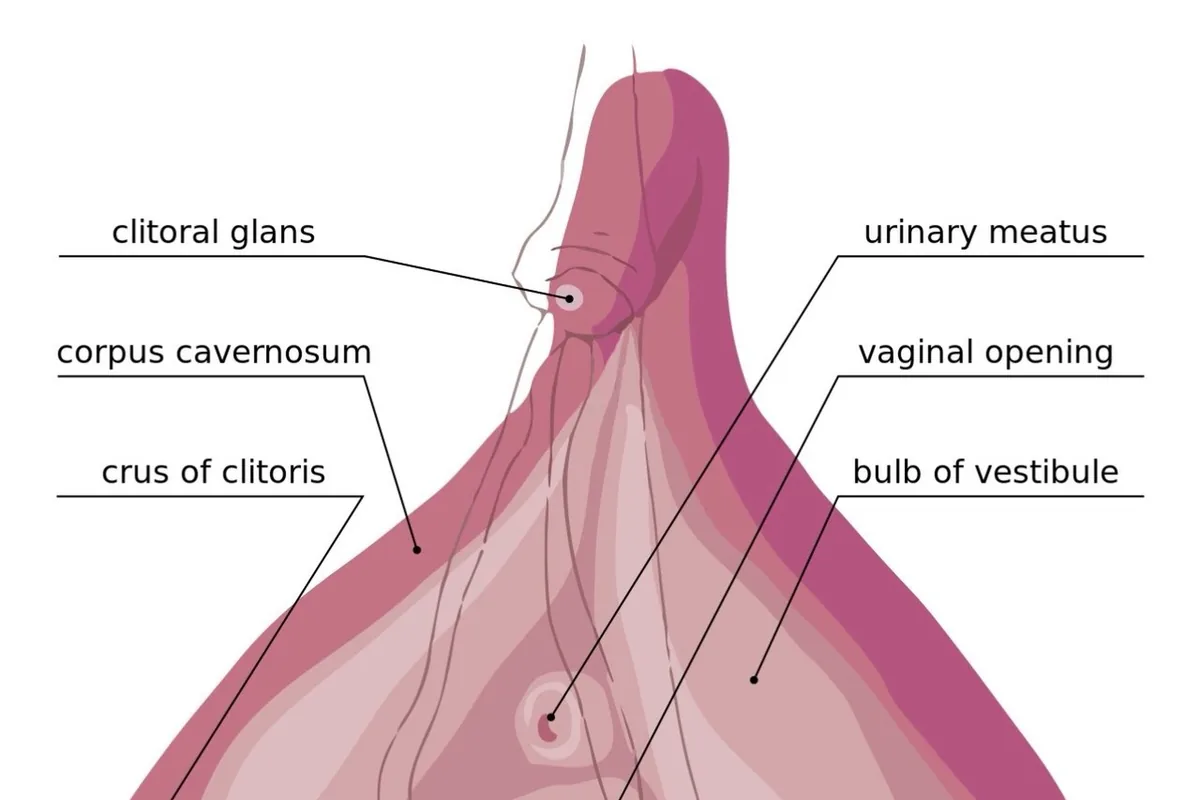
Most people picture the clitoris as a small nub at the top of the vulva. That nub is only the tip. The full organ is a network of erectile tissue and nerves, and about four-fifths of it lies under the surface.
The parts you can see: glans and hood
The glans is the visible part, roughly the size of a pea. It packs in about 10,000 nerve endings, which is why direct pressure can feel too intense or even painful for some people. A recent anatomy review puts the count at 8,000 to 10,000 sensory nerve endings, denser than anywhere else in the body. The clitoral hood is a fold of skin formed where the inner labia meet. It may cover all, part or none of the glans, and every variation is normal.
The parts inside: body, crura and bulbs
Behind the glans, the clitoris runs inward and splits like an upside-down wishbone. The body, or shaft, extends back from the glans. It then divides into two legs called crura, which curve around the vaginal canal and the urethra. Two vestibular bulbs sit between the crura and the vaginal wall.
All of these parts fill with blood during arousal. Cleveland Clinic notes that the bulbs can double in size, and that this swelling presses on the vaginal wall. Measured end to end, the whole structure is about 3.5 to 4.25 inches long. So the organ that responds during sex is much larger than the part anyone can see.
Where the vagina fits in
Because the crura and bulbs hug the vaginal wall, pressure inside the vagina can reach clitoral tissue. Cleveland Clinic says plainly that penetration can stimulate the clitoris through the vaginal wall. The authors of a 2026 anatomy review go further. They conclude that most “vaginal” orgasms come from indirect stimulation of the internal clitoris.
Some researchers use the term clitourethrovaginal complex for this shared zone, where the clitoris, urethra and front vaginal wall work as one area. The idea grew out of a few imaging studies in which the front vaginal wall appeared to descend. It remains a model that anatomists still debate. Still, it captures why the two labels overlap so much. For a fuller picture of what the body does at climax, see what happens during an orgasm.
Clitoral orgasm vs vaginal orgasm side by side
The two labels describe the route to orgasm more than two separate events. Research describes women reaching orgasm through direct clitoral touch, indirect clitoral touch, vaginal stimulation or stimulation of the areas around the vagina. The table sorts what is known about the two best-known routes.
| Clitoral orgasm | Vaginal orgasm | |
|---|---|---|
| Where the stimulation is | The glans, hood and shaft, by hand, mouth, toy or body contact | Inside the vagina, often the front wall, through penetration alone |
| What people report it feels like | Often described as focused and centred on the vulva | Often described as deeper or more spread out, though descriptions vary widely |
| How common | Common; in one survey, 36.6% needed clitoral touch during intercourse | Less common; 18.4% said intercourse alone was enough |
| What the research says | The external clitoris is the most sensitive part of the vulva | Penetration likely works partly by pressing on the internal clitoris |
A few points sit behind the table. The “feels like” row comes from personal descriptions, not lab measurement. No study has shown that the two routes produce physically different orgasms, so treat those descriptions as individual experience. Many people also describe blended orgasms, where clitoral touch and penetration happen together.
The “how common” row also needs care. The survey figures describe what women said they needed during intercourse, not what they can do in general. About 90% of women report orgasm from some form of stimulation, yet most do not routinely reach orgasm from intercourse alone. Our guide to types of orgasms sorts other named types by how much evidence supports them.
The G-spot debate, stated fairly
The G-spot is usually described as a sensitive area on the front wall of the vagina. Whether it is a distinct structure is still unproven. Kenhub’s anatomy reference places it 5 to 8 cm up the front vaginal wall but notes that its existence has not been proved.

Where the idea came from
In 1950 the physician Gräfenberg described an erotic zone on the front vaginal wall, along the path of the urethra. He did not argue that women needed a vaginal orgasm. In 1981, Addiego and colleagues named the area the Gräfenberg spot, and the shorter “G-spot” soon took over. Popular media embraced it quickly. Medical research has been far less certain.
What a review of 31 studies found
A 2021 systematic review in Sexual Medicine pulled together 31 studies, from surveys and clinical exams to imaging and tissue studies. In surveys, 62.9% of women said they had a G-spot. Clinical exams identified one in 55.4% of women, but two studies found it in nobody.
The harder evidence pointed in different directions. Imaging results contradicted each other, and one anatomist found the spot consistently while another team did not. Studies of nerve supply found no patch of the vaginal wall with a richer nerve supply than the rest. The reviewers rated the overall evidence as low to very low quality.
So what does that mean for you? Many people do find pressure on the front vaginal wall pleasurable, and that experience is real. The likely reason is what that area sits next to: the urethra and the internal clitoris. Missing a “spot” is not a sign that anything is wrong. The same review notes that the two-orgasm idea puts pressure on women who cannot reach a vaginal orgasm.
How rare is it to orgasm only from internal stimulation?
Orgasm from penetration alone is the less common pattern. Can women orgasm from penetration? Some can, and many others reach orgasm during intercourse when clitoral touch is added. Needing or wanting that touch is common.
What surveys of women report
The best-known U.S. figures come from Herbenick and colleagues’ 2018 survey. Of 1,055 women, 18.4% said intercourse alone was enough for orgasm and 36.6% said they needed clitoral stimulation during intercourse.
Solo sex tells a similar story. Clitoral stimulation by hand was the most common solo activity among 27,931 Flo app users. A partner touching the clitoris was the most common partnered activity in that study. Wallen and Lloyd sum up the wider literature. About 90% of women report orgasm from some form of stimulation, but most do not routinely reach it from intercourse alone.
Anatomy may play a part
One old idea links orgasm during intercourse to body layout. In 1924, Marie Bonaparte suggested that women whose clitoral glans sat closer to the urethral opening reached orgasm from intercourse more easily. When Wallen and Lloyd reanalysed her data and a 1940 dataset, both showed a strong link between a shorter distance and orgasm in intercourse. The data are nearly a century old, and the authors call for modern studies. Even so, the finding fits the anatomy above: some bodies may simply get more clitoral contact from penetration.
The orgasm gap is partly a script problem
Across age groups, men report reaching orgasm during sex 70% to 85% of the time, compared with 46% to 58% for women. Researchers call this the orgasm gap. Heterosexual women report lower rates than both men and lesbian women.
Anatomy alone does not explain it. The common heterosexual “script” is brief foreplay, then intercourse, ending when the man reaches orgasm. That leaves little time for the clitoral stimulation many women need or enjoy. In experiments with bisexual women, the gap in expected orgasm with a male partner disappeared once the scenario included clitoral stimulation and a partner who actively pursued her orgasm. Our article on orgasm with a partner looks at how couples close that gap.
Why the “mature orgasm” idea lingers
Much of the pressure traces back to Freud. In 1905 he argued that girls move from clitoral to vaginal pleasure as they mature. That framed the clitoral orgasm as immature, an idea later anatomy and survey research do not support.
The legacy still shapes how people judge themselves. Reviewers of the G-spot research note that the two-orgasm idea pressures women who cannot reach a vaginal orgasm. Orgasm is also not the only measure of good sex. Gesselman and colleagues describe orgasm as not essential for sexual pleasure. Whatever route works for you, or for your partner, is a healthy one.
Practical tips for adding clitoral stimulation during partnered sex
If you want orgasm during penetration, the most reliable approach is to bring the clitoris into it rather than wait for penetration alone to do the work. Everything below works best when both partners agree to it, check in as they go and feel free to stop. Treat these as options to explore, not a checklist to pass.

Four techniques women named in a national survey
A 2021 study asked 3,017 American women aged 18 to 93 what makes penetration more pleasurable for them. Four techniques came up again and again:
- Angling: 87.5% shift, raise or lower their hips to change where penetration rubs.
- Rocking: about 76% use rocking to make penetration more pleasurable. This means staying fully inside, so the base of the penis or toy rubs against the clitoris, rather than thrusting in and out.
- Shallowing: about 84% enjoy touch just inside the vaginal entrance rather than deep inside.
- Pairing: 69.7% add clitoral touch from a finger or toy during penetration, done by themselves or a partner.
Pairing is the plainest answer to how to orgasm from penetration for most women. It turns intercourse into a blended experience instead of a test of whether penetration alone is enough.
Positions that leave room for touch
Positions matter mainly because of what they free up. On-top positions let the person being penetrated control angle, depth and pressure, which makes angling and rocking easy. Face-to-face positions keep bodies close, so the pubic bone can press on the clitoral area. Side-lying and rear-entry positions often leave a hand free for pairing. Our guide to face-to-face and on-top sex positions covers these in more detail, and sex techniques for female pleasure goes beyond positions.
Vibrators and other tools
A small vibrator can make pairing easier, especially when hands are busy. Over half (53%) of adult women have used one. Sexual health specialists describe genital vibration as an evidence-based treatment for anorgasmia, the medical term for persistent difficulty reaching orgasm. Clean toys carefully, because sharing devices can raise the risk of sexually transmitted infections. Lubricant also helps keep longer sessions comfortable.
Why a clitoral orgasm can feel different by yourself than with a partner
Many women notice that a clitoral orgasm feels different by themselves than with a partner. Part of the reason is control. Alone, you set the pressure, speed and timing, and you can adjust the moment something changes. Women generally reach orgasm more often during solo sex than partnered sex; between 38 and 92% say they usually or always do during masturbation.
With a partner, attention is split. You may be tracking their pleasure, worrying about how long it is taking or feeling self-conscious. None of that means partnered sex is worse. It means the skills that work alone, such as knowing the touch you like, are worth sharing with a partner in words or by guiding their hand. For a step-by-step approach to learning your own responses, see how to have an orgasm.
When to talk to a clinician
Not reaching orgasm from penetration is not a medical problem in itself. It becomes worth raising with a clinician when it bothers you. Medical definitions of orgasm difficulty describe a persistent delay in, or absence of, orgasm despite enough stimulation, and they require that it causes personal distress.

Consider booking an appointment if any of these apply:
- You rarely or never reach orgasm in any way, and you want that to change.
- Orgasm used to come easily and has become difficult, for example after starting a new medication.
- Sex is painful.
- The clitoris feels sore, itchy or painful. Cleveland Clinic advises seeing a provider, ideally a gynecologist, for these symptoms.
- Worry about orgasm is straining your relationship or making you avoid sex.
A gynecologist or primary care clinician can check for physical causes, such as medication side effects or hormone changes. Talking therapy also has a strong track record. A 2022 review found that cognitive-behavioral and mindfulness-based therapies have the most research support for female sexual difficulties, including orgasm problems. A sex therapist can help with both the practical and emotional sides. Our page on anorgasmia explains the condition in more depth.
Vaginal and clitoral orgasm FAQ
What does a vaginal orgasm feel like?
People who report vaginal orgasms often describe them as deeper or more spread through the pelvis than a clitoral orgasm. Others notice little difference. These are personal descriptions, and research has not shown that the two are physically separate events. Since penetration likely stimulates the internal clitoris, many orgasms during intercourse may be blended. Our article on what an orgasm feels like covers the range of experiences.
Is it common to not finish from penetration?
Yes, very common. In a U.S. survey, only 18.4% of women said intercourse alone was enough for orgasm. Most women do not routinely reach orgasm from intercourse alone, even though about 90% reach it some other way. Not finishing from penetration says nothing about your health, your attraction to your partner or your partner’s skill.
Is something wrong with me if I can only orgasm with a vibrator or oral sex?
No. Women are most likely to reach orgasm through sex acts that involve clitoral stimulation, such as oral sex, manual touch or a vibrator. That is the typical pattern, not a fault. If you would like orgasm during penetration too, try pairing a hand or toy with it, or positions that let you control the angle and pressure.
Is it normal to orgasm from penetration alone?
Yes. A minority of women reach orgasm from penetration alone, and that is just as normal as needing clitoral touch. Some researchers think a shorter distance between the clitoral glans and the urethral opening may make it more likely, though that evidence is old. Neither route is healthier, more mature or more “real” than the other.
What are vaginal orgasmic contractions?
At climax, the pelvic floor muscles contract in a rhythm, about every 0.8 seconds according to one anatomy review. People often feel these contractions in and around the vagina, which is why they get linked to vaginal orgasm. They happen whatever the route, whether orgasm comes from clitoral touch, penetration or both together.
How do you have a clitoral orgasm?
Start by learning what touch you like on your own, without a goal or a time limit. Some people prefer indirect touch through the hood or nearby skin, because the glans is so sensitive that direct pressure can feel too intense. Vary pressure, speed and rhythm, and use lubricant if it helps. Then share what works with a partner.
One orgasm, many routes
Clitoral and vaginal orgasms are best understood as two routes to the same response, not two ranks of pleasure. The clitoris extends well inside the body and wraps around the vagina, so the line between the two is blurry by design. Most women do not routinely reach orgasm from penetration alone, many need or benefit from clitoral touch, and both patterns are normal.
If orgasm during penetration matters to you, the practical steps are simple: add clitoral touch, use positions that give you control, try a vibrator, and talk openly with your partner. If orgasm difficulty causes distress or sex hurts, a clinician or sex therapist can help. For more on the wider picture, see types of orgasms and sex techniques for female pleasure.
Related reading
- Types of Orgasms: Terms, Anatomy and Common Myths
- Sex Techniques for Female Pleasure Explained: Shallowing, Angling, Rocking and More
- How to Orgasm With a Partner: Communication, Comfort and Realistic Expectations
- What Happens During an Orgasm? Your Body and Brain, Explained
Sources
- Sexual Satisfaction and Orgasm Experiences During Partnered and Solo Sex Among 27,931 Users of the Flo App - Archives of Sexual Behavior (via PubMed Central)
- Clitoris: Anatomy, Location, Purpose & Conditions - Cleveland Clinic
- Clitoris: Location, structure, diagram - Kenhub
- Clitoris Anatomy Applied to Aesthetic, Reconstructive and Transgender Surgery: A Narrative Review - International Brazilian Journal of Urology (via PubMed Central)
- G-spot: Fact or Fiction?: A Systematic Review - Sexual Medicine (via PubMed Central)
- Female Sexual Arousal: Genital Anatomy and Orgasm in Intercourse - Hormones and Behavior (via PubMed Central)
- The lifelong orgasm gap: exploring age’s impact on orgasm rates - Sexual Medicine (via PubMed Central)
- An Experimental Investigation of Sexual Scripts by Partner Gender: Anticipated Clitoral Stimulation and Partner Orgasm Pursuit Shape Women’s Orgasm Expectations - Archives of Sexual Behavior (via PubMed Central)
- Women’s techniques for making vaginal penetration more pleasurable: Results from a nationally representative study of adult women in the United States - PLOS ONE (via PubMed Central)
- Genital vibration for sexual function and enhancement: best practice recommendations for choosing and safely using a vibrator - Sexual and Relationship Therapy (via PubMed Central)
- Delayed Orgasm and Anorgasmia - Fertility and Sterility (via PubMed Central)
- Behavioral Therapies for Treating Female Sexual Dysfunctions: A State-of-the-Art Review - Journal of Clinical Medicine (via PubMed Central)