The Demisexual Flag: Colors, Meaning and Related Symbols
What the demisexual flag colors mean, stripe by stripe, with hex codes, its uncertain origin, the asexual flag link, and demiromantic and double demi flags.
General education, not medical advice. If something here worries you, talk with a clinician.
Table of Contents
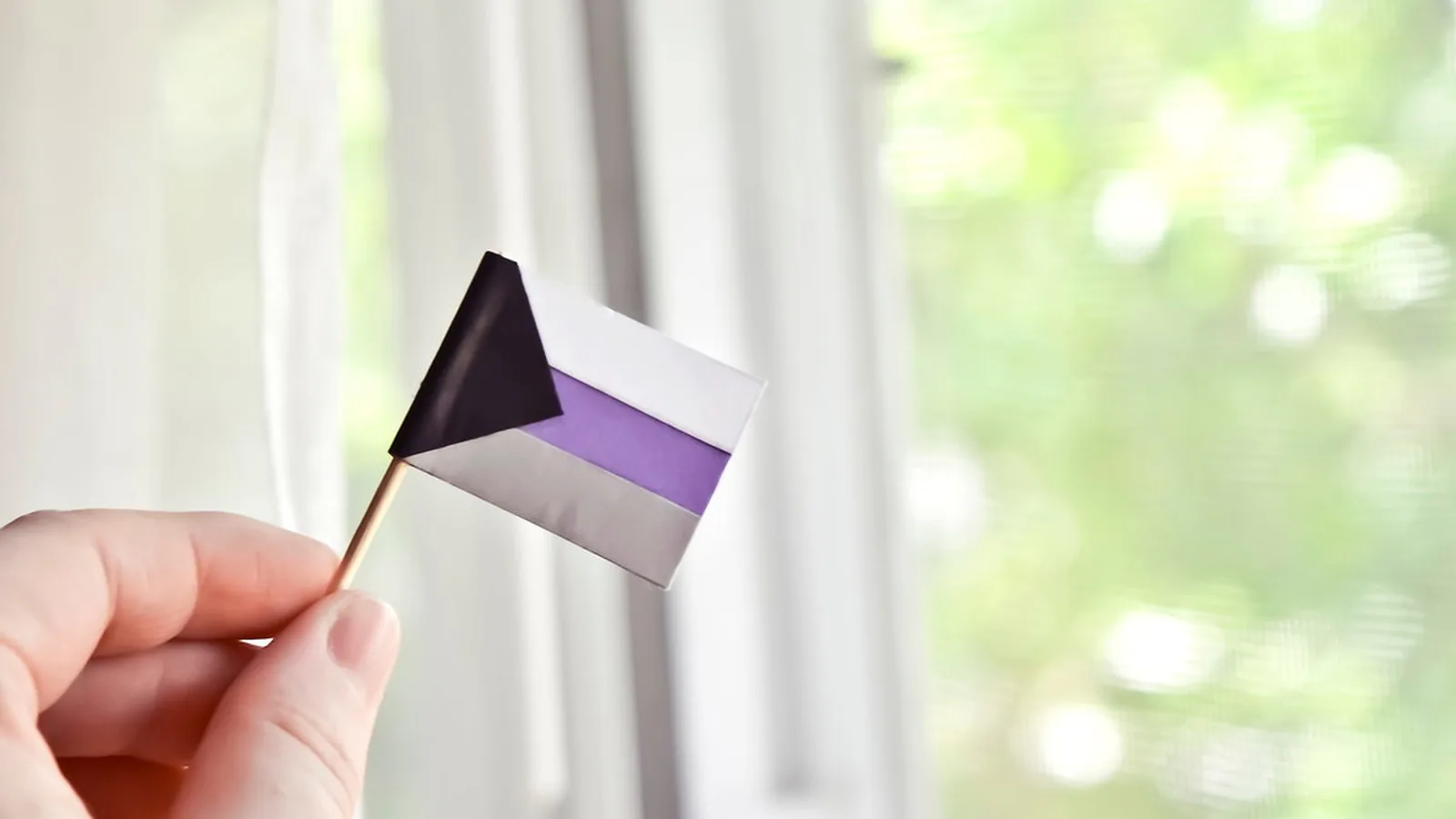
The demisexual flag is a black chevron on the left edge, set against a wide white stripe, a thin purple stripe and a wide grey stripe. Black stands for asexuality, grey for the grey area between asexual and sexual, white for sexuality and purple for community. Put simply, it says “my attraction sits on the asexual spectrum, and it needs an emotional bond first.”
Who drew it first is less clear. The sources disagree, and this guide says so rather than guessing.
Below you will find a stripe-by-stripe table with colour codes, the link to the asexual flag, the combined demi flags people make, and practical advice on flying any of them. If you are still working out the label itself, start with what demisexuality means and come back for the symbols.
Demisexual flag colors, stripe by stripe

What each part of the demi flag stands for
Each of the four colours carries one idea, and the shape matters as much as the colour. The table below reads the flag from the hoist (the edge nearest the pole) outward.
| Part of the flag | Colour | Hex code in the Commons file | What it stands for |
|---|---|---|---|
| Chevron on the left | Black | #000000 | Asexuality and the ace spectrum that demisexual people belong to |
| Top stripe | White | #FFFFFF | Sexuality, or the presence of sexual attraction |
| Thin centre stripe | Purple | #6E0070 | Community |
| Bottom stripe | Grey | #D2D2D2 | Gray-asexuality and the grey area between asexual and sexual attraction |
The sources agree on black, white and purple. Grey gets worded in two ways. LGBTQ Nation ties it to gray-asexuality and the gray-ace community. Mid-South Pride, a pride organisation, describes it as the grey area between sexual and asexual attraction. Both readings point the same way: demisexuality sits between “no sexual attraction” and “regular sexual attraction.”
Purple has a backstory. Heckin’ Unicorn traces it to the purple colour scheme of AVEN, the Asexual Visibility and Education Network. That shared purple is one reason the demi flag reads as part of the ace family at a glance.
Demisexual colors as hex codes
No standards body publishes official demi flag colours. The closest thing to a reference is the vector file on Wikimedia Commons, which fills the shapes with black #000000, white #FFFFFF, purple #6E0070 and grey #D2D2D2. In RGB terms, the purple is 110, 0, 112 and the grey is 210, 210, 210.
Treat these as a common reference, not a rule. Shades can look a little different from one print or screen to another, and nobody is wrong for that.
Proportions matter more than exact shades. In the Commons file the purple band takes up one-sixth of the height, while white and grey are equal and much wider. If your purple stripe is as thick as the others, you have drawn something closer to a different flag.
Who designed the demisexual flag, and when?
The honest answer is that nobody can say for certain. No designer has a verified, widely accepted claim to the demisexual flag, and the dates in circulation conflict.
What the record actually shows
The word came first. Healthline, citing a 2015 Wired report, says the term “demisexuality” was first recorded in 2006, when a user coined it on an AVEN forum.
The flag came later, and here the trail gets thin. Heckin’ Unicorn states that it is not known who designed the demisexual pride flag. It adds that the design is believed to draw on the asexual flag of 2010.
Wikimedia Commons offers a name. Its file caption says the flag was designed in 2013 by a user called Vimopu. Yet the same page shows that the vector file was uploaded on 22 June 2013 as a redraw of an older image, Demisexual Flag.jpg. So the flag already existed as a picture before that upload. The 2013 date may describe the vector copy rather than the first design.
Why the origin is hard to pin down
Many smaller pride flags were born on blogs and forums rather than at events. LGBTQ Nation notes that in the 2010s, Tumblr, Reddit and Twitter became places where people coined new terms and made flags to match. Posts were reblogged without credit, accounts were deleted, and early images lost their captions.
Sharing the history? Keep it modest. Say the flag was adapted from the 2010 asexual flag, and that its designer is not reliably recorded. A claim that careful will not need correcting later.
How the demi flag relates to the asexual flag
The two flags use the same four colours because demisexuality sits inside the asexual spectrum. What changes is the layout, and the layout carries the message.
The asexual flag in brief
The asexual flag came out of a community process. AVEN’s own forum archive shows the first round of flag voting opened on July 4, 2010. Members could even vote for having no flag at all. According to LGBTQ Nation, the winning design came from AVEN user “standup” after a month-long campaign.
The winning flag has four horizontal stripes: black, grey, white and purple. USA Today, citing the University of Illinois Springfield, says grey stands for gray-asexuality and demisexuality, and white for non-asexual partners and allies. For the fuller story, including the AVEN triangle that came before it, see our guide to asexual pride flag symbols and history.
Same colours, different layout, and why that matters
Look closely and the meanings shift between the two flags. On the ace flag, demisexuality is folded into the grey stripe. On the demi flag, grey keeps its “grey area” sense, and black moves into a chevron at the hoist.
The chevron does real work. It places asexuality at the root of the design, with the other stripes reading outward from it. The message is “demisexual, and part of the ace community,” instead of a separate identity with borrowed colours.
Telling them apart is simple once you know the trick:
- Four horizontal stripes running black, grey, white, purple: the asexual flag.
- A black triangle on the left, with a thin purple band through the middle: the demi flag.
- A black triangle with green instead of purple: the demiromantic flag, covered next.
Some people fly both flags together. That is common for demi people who also call themselves ace, and there is nothing redundant about it.
Related and combined demi flags: demiromantic, double demi, demi bisexual and more
Once the demi layout existed, people started adapting it. Some versions are widely used, while others belong to one person who drew a flag for their own mix of identities. The table sorts them by how well each is documented.
| Flag | What the layout shows | How well documented |
|---|---|---|
| Demiromantic flag | The demi flag layout with aromantic green in place of purple | Well established; Wikimedia Commons calls it the flag most often used for the demiromantic community |
| Demiromantic demisexual (double demi) flag | Mixes of the demi and demiromantic flags; no single agreed design | Community-made; individual artists post their own versions |
| Demi bi (demi-biromantic or demi-bisexual) flag | Demi elements combined with bisexual colours | Community-made; one example is a free DeviantArt design from 2020 |
| Demi ace usage | Usually the demi flag itself, or the demi and ace flags flown together | Demi people often identify with the ace spectrum, so they may fly the ace flag alongside the demi one |
The green-chevron flag and its double demi offshoots
The demiromantic flag is the best documented relative. It keeps the black chevron and swaps purple for the green used on the aromantic flag. Gayety reports it was first posted on Tumblr by @QueerAsCat on March 9, 2015. The same article lists other versions, including a lithromantic one with yellow and light green. It also notes that the meanings of the stripes are contested.
Double demi means someone is both demiromantic and demisexual. There is no single double demi flag. Some people split the field between the two designs, some stack them, and many just fly both. The difference between the two labels is covered in demisexual vs demiromantic.
Demi bi, demi pan and demi ace
Combined flags such as a demi bi flag usually start as personal art. One DeviantArt artist explains making a demiromantic/demisexual flag because the existing ones did not suit them. A year later the same artist posted a demi-biromantic version.
Most blends share this status: personal designs that some people adopt. They are valid to use, but strangers may not recognise them. If you are working out how demisexuality combines with who you are drawn to, see being demisexual and bi, pan, gay or straight.
“Demi ace” is mostly a label, not a flag. Since demisexual people often place themselves on the ace spectrum, the demi flag already says it.
Vertical flags, twibbons and demisexual art online
Online, the demi flag shows up far more often than at any parade. It appears as profile frames, phone wallpapers, banner headers and fan art. Most of these uses are fine, but a few habits keep you on the right side of the people who made them.

Demisexual flag vertical and emoji-style versions
A vertical version turns the flag on its side so it hangs from a crossbar or fits a tall phone screen. Wikimedia Commons hosts a vertical demisexual flag file at 480 by 800 pixels, along with an emoji-style version. Use a ready-made vertical file rather than rotating the image yourself, since a hand-turned copy can end up with the chevron on the wrong edge.
A twibbon is a frame or ribbon laid over a profile picture, often for an awareness campaign. A demisexual twibbon usually puts the four colours in a ring or corner band around your photo. It is a quiet way to show the flag without posting a large image.
When you post any flag image, add a short text description for screen-reader users. Something like “demisexual pride flag: black chevron on the left, white, purple and grey stripes” is enough. A bare “flag emoji” or an empty description tells a blind follower nothing, and the colours are the whole point.
Respecting artists’ licences
The plain flag is free to use. Commons states that the basic demisexual flag image is too simple for copyright and sits in the public domain. Copyright does not stop you printing or adapting it.
Derived files can carry conditions. The demiromantic flag file on Commons is shared under CC BY-SA 4.0. That licence lets you share and adapt the work if you credit the maker, link the licence and say what you changed. Anything you build from it must use the same or a compatible licence.
Demisexual art is different again. An illustration, a stylised heart or a custom combined flag belongs to the artist, even when it is offered as a free download. Check what the artist allows, credit them, and ask before using their work on products you sell.
Is demisexual part of LGBTQ+?
For most people who use the label, it is. Demisexuality is generally counted under the A in LGBTQIA+, which stands for asexual. The flag’s black chevron makes the same point visually.
Where demisexual sits in LGBTQIA+
USA Today notes that the I and A, for intersex and asexual, were added to the acronym in recent years. It describes asexuality as an umbrella term on a spectrum. Demisexual people often place themselves on that spectrum, in the grey area between asexual and allosexual.
Belonging is still a personal call. Some demisexual people call themselves queer and march at pride. Others feel their daily life looks much like everyone else’s and prefer not to claim the word. Both positions are fair, and neither makes the orientation more or less real.
It also helps to separate two questions. “Is demisexuality part of the community?” has a broad yes. “Does this particular person feel part of it?” only they can answer.
Straight, gay or bi and demisexual
Demisexuality describes when attraction can happen, not which genders it is aimed at. So a person can be demisexual and straight, gay, bi or pan. USA Today notes that ace people may add hetero-, homo-, bi- or pan- before “romantic” to describe who they are drawn to.
This explains searches for a straight demisexual flag. A heteroromantic demisexual person might fly the demi flag alone, or pair it with an ally flag. If the question is really “am I demisexual?”, our am I demisexual guide walks through it gently.
How to use the demisexual flag respectfully
A flag is a small object with a big message, so a little planning helps. Most flag guides stop at the colours. The questions below are the ones people tend to face once they actually own one.
At pride events and in profile badges
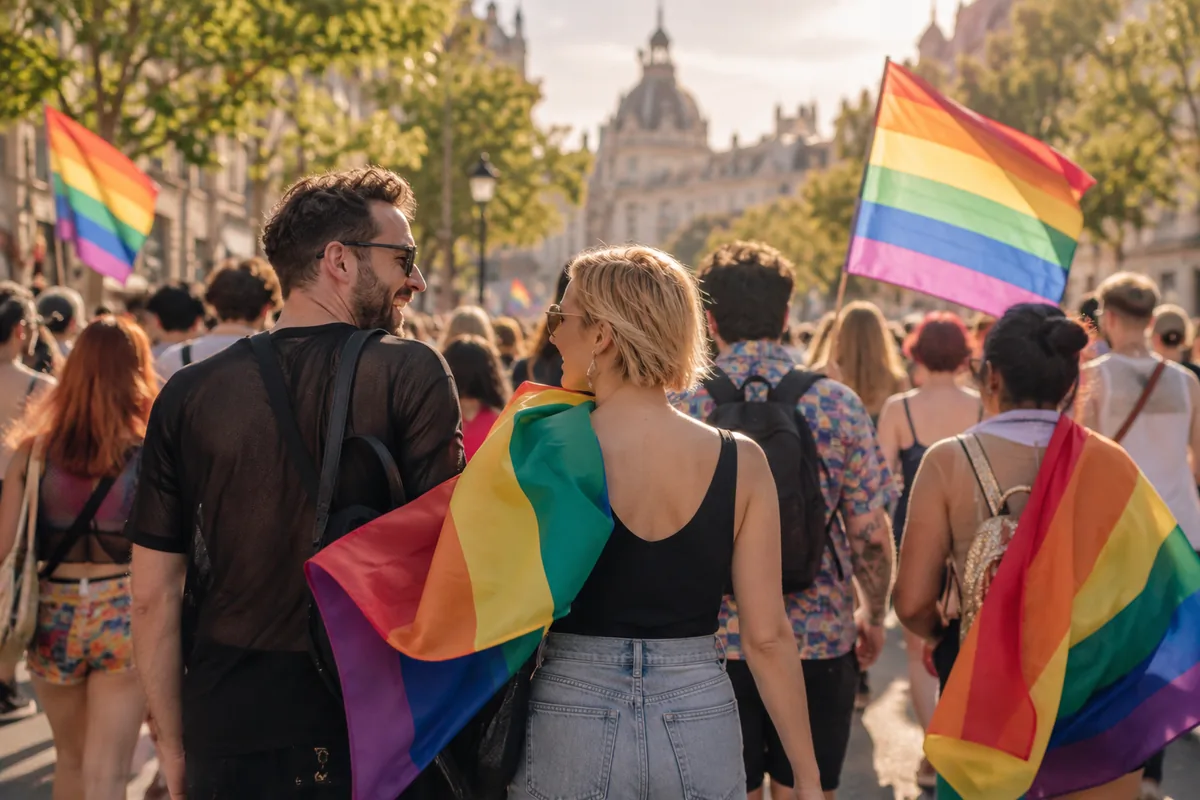
Demi flags do turn up at pride. Wikimedia Commons holds photographs from Swindon Pride 2021 that show the flag being carried. If you bring one, expect some people to ask what it is. A short answer works: “it’s the demisexual pride flag, part of the asexual spectrum.”
Buying a flag first? Look at the product photo, not just the title. Some listings swap the stripe order, make the purple as thick as the others, or sell the asexual flag under a demi name. The thin purple band and the black chevron are the two details to check.
Check which way up it is before you hold it high. The chevron goes at the pole side, with white on top and grey at the bottom. Upside down, the purple band still sits in the middle, so the mistake is easy to miss.
Online, a profile badge, twibbon or a single emoji-style flag in your bio is a lower-key option. You choose how visible to be, and you can remove it in seconds. On dating apps, some people add it so matches understand early that attraction takes time. Our guide to demisexual dating and relationships covers how to explain that.
One combined flag or two flags?
Two established flags, such as the demi flag beside a bi or demiromantic flag, are instantly readable to people who know them. A combined flag is more personal. It can say exactly who you are, but most people will not recognise it, and you may spend the day explaining it.
A rough rule: use two flags where you want to be understood by strangers. Use a combined design where the flag is mainly for you, such as a bedroom wall, a pin on your bag or a profile picture.
Flying it without outing anyone
Wearing a flag tells people something about you. Giving one to someone else, or tagging them in a post, can tell people something about them. Never use a flag to label a friend, partner or family member who has not chosen to share their orientation.
Allies can fly the demi flag too. A short note such as “supporting my demisexual friends” keeps the meaning clear and avoids people guessing about you. If a friend has come out to you privately, keep any visible support general until they say otherwise.
The same care applies to photos. Pride pictures often show faces next to a clearly labelled flag. Before posting a group shot, ask the people in it whether they are comfortable being seen beside that flag in public.
Demi flag FAQ: what searchers ask next
Is there a flag for demisexuals?
Yes. The demisexual pride flag has a black chevron on the left and white, purple and grey stripes behind it. It was adapted from the asexual flag, which uses the same colours in plain horizontal stripes. It is widely used, even though its original designer is not reliably recorded.
What does demisexual mean in LGBT?
Demisexual people only feel sexual attraction after a close emotional bond has formed. That bond can be friendship and does not have to be romance. Within LGBTQIA+, demisexuality is usually placed under the A, on the asexual spectrum.
Is it possible to be demiromantic and demisexual?
Plenty of people are both. Romantic and sexual attraction can work separately, an idea known as the split attraction model. Someone can need an emotional bond before either kind of attraction appears. People who are both often call themselves “double demi.”
What is double demi?
Double demi is shorthand for being both demiromantic and demisexual. There is no single official double demi flag. Some people fly the demisexual and demiromantic flags together, and others use a combined design made by an artist.
What is the difference between the asexual flag and the demisexual flag?
The asexual flag has four horizontal stripes in black, grey, white and purple. The demi flag uses those colours but puts black in a chevron on the left, with a thin purple band through the middle.
Getting the demi flag right
The demi flag is easy to describe and harder to date. Black chevron, wide white, thin purple, wide grey: asexuality, sexuality, community and the grey space between. It borrows the asexual palette on purpose, which ties demisexuality to the ace spectrum.
Its origin is uncertain, so say so when you share it. Of the related designs, the demiromantic flag is well established, while most blends are personal art that deserves credit.
Fly it however suits you, on a pole, a pin or a profile picture. Just let other people choose their own flags. If the label still feels new, our guide to demi-curious and non-demi-curious meanings is a good next read.
Related reading
- Asexual Pride: The Ace Flag, Symbols, History, and Coming Out
- What Is Demisexuality? Meaning, Signs and How It Differs
- Demisexual vs Demiromantic: Sexual and Romantic Attraction on Two Axes
- Can You Be Demisexual and Bisexual, Pansexual, Gay or Straight?
Sources
- Category:Demisexuality flags - Wikimedia Commons
- All about the demisexual flag - LGBTQ Nation
- File:Demisexual Pride Flag.svg - Wikimedia Commons
- What is the Demisexual pride flag and what does it mean? - Heckin’ Unicorn
- Demisexual Pride Flag - Mid-South Pride
- Demisexuality: What Does It Mean? - Healthline
- Asexual Flag Voting (First Round) - Asexual Visibility and Education Network (AVEN)
- The Ace Flag: Everything You Need To Know - LGBTQ Nation
- What is asexuality? What the ‘A’ in LGBTQIA stands for. - USA Today
- File:Demiromantic Pride Flag.svg - Wikimedia Commons
- Demi-Biromantic/Demisexual Flag (Free Download) - DeviantArt (HopeCvon)
- What Is The Demiromantic Flag? - Gayety
- Deed - Attribution-ShareAlike 4.0 International - Creative Commons