Does Sex Position Affect Getting Pregnant? What the Evidence Says
Does sex position affect getting pregnant? What research says about gravity, orgasm and lying down, what really helps you conceive, and why no position prevents it.

General education, not medical advice. If something here worries you, talk with a clinician.
Table of Contents
Does sex position affect getting pregnant? Not in any way research has been able to show. No position has been proven to raise your odds of conceiving, and none has been shown to lower them either.
That answer cuts both ways. If you are trying for a baby, you can stop worrying about legs in the air and pillows under your hips. If you are hoping a position will keep you from getting pregnant, it will not.
What does change the odds is timing, along with age and general health. Preventing pregnancy takes contraception. This guide checks the common position myths against the evidence, then covers what actually helps you conceive and what actually protects you.
Does sex position affect your chances of getting pregnant?
What the research shows
There is no best sex position to get pregnant. Shady Grove Fertility, a large US fertility clinic, states that no studies show any one position increases the likelihood of pregnancy. Its reproductive specialist Dr Alexandra Gannon puts it plainly: any position where sperm is released into the vagina is a good position.
Part of the reason is that the question has barely been studied. BabyCenter notes that the popular theories have no evidence behind them because experts have not done the research. The best-known imaging work used MRI scans of couples during sex, and it looked at only two positions. In both, the penis reached the area right beside the cervix, the narrow opening of the uterus. Other positions, such as standing or the woman on top, were never scanned, so nobody can say they are worse.
So the honest summary is this. No position has been shown to help, and none has been shown to hurt.
How sperm reach the egg
The biology explains why position matters so little. Sperm can reach the cervical canal within seconds of ejaculation, whatever position you were in. From there they swim on through the uterus toward the fallopian tubes, where an egg can be fertilised.
Around ovulation the body helps them along. A few days before an egg is released, cervical mucus turns clear, slippery and stretchy, a bit like raw egg white. The Australian program Your Fertility explains that sperm travel more easily through this kind of mucus. That change happens on its own schedule, and it has nothing to do with how you had sex.
In other words, sperm are not waiting for gravity to carry them uphill. They are active swimmers moving through fluid that, near ovulation, is built to guide them.
Common position myths, checked against the evidence
Gravity, legs up and pillows under the hips
The idea behind most position tips is gravity. If sperm have to swim “up”, the thinking goes, tilting the hips or raising the legs should give them a head start. The trouble is that sperm do not need the help. They reach the cervical canal in seconds, and it takes only minutes for them to reach the fallopian tubes.
Because sperm move this fast, Shady Grove Fertility says there is no need to lie with your feet in the air after sex. A pillow under the hips will not hurt anyone. It just has no evidence showing it improves your odds, so treat it as optional comfort rather than a fertility tool.
Lying down after sex
This myth has the most research behind it, though almost all of it comes from fertility clinics rather than bedrooms. The studies looked at intrauterine insemination (IUI), a treatment where sperm is placed directly into the uterus.
The results disagree. A Dutch trial published in the BMJ in 2009 found that 15 minutes of bed rest after IUI improved pregnancy rates. A larger randomised trial presented at the 2016 ESHRE meeting then tested the same idea in 479 patients. Treatment ran for as many as six cycles. Across that whole course, the cumulative pregnancy rate per couple was 32.2% after lying still and 40.3% after getting straight up. The gap was not statistically significant. These are totals across several cycles, not the odds for a single attempt. The researchers concluded that bed rest gave no benefit.
The lead investigator also cautioned that IUI is too different from sex to generalise. She noted that no randomised trial has tested lying still after intercourse. So staying in bed for a few minutes is fine if you like it. Getting up to use the bathroom is fine too. Dr Gannon specifically tells patients there is no evidence that lying down or holding in urine raises the chance of pregnancy.
Some semen will leak out when you stand, and that is normal. Each ejaculation holds millions of sperm, so plenty remain inside even if you get up soon after.
Deep penetration and a tilted uterus
Deep penetration is often sold as a way to place sperm “closer” to the egg. The MRI studies showed the penis already reaches the area beside the cervix in ordinary positions. There is no conclusive evidence that deeper positions do better.
People with a tilted uterus are sometimes told they need a special position. A retroverted, or tilted, uterus simply tips backward toward the spine instead of forward. It is common. Cleveland Clinic puts it at about 1 in 5 women, while Victoria’s Better Health Channel says about one quarter. Both agree it is a normal variation that should not affect fertility. If someone with a tilted uterus has trouble conceiving, Cleveland Clinic says another condition is the more likely cause.
Positions for a boy or a girl
Choosing a position will not choose the baby’s sex. It is set by the sperm that fertilises the egg, depending on whether it carries an X or a Y chromosome. The odds sit close to 50/50, with slightly more boys born than girls worldwide.
Folk rules, such as having the woman on top to conceive a girl, have very little evidence behind them. The best-known timing system, the Shettles method, has not been proven in medical trials. Following the version meant to conceive a girl strictly can backfire, because it means avoiding sex near ovulation, when you are most likely to conceive.
Does orgasm help you get pregnant?
No, you do not need an orgasm to get pregnant. Dr Gannon of Shady Grove Fertility says female orgasm may help move sperm along, but there is no known link between orgasm and fertility. BabyCenter’s review of the research reaches the same conclusion: there is no evidence that a woman has to climax to conceive.
The belief comes from the so-called “upsuck” idea. It suggests that the muscle contractions of orgasm draw semen up through the cervix. The uterus does make gentle contractions that help sperm on their way. Those contractions happen with or without an orgasm, though.
The male partner’s ejaculation is a different matter, since that is what delivers most of the sperm. Even so, some people have a small amount of sperm in pre-cum, the fluid released before ejaculation. That detail matters a great deal for anyone trying to avoid pregnancy, and the prevention section below explains why.
For couples trying to conceive, the practical point is simple. Pleasure is a good reason to enjoy sex, but turning orgasm into a fertility task adds pressure without adding odds. If sex starts to feel like a chore, that strain is worth more attention than any technique.
What actually affects your chances of conceiving

The fertile window
Timing matters far more than position. You can only get pregnant during the fertile window, which is the day of ovulation plus the five days before it. That gives about six fertile days in each cycle.
The odds rise as ovulation gets closer. Your Fertility, drawing on guidance from the American Society for Reproductive Medicine, gives these averages:
- Sex six or more days before ovulation: virtually zero chance.
- Sex five days before ovulation: about 10 percent.
- Sex on ovulation day or the two days before: around 30 percent.
The window works this way because sperm can live for around five days inside the body, while an egg can be fertilised for only about 24 hours after release. Sperm that are already waiting when the egg arrives have the best chance. Ovulation predictor kits and changes in cervical mucus can help you spot those days.
How often to have sex
You do not need to time sex to the hour. The NHS says more than 8 out of 10 couples, where the woman is under 40, conceive within a year if they have regular sex every 2 or 3 days. That rhythm keeps sperm present throughout the fertile window, even if you are not sure exactly when you ovulate.
More frequent sex is fine as well. Dr Gannon notes that daily ejaculation does not reduce sperm concentration or movement, while waiting five days between ejaculations does.
Age, health and lubricants
Age is the biggest factor most couples cannot control. ACOG is the American College of Obstetricians and Gynecologists. It says healthy couples in their 20s or early 30s have about a 25 to 30 percent chance of pregnancy in any one cycle. That chance starts to fall in the early 30s, drops faster after 37, and is under 10 percent per cycle by age 40.
General health counts too. The NHS lists weight, smoking, alcohol, sexually transmitted infections such as chlamydia, and stress among the things that can affect fertility.
Lubricant is a smaller question that comes up often. You do not need a special “fertility-friendly” product to conceive. If you want one, Dr Gannon suggests lubricants made with hydroxyethyl cellulose, or mineral oil or canola oil, as sperm-friendly options. Your doctor may ask what you use, since it is part of a standard fertility history.
When to talk to a doctor
ACOG recommends a fertility evaluation if you have not conceived after 1 year of regular sex without birth control. If you are older than 35, the threshold drops to 6 months. If you are older than 40, ACOG suggests talking to an ob-gyn about an evaluation now.
The NHS adds that anyone who already knows of a possible fertility problem should see a doctor sooner. Irregular periods, past pelvic infections or known sperm problems are good reasons not to wait out the full year. Asking early costs nothing, and for many causes treatment is available.
Can any sex position prevent pregnancy?
Why position offers no protection
No sex position prevents pregnancy. Bedsider, the birth control site run by Power to Decide, explains that sperm can swim in every direction, so pregnancy is possible in any position. Gravity cannot stop sperm from reaching an egg.
This rules out several common beliefs. Having sex standing up does not protect you. Neither does being on top, or getting up and washing straight afterwards. Sperm reach the cervical canal within seconds, long before anyone could rinse them away. Sex in a pool or bath carries the same risk.
Timing is not a safe shortcut either. Sperm can survive for up to 5 days, so sex several days before ovulation can still lead to pregnancy. If you are unsure what counts as risky, our guide to what unprotected sex means covers it in more detail.
Pre-ejaculate and pulling out
Many couples who rely on position also rely on pulling out. Withdrawal means removing the penis before ejaculation, and it is far less reliable than it feels. Planned Parenthood reports that with real-life use, about 22 out of 100 people relying on withdrawal get pregnant each year. That is roughly 1 in 5. Even with perfect use, 4 in 100 do.
Part of the risk is timing, since it is hard to pull out perfectly every time. Part of it is pre-cum. A 2024 pilot study of 24 men found sperm in 12.9% of pre-ejaculate samples, coming from 6 of the men. Most samples had none. Still, nobody can tell in the moment whose fluid carries sperm, or on which day.
Our explainer on what withdrawal is in sex goes through how the method works and where it fails. The short version is that it beats using nothing, but it is not a substitute for real contraception.
What actually prevents pregnancy
If you want to avoid pregnancy, the method you use matters and the position does not. Contraceptive effectiveness is measured as the share of users who get pregnant in the first year of typical use, which includes missed pills and other everyday slips. The table below uses CDC figures, plus Planned Parenthood’s estimate for withdrawal.
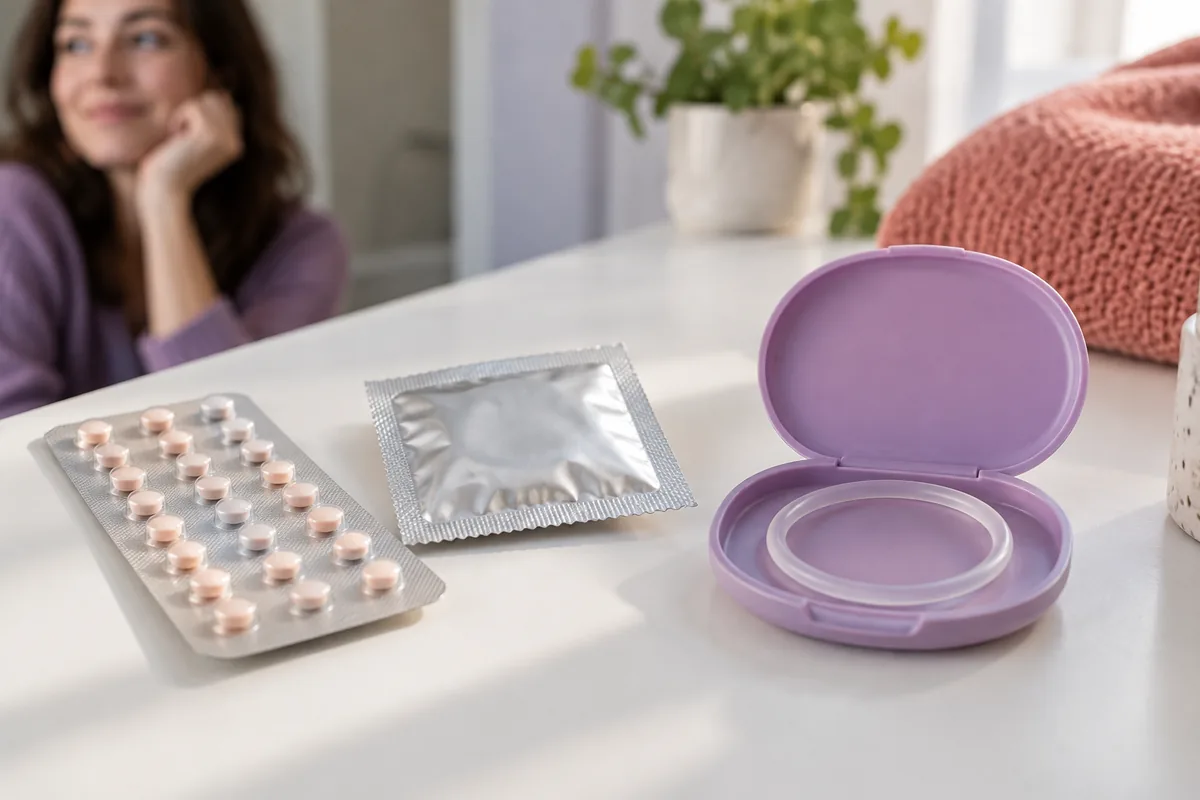
| Method | Percent who get pregnant in the first year (typical use) | What it involves |
|---|---|---|
| Implant | 0.1 | A thin rod placed under the skin of the upper arm |
| Hormonal IUD | 0.1 to 0.4 | A small T-shaped device placed in the uterus |
| Copper IUD | 0.8 | A hormone-free device that can stay in for up to 10 years |
| Injection | 4 | A progestin shot every three months |
| Pill, patch or ring | 7 | A daily pill, a weekly patch or a monthly ring |
| External (male) condom | 13 | Worn on the penis each time you have sex |
| Fertility awareness methods | 2 to 23 | Daily tracking of fertile signs and avoiding sex or using a barrier on those days; the low end needs strict, consistent tracking, not guessing at safe days |
| Withdrawal | 22 | Pulling out before ejaculation |
Two things stand out. Implants and IUDs keep failure under 1% because they need no action once they are in place. Condoms fail more often in real life, yet with perfect use the male condom’s rate falls to 2%. Condoms are also the only methods that protect against sexually transmitted infections as well as pregnancy. Many couples pair a condom with a hormonal method or an IUD for that reason.
If contraception fails or you used none
Emergency contraception can still prevent pregnancy after sex without protection or after a condom breaks. The NHS says it must be used within 3 to 5 days, and it works better the sooner you use it. A copper IUD fitted within 5 days is the most effective option. The levonorgestrel pill should be taken within 3 days, and the ulipristal acetate pill within 5 days.
Emergency contraception is a backup, not a regular method. A clinician or pharmacist can help you pick an ongoing method that fits your health and plans.
Frequently asked questions
Which sex position has the highest pregnancy rate?
None has been shown to. No study links any position to a higher pregnancy rate, and fertility specialists say any position that places sperm in the vagina works. Imaging research has compared only two positions, and in both the penis reached the area beside the cervix. Choose whatever is comfortable, because enjoying sex makes it easier to keep having it regularly through the fertile window.
How do I increase my chances of getting pregnant during sex?
Focus on when you have sex rather than how. Aim for the six-day fertile window, especially ovulation day and the two days before it, when the chance per cycle is around 30 percent. Regular sex every 2 or 3 days covers the window if your cycle varies. If you use lubricant, pick a sperm-friendly one.
How do I make sure my sperm meets my egg?
You cannot steer sperm, and you do not need to. They reach the cervical canal within seconds and the fallopian tubes within minutes, whatever position you use. What you can control is having sperm present when the egg is released. Sperm survive about five days, while an egg lasts about 24 hours, so sex in the days before ovulation gives the best odds.
Can you get pregnant having sex standing up?
Yes. Gravity cannot stop sperm from reaching an egg, and pregnancy is possible in any position. Standing up, being on top or washing straight after sex offers no protection. If you do not want to get pregnant, use a reliable method such as an implant, an IUD, the pill or condoms.
The bottom line
Sex position does not decide whether you get pregnant. Sperm move fast and in every direction, so no position reliably helps conception and none prevents it. Lying still afterwards, raising your hips or having an orgasm are all optional rather than necessary.
If you are trying to conceive, put your energy into timing. Have sex regularly, especially in the days before ovulation, and see a doctor after a year of trying, or 6 months if you are over 35. If you are trying not to conceive, choose a real contraceptive method and keep emergency contraception in mind as a backup. Either way, the position you pick can simply be the one you enjoy.
Related reading
- What Is Withdrawal in Sex? The Pull-Out Method, Its Effectiveness and Its Limits
- What Is Unprotected Sex? Risks and What to Do Next
- What Is the Best Sex Position? What Surveys Say and How to Choose
- What Is a Cream Pie in Sex? Plus Creaming, Milking, Facials and Snowballing
Sources
- Fertility Facts: No best sex position to conceive a baby - Shady Grove Fertility
- 10 Sex Myths Busted By a Fertility Specialist - Shady Grove Fertility (Alexandra Gannon, MD)
- Sex positions for getting pregnant - BabyCenter Australia
- Right Time For Sex, When Do You Ovulate? - Your Fertility (Australian Government-funded program)
- A short period of bed rest after intrauterine insemination makes no difference to pregnancy rates - ESHRE via EurekAlert! (AAAS)
- Retroverted (Tilted) Uterus: Causes, Symptoms & Fertility - Cleveland Clinic
- Retroverted uterus - Better Health Channel (Victoria State Government)
- Is it a boy or a girl? The father’s family might provide a clue - UT Southwestern Medical Center
- Conception Question 3: Can you really control the sex of your baby? - Kamm McKenzie OBGYN
- How effective is the pull out method? - Planned Parenthood
- Infertility - NHS
- Evaluating Infertility - American College of Obstetricians and Gynecologists (ACOG)
- Are there any positions that prevent pregnancy? - Bedsider (Power to Decide)
- Pre-Ejaculate Sperm Concentration Study: 12.9% Detection Rate - Physicians Weekly (summary of Patel et al., 2024)
- Contraception and Birth Control Methods - Centers for Disease Control and Prevention (CDC)
- Contraceptive Effectiveness in the United States - Guttmacher Institute
- Emergency contraception - NHS