What Is the Difference Between Sex and Gender?
Sex describes biological traits; gender covers roles, identity and expression. See how WHO, CIHR and other health bodies define each term and why it matters.

General education, not medical advice. If something here worries you, talk with a clinician.
Table of Contents
Sex and gender are often used as if they mean the same thing, but health bodies treat them as two different ideas. In short, sex describes biological traits such as chromosomes, hormones and anatomy. WHO defines gender as the norms, behaviours and roles a society attaches to women, men, girls and boys. CIHR uses a wider definition that also takes in identity and expression.
This article covers biological sex, gender identity and gender expression. It does not cover sex as sexual activity, which is a separate topic. You will find the main definitions, the places where sources disagree, and the reasons the difference matters in medicine and research.
What sex refers to
Biological attributes make up sex. The Canadian Institutes of Health Research (CIHR) lists chromosomes, gene expression, hormone levels and function, and reproductive and sexual anatomy. A National Academies report calls sex a classification based on biological differences. Those differences are rooted in anatomy or physiology.
The traits that make up sex
Most people are sorted into female or male. CIHR notes that the biological attributes vary. So does the way they show up in each person. The American Psychiatric Association (APA) says sex is often described as a biological construct. It is defined on an anatomical, hormonal or genetic basis. No single trait tells the whole story.
How sex is assigned at birth
Day to day, sex is recorded when a baby is born. Planned Parenthood says the label, male or female, rests on the genitals a baby is born with and on chromosomes. It goes on the birth certificate. In the U.S., the APA says, a sex is assigned at birth based on external genitalia.
Chromosomes give a typical pattern. Someone with XX chromosomes usually has female sex and reproductive organs. According to Planned Parenthood, a person with XY chromosomes usually has male ones.
Some people say “assigned male at birth” or “assigned female at birth” instead of “biological sex.” Planned Parenthood explains why. The older phrase does not fully capture the biological, anatomical and chromosomal variation that can occur.
Intersex variations
The New York City health department says intersex describes natural variations in sex characteristics. It lists chromosomes, genitals, reproductive organs and secondary sex traits. People can differ from what is considered typically male or female in any of these areas.
Cleveland Clinic says some traits are noticeable at birth. Others appear at puberty, and some are never noticed. It gives XXY chromosomes and a single X chromosome as examples.
Estimates of how common this is differ between sources, and they may not measure the same thing. Cleveland Clinic says the figure depends on how providers define and diagnose these conditions, and that older estimates included conditions not always counted as intersex. It cites one study suggesting about 1 out of every 2,700 births. The New York City health department says nearly 2% of people are born with intersex traits, without defining those traits.
Being intersex does not determine sexual orientation. Cleveland Clinic also calls the word hermaphrodite outdated. It says most intersex people find the word offensive.
What gender means
A wider and more social set of ideas sits under gender. The World Health Organization (WHO) defines it as the socially constructed characteristics of women, men, girls and boys. These include norms, behaviours and roles. WHO describes gender as a social construct that varies from society to society and can change over time. CIHR adds that gender shapes how people act and interact. It also shapes how power and resources are shared.
Gender identity
Gender identity is a person’s deeply felt, internal experience of gender. WHO says it may or may not match the person’s body or the sex designated at birth. The APA describes it as a basic internal sense of being a man, a woman and/or another gender.
CIHR’s account says gender identity is not limited to two options. It exists along a continuum. Planned Parenthood states that feelings about gender identity can begin as early as age 2 or 3, though it names no study for this.
Gender expression
How a person shows gender to others is called expression. Statistics Canada lists body language, clothes, hairstyle and makeup. It treats expression as separate from gender identity.
The APA says expression comes through appearance, behaviors and personality styles. Cultures often define these as masculine or feminine. The Human Rights Campaign adds that expression may or may not follow socially defined masculine or feminine behaviors.
Gender roles and norms
Roles are the expectations a society holds about how people of each gender behave, dress and communicate. The Trevor Project says these expectations are learned early. They change from culture to culture and are not set in stone.
Norms also have health effects. WHO says rigid notions of masculinity can encourage boys and men to smoke, take risks and avoid seeking help. People with diverse gender identities often face violence, stigma and discrimination, including in healthcare settings. WHO links this to higher risk of HIV and mental health problems.
Cisgender, transgender and non-binary
Three terms come up often when people describe how sex and gender relate to each other.
When identity and assigned sex align, and when they do not
For many people, gender corresponds to sex at birth. Statistics Canada calls them cisgender men and cisgender women. For some people the two do not align. Statistics Canada refers to them as transgender men and transgender women.
The Human Rights Campaign calls transgender an umbrella term. It covers people whose gender identity or expression differs from cultural expectations based on the sex they were assigned at birth. Planned Parenthood notes that not all transgender people share the same exact identity.
The NHS uses a separate term, gender dysphoria. It means long-term distress or discomfort that arises when gender identity is different to sex registered at birth. The feeling of difference itself is called gender incongruence.
Non-binary and other identities
A non-binary person, by Statistics Canada’s definition, is someone who is not exclusively a man or a woman. Canadian census counts give a sense of scale. In the 2021 census, 100,815 people aged 15 and older were transgender (59,460) or non-binary (41,355). That is 0.33% of the age group.
People were also asked to describe their gender in their own words. Of those who answered, 70.5% used the term non-binary. Nearly one in six non-binary people wrote fluid (7.3%), agender (5.1%) or queer (4.1%).
These figures describe Canada only. They still show that people use many words for gender, and that the vocabulary keeps changing.
How sex, gender and sexual orientation differ
Sexual orientation is a third, separate idea. The APA describes it as the types of partners to whom a person is romantically or sexually attracted. It calls orientation and gender identity distinct constructs. A transgender person may be straight, gay, lesbian, bisexual or another orientation.
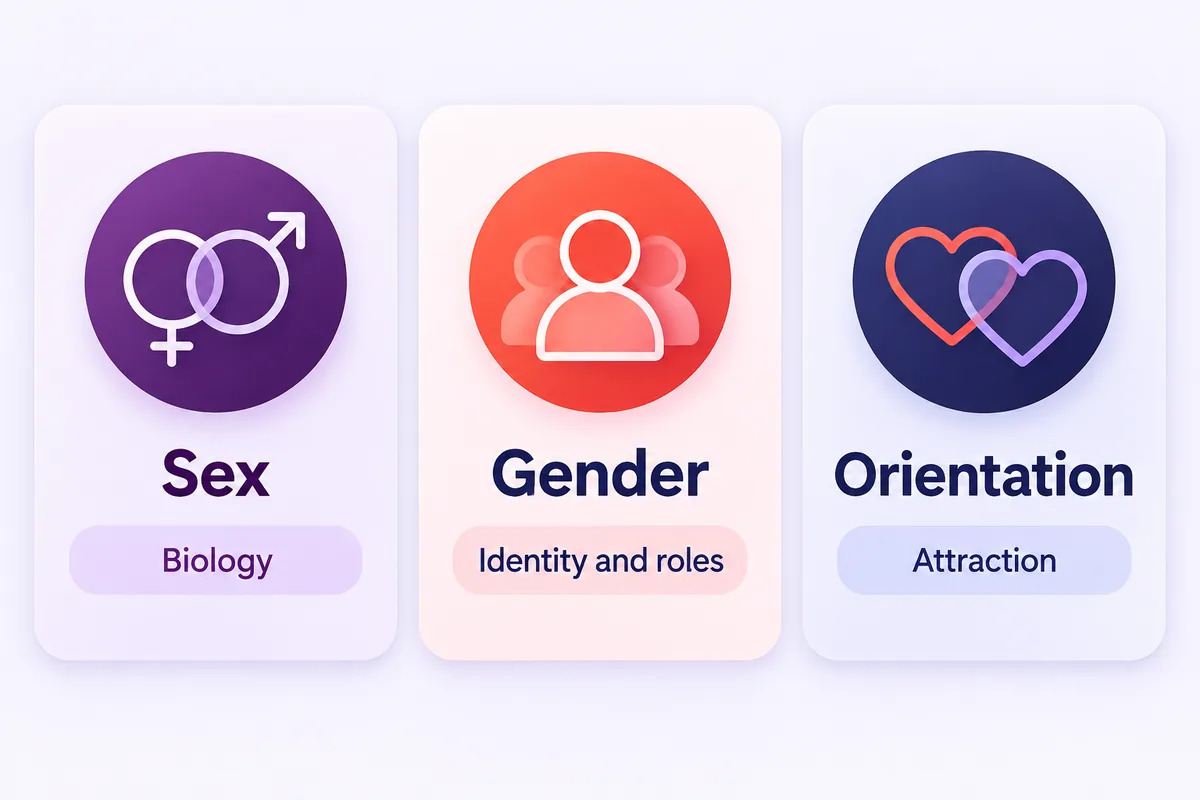
The same holds for intersex people. Cleveland Clinic says being intersex does not determine sexual orientation. Put simply, sex is about the body, gender is about identity and social roles, and orientation is about attraction. The table below puts the three ideas side by side.
| Sex | Gender | Sexual orientation | |
|---|---|---|---|
| What it refers to | Body traits such as chromosomes and hormones | Roles, norms, expressions and identities | Who a person is attracted to |
| How it is set or shown | Assigned at birth from genitals and chromosomes | Felt as identity and shown as expression | How a person identifies by attraction |
| Examples | Female, male or intersex | Woman, man or non-binary person | Straight, gay, lesbian or bisexual |
Where sources define the terms differently
The sources here treat sex and gender as separate ideas, but they do not word them identically. Three differences are worth knowing.
Assigned sex or biological sex
Both CIHR and the APA use biological language when they define sex. Planned Parenthood notes that some people call assigned sex “biological sex.” It argues that the term does not fully capture the variation in bodies.
An article in the Bulletin of the World Health Organization makes a related point. Definitions built on two categories do not recognise intersex people.
Is gender a role, an identity, or both?
The National Academies report defines gender as a classification based on the social construction of cultural distinctions between males and females. The UN has described gender in a similar way. It means the roles, behaviours, activities and attributes that a society considers appropriate for men and women. That wording stresses roles and norms.
The Statistics Canada definition is different. It describes gender as a person’s personal and social identity. It builds identity and expression into the term. The APA likewise counts identity and expression as the two parts of gender. WHO treats gender identity as related to gender but different from it.
Binary or spectrum
CIHR says sex is usually categorized as female or male, and that gender identity exists along a continuum. The Bulletin authors note that both terms are often treated as binaries. They argue that gender is a spectrum and that sex may include intersex individuals.
These differences are mostly about wording. No source here says that sex and gender mean the same thing.
Why the distinction matters in health care and research
The split is not only a matter of vocabulary. It changes how researchers read data and how clinicians read patients.

Sex and gender both shape health
A National Academies report says health differences between males and females often reflect both sex and gender at once. Sometimes biology alone explains an outcome, such as gonadal dysgenesis among women with Turner syndrome.
Elsewhere, gender relations matter more. Higher needle-stick injuries among female health care workers were attributed to gender segregation of the workforce.
Clinician behaviour also plays a part. One study looked at 256 primary care doctors in the United States and United Kingdom. They watched videotaped visits with identical symptoms. Diagnosis and management decisions were significantly affected by the patient’s gender.
What goes wrong when the terms are mixed up
An article in the Bulletin of the World Health Organization gives a clear example. The higher incidence of breast cancer among females is a sex-related issue. Having the agency and resources to get breast cancer care is a gender-related issue.
The same authors show how mixing the terms clouds COVID-19 data. Males have been reported to have more severe symptoms and higher mortality. Females have been reported to be more likely to develop long COVID.
Without clear labels, it is hard to tell whether such gaps come from sex or gender. Gendered jobs such as health-care work may raise exposure, for example.
The authors suggest a two-step data collection process. It asks about both sex and gender. It also recognises intersex, third gender, transgender and non-binary people.
Sex- and gender-based analysis in practice
CIHR points researchers to gender-based analysis plus (GBA+) resources. These explain how to bring sex and gender into research. The Bulletin authors name the Sex and Gender Equity in Research checklist as a tool for data collectors and journal editors.
On the care side, WHO says gender influences people’s experience of and access to healthcare.
How the terms appear on forms and records
The same word can mean different things on different documents, and the sources show a mix of practices.
Some records capture sex at birth. Planned Parenthood says assigned sex goes on the birth certificate in the U.S. The NHS speaks of sex registered at birth. In New York City, doctors may assign a sex marker of male, female or X on the birth certificate of an intersex child.
Some statistics agencies now ask two questions. In 2021, the Canadian census added “at birth” to its sex question. It also introduced a separate gender question. That kept the historical series on sex. It also let cisgender, transgender and non-binary people report their gender.
The same agency notes that a person’s gender may differ from their sex at birth. It may differ from what a birth certificate, passport or driver’s licence shows.
Law varies by country. In 2017, Canada amended its Human Rights Act and Criminal Code to protect people from discrimination and hate crimes based on gender identity and expression.
Other countries differ. Most countries’ laws recognise only binary categories on birth and death registrations or identity documents. India and Thailand allow other, intersex or third gender categories. Where being known as transgender could cause harm, the Bulletin authors say data that separate sex from gender may be impossible to collect.
Common misconceptions
- Myth: sex and gender are synonyms. WHO says gender interacts with but is different from sex, and CIHR says the terms have different meanings.
- Common assumption: sex is always two clean boxes. CIHR says sex is usually categorized as female or male, but notes variation. The New York City health department describes intersex variations in sex characteristics.
- Myth: gender identity decides who a person is attracted to. Orientation and gender identity are distinct constructs, says the APA.
- Myth: intersex means transgender. An intersex person may or may not identify as transgender, according to the New York City health department.
- Myth: gender is the same everywhere. WHO says gender varies from society to society and can change over time.
- Myth: gender is fixed for life. CIHR and Statistics Canada both say a person’s gender can change over time.
Frequently asked questions
What is the main difference between gender and sex?
The word sex refers to biological attributes such as chromosomes, hormones and reproductive anatomy. Gender refers to socially constructed roles, behaviours, expressions and identities. WHO describes the two as interacting but different.
Is it true that sex and gender are not the same thing?
Yes. A National Academies report says the terms are often used interchangeably but have distinct meanings. An article in the WHO Bulletin says scientists generally agree they are two different concepts, although they are related.
Can gender identity differ from sex assigned at birth?
Yes. Planned Parenthood calls people cisgender when assigned sex and gender identity line up. It calls people transgender when they do not. Statistics Canada adds that some people are not exclusively a man or a woman. It describes them as non-binary.
Is intersex the same as being transgender?
No. Intersex refers to variations in sex characteristics. Transgender relates to gender identity, as Statistics Canada and the APA describe it. An intersex person may or may not identify as transgender.
Does gender identity decide who someone is attracted to?
No. The APA treats sexual orientation and gender identity as distinct. A transgender person may be straight, gay, lesbian, bisexual or another orientation.
Why do researchers recommend separating sex and gender in health data?
The WHO Bulletin authors argue that mixing them makes it hard to tell whether a health gap comes from biology or from gendered factors. They suggest collecting both. Among the sources here, Statistics Canada is the agency that describes asking separate sex and gender questions.
The short version
Sex points to biological attributes, usually recorded at birth. Gender points to social roles and norms, plus the identity and expression of each person. Sexual orientation is a separate matter again. Sources word these ideas a little differently, but they agree that the terms are not interchangeable, and health research gets clearer when they are kept apart. When you see one of these words on a form or in a study, check which idea it is really asking about.
This article offers general educational information, not medical advice.
Related reading
- What Is Sex? What the Word Means and What Counts
- What Is Asexuality? Meaning, Spectrum, Myths and Research
Sources
- Gender and health - World Health Organization
- What is gender? What is sex? - Canadian Institutes of Health Research
- Sex/Gender, Race/Ethnicity, and Health (in Genes, Behavior, and the Social Environment) - Institute of Medicine (US), National Academies Press via NCBI Bookshelf
- Definitions of Gender, Sex, and Sexual Orientation and Pronoun Usage - American Psychiatric Association
- Sex and Gender Identity - Planned Parenthood
- Intersex Health - NYC Department of Health and Mental Hygiene
- Intersex: Meaning & Anatomy - Cleveland Clinic
- Gender of person, category (Canadian Income Survey) - Statistics Canada
- Sexual Orientation and Gender Identity Definitions - Human Rights Campaign
- Understanding Gender Identities & Pronouns - The Trevor Project
- Canada is the first country to provide census data on transgender and non-binary people - Statistics Canada
- Gender dysphoria and incongruence - NHS
- Filling gaps in gender diversity data in Canada - Statistics Canada
- Differentiating sex and gender in health research to achieve gender equity - Bulletin of the World Health Organization (Kaufman, Eschliman, Sanchez Karver)