What Does Asexual Mean? Asexual Reproduction vs Asexual Orientation
Asexual has two meanings. Learn what asexual reproduction is, its types, pros and cons, animals that do it, and what asexual means as an orientation.
General education, not medical advice. If something here worries you, talk with a clinician.
Table of Contents
“Asexual” has two meanings that share a spelling and nothing else. In biology, asexual reproduction means a living thing makes offspring from one parent, with no sperm meeting an egg. As a sexual orientation, asexual describes a person who feels little or no sexual attraction to others.
Most people who search the word are asking about the biology, so that part comes first and runs longest. It covers what counts as asexual reproduction, the main types, the trade-offs, how it compares with sexual reproduction, and the animals that do it. If you came for the orientation, skip to the section near the end, which explains the term briefly and points to a fuller guide.
One rule holds throughout. The biological meaning says nothing about asexual people, and the orientation has nothing to do with how anyone reproduces.
Asexual reproduction in biology: one parent, no fertilization
Asexual reproduction is reproduction with a single parent and no fertilization. The offspring come out genetically identical to that parent and to each other. Every prokaryote, meaning bacteria and their single-celled relatives, reproduces this way, and so do some eukaryotes.
What the textbook definition requires
Two conditions do the work. First, only one parent contributes genes. Second, no gametes fuse, so there is no moment where a sperm and an egg combine.
The copying usually happens through mitosis, the kind of cell division that gives each new cell the same DNA as the original. Meiosis is the other kind. It halves the DNA to make sperm and eggs, which is the first step of sexual reproduction. Most single-celled microbes simply copy their genetic material and split in half, and phytoplankton in the ocean rely on this route most of the time.
A useful test: if you could trace every gene in the offspring back to one individual, with no partner involved, you are looking at asexual reproduction.
The reverse case is worth knowing too. Bacteria can pass a piece of DNA from one cell to another through a thin tube, a process called conjugation. No new cell is made, yet genes get mixed. Biologists treat that as sex without reproduction, which shows the two ideas can be pulled apart.
Why the offspring are only nearly identical
Textbooks call asexual offspring clones, and the University of Minnesota’s open biology text adds an honest qualifier: they are identical “barring any mutations”. Each round of copying can introduce small errors, so a long line of clones slowly drifts apart.
Parthenogenesis, where an egg develops without being fertilized, bends the rule further. In some species the egg is made by meiosis first and its chromosomes are doubled afterward. Scientific American’s account of Komodo dragon births spells out the result: with only a mother, the young still are not clones, because the egg starts with half her genes. In another form, a leftover cell from egg-making fuses with the egg, which shuffles the mother’s genes a little.
So “clone” is a fair shorthand. It is an approximation, and the exceptions matter later when we get to lizards and sharks.
Six main types of asexual reproduction, with example organisms
Biology courses usually group asexual reproduction into six methods. Three split or copy an existing body, one grows a new plant from a piece of the old one, one scatters tough cells, and one starts from an unfertilized egg.
How the six methods compare
| Method | What happens | Example organisms |
|---|---|---|
| Binary fission | One cell, or a simple body, grows and then splits into two similar-sized individuals | Bacteria, many single-celled eukaryotes, some sea anemones and coral polyps |
| Budding | An outgrowth forms on the parent and becomes a new individual, which may break off or stay attached | Yeast, hydras, corals |
| Fragmentation | The body breaks into pieces and each large enough piece regrows the rest | Many sea stars, annelid worms, flatworms, sponges |
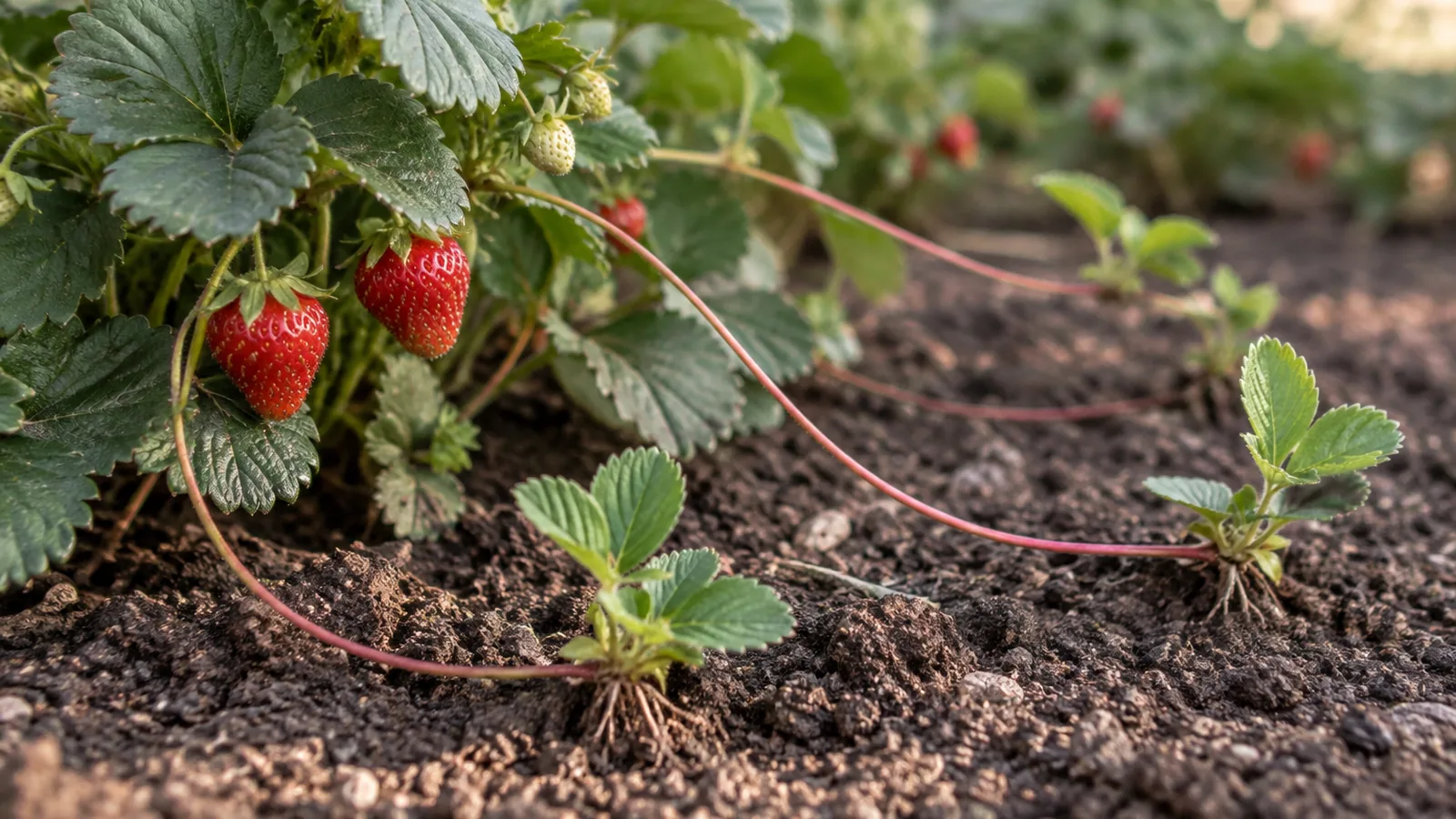
| Vegetative propagation | A new plant grows from a stem, root or leaf instead of a seed | Potato tubers, strawberry runners, garlic corms, ginger rhizomes |
| Spore formation | The organism releases dormant, thick-walled cells that survive heat and dryness and later germinate | Fungi, slime molds, ferns and other vascular plants |
| Parthenogenesis | An egg develops into a full individual without being fertilized | Water fleas, rotifers, aphids, stick insects, some bees and wasps, some reptiles |
The split between fission and fragmentation is mostly about size. Fission gives two individuals of about the same size, while fragmentation usually leaves one large piece and one small one. OpenStax notes a story that makes the point: fisheries workers who cut clam-eating sea stars in half and threw them back only doubled the number of sea stars.
Plants lean on vegetative propagation because it is cheap. A plant that grows from a tuber or runner skips flowers, pollinators and seed dispersal, and it reaches maturity faster than a seedling. Gardeners copy the trick with cuttings, grafting and tissue culture. Tissue culture can turn one plant into many in a short time, which helps growers save rare species. Some bamboo species push the strategy to an extreme. They may spread asexually for a vegetative period as long as 120 years, then flower once and die.
Where the categories blur
Real organisms do not stay inside one box. Some plants make seeds without fertilization, a process called apomixis, so a seed is not always proof of sex. Biology Online lists apomixis in mosses and liverworts, certain ferns and flowering plants.
Plenty of species switch modes. Starfish can regrow from a single arm yet also reproduce sexually. Honeybees use parthenogenesis for one sex only: unfertilized eggs become males, called drones.
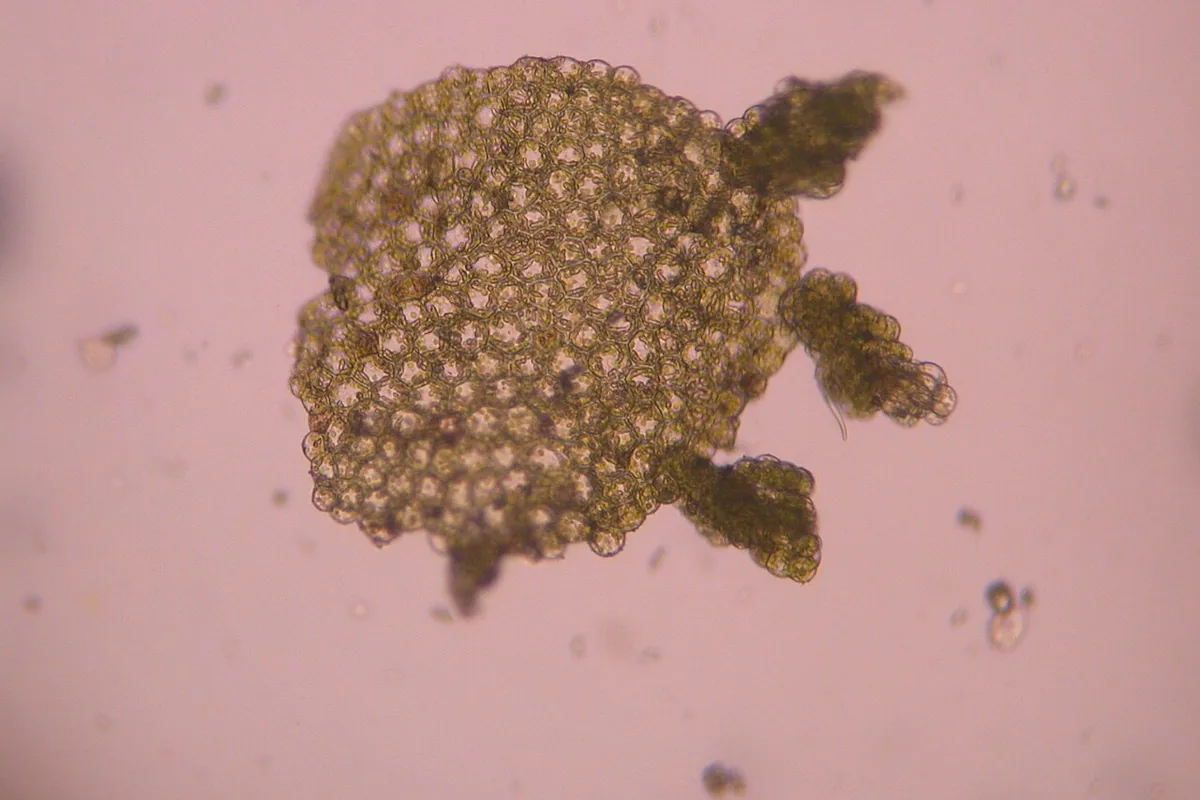
Spores are the trickiest category. They are usually listed as asexual, yet in plasmodial slime molds the spores come from meiosis and belong to the sexual phase of the life cycle. Fern spores work the same way, since they form by meiosis and grow into a separate generation of the plant. Many fungi make both kinds of spore, some by plain cell copying and some after sex. So a spore tells you how an organism spreads, while the life cycle tells you whether sex was involved.
Advantages and disadvantages of asexual reproduction: speed versus variation
Cloning trades long-term flexibility for short-term speed. A lone individual can multiply quickly and cheaply, but its offspring share the same genes and therefore the same weak spots.
Advantages and disadvantages at a glance
| Advantages | Disadvantages |
|---|---|
| One individual is enough, so no time or energy goes into finding a mate | Offspring are near-copies, so a disease or change that harms one tends to harm all |
| Large numbers of offspring can be produced quickly | Little variation is available when conditions shift |
| A single arrival can colonize a new habitat | Lineages may lose genetic diversity over time, a concern for rare species |
| Offspring suit a stable environment the parent already survived | Helpful gene combinations from two parents never form |
The two columns are really one trade. Uniform offspring are an asset while the environment stays the same and a liability once it changes. OpenStax adds a twist: because asexual species breed so fast, a useful new mutation can still spread quickly through them.
Why cloning wins on speed: the twofold cost of males
The classic argument comes from the biologist John Maynard Smith. A sexual female spends about 50% of her resources on sons, and sons cannot bear young themselves. An asexual female spends everything on daughters, and every daughter can reproduce.
Here is a hypothetical to show the effect. Suppose each female, sexual or asexual, raises two surviving young. A sexual female has one daughter and one son, so the next generation has one breeding female. An asexual female has two daughters, so it has two. All else being equal, the asexual line grows twice as fast, which is why the effect is called the two-fold cost of males.
This was long a prediction rather than a measurement. A 2017 study in Evolution Letters noted there had been no direct estimates. The researchers kept mixed groups of sexual and asexual New Zealand mud snails in outdoor tanks across four separate years. Asexual snails gained ground every year, at roughly the rate a two-fold cost predicts.
Why it loses in the long run: no shuffling of genes
If cloning is twice as efficient, sex should have vanished. It has not, so sex must pay for itself somehow.
The leading explanations turn on variation. Sexual reproduction mixes genes from two parents into new combinations, which may help offspring cope with an unpredictable environment. A related idea, the Red Queen hypothesis, points to parasites. Parasites evolve to attack whatever host type is common, and a widespread clone is an easy target, so rare sexual offspring escape.
The evidence is still being argued over. The snail study deliberately removed most parasites so it could isolate the cost of sex. That means it measured the price of sex cleanly but did not test which benefit pays it. Most biologists accept that variation matters. How much each proposed benefit contributes, and in which species, remains open.
Sexual vs asexual reproduction: a side-by-side comparison
The core difference is the number of parents. Sexual reproduction combines genetic information from two parents into offspring that are each unique, while asexual reproduction copies one parent. Nearly every other difference in the table follows from that.
| Feature | Asexual reproduction | Sexual reproduction |
|---|---|---|
| Parents | One | Two |
| Sex cells (gametes) | None needed | Sperm and egg, each with half the chromosomes |
| Fertilization | Absent | Gametes fuse to form a zygote |
| Main cell division | Mitosis, which keeps the full DNA set | Meiosis to make gametes, then mitosis to grow |
| Genetic variation | Offspring near-identical to the parent | Each offspring a new mix of both parents |
| Speed | Fast; bacteria may divide several times an hour | Slower, since mates must meet and sons do not bear young |
| Energy and time | Lower, with no mate search | Higher, with courtship, mating and the cost of producing sons |
| Best suited to | Stable, predictable conditions | Changing or unpredictable conditions |
| Typical examples | Bacteria, yeast, hydra, potatoes, fungi | Mammals, birds and most flowering plants grown from seed |
The speed row deserves a number. Under ideal conditions, 100 bacteria could become millions in a few hours. They rarely get the chance, because food runs short, predators eat them, and their own waste builds up.
The table makes the two modes look like rival teams, and many species refuse to pick one. The University of Utah’s Genetic Science Learning Center makes exactly this point: each strategy has costs and benefits, and some organisms do both. Starfish, aphids and Komodo dragons are all examples, as the sections above and below show.
Animals that reproduce asexually: whiptail lizards and aphids
Among animals, cloning is routine for many small invertebrates and rare in species with backbones. National Geographic counts parthenogenesis in more than 80 vertebrate species, about half of them fish or lizards. Two groups show the range well: lizards that have dropped males entirely, and insects that clone themselves for most of the year.
Whiptail lizards: species with no males at all
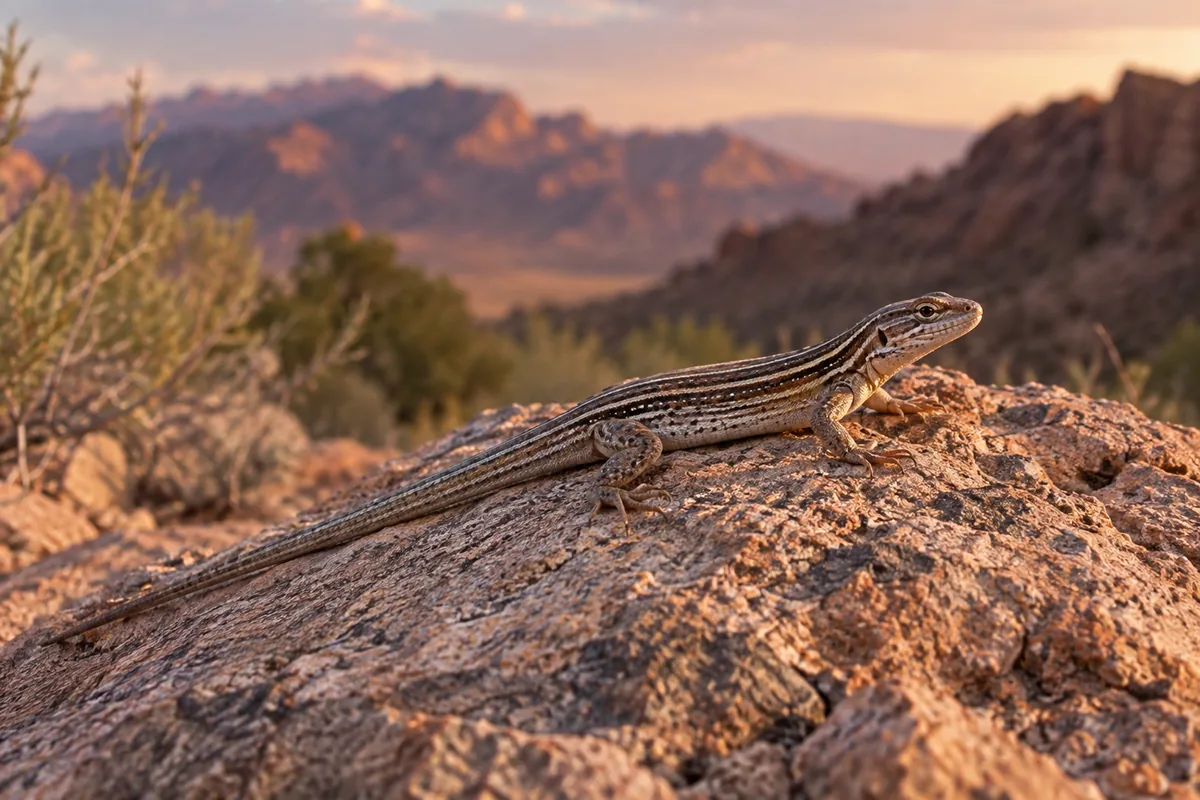
Some whiptail lizards have no males at all. In the desert grassland whiptail, every individual is female and reproduces by parthenogenesis. Whiptails of the genus Aspidoscelis double their chromosomes before the egg-making division, not after it. Because each chromosome then pairs with its own copy, a daughter keeps her mother’s full set of gene pairs and is a near-exact clone of her. No sperm is ever involved.
Their behavior is the surprising part. Females still court and mount each other, and the University of Minnesota’s open textbook notes that this behavior has been shown to increase the number of offspring produced. In one species, which female takes which role depends on which one is about to ovulate.
The cost of cloning shows up in the field. Some New Mexico whiptail populations share nearly identical genetic profiles, which leaves them more exposed to disease and environmental change. That is the disadvantages table from earlier, playing out in a real species.
Aphids: live-born clones and an egg-laying sexual generation
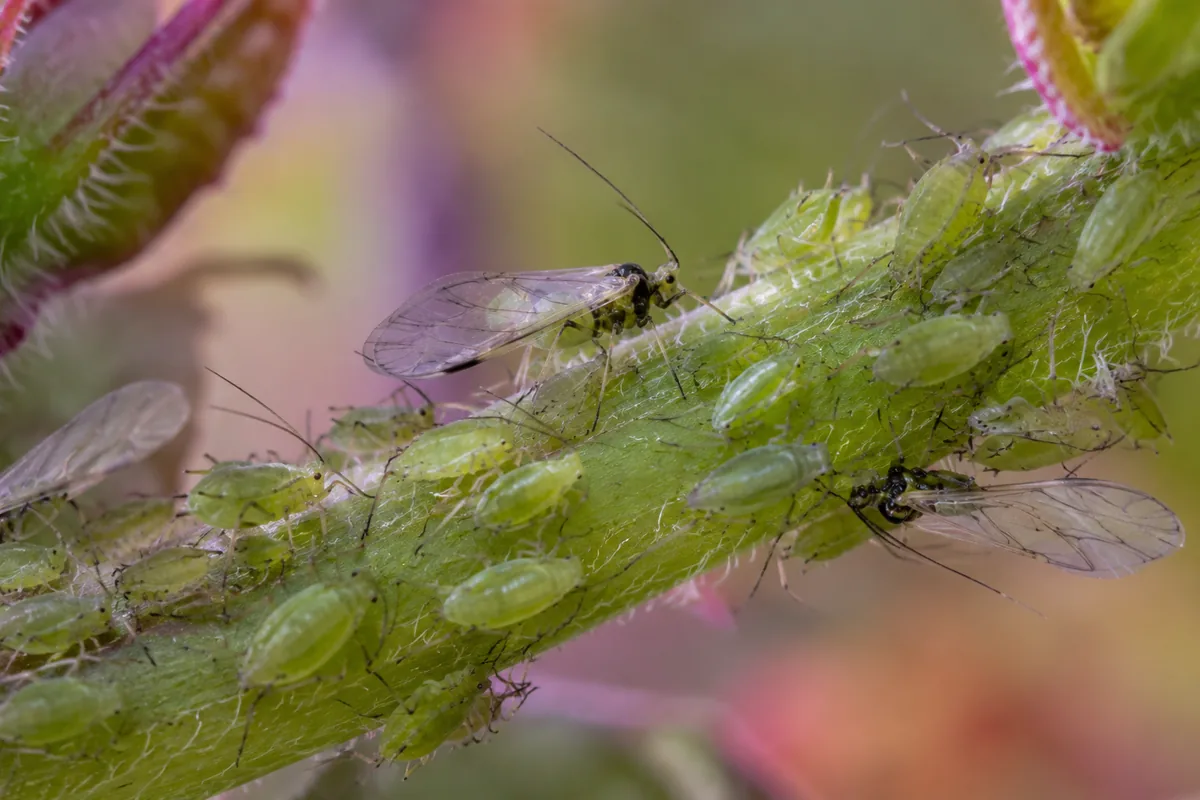
Aphids, the small sap-sucking insects on garden plants, combine two shortcuts. They develop from unfertilized eggs, and the mother gives birth to live young rather than laying eggs. There are about 4,700 species of true aphids.
Their speed comes from what aphid specialists Blackman and Eastop call telescoping generations. An adult mother already carries daughters, and those daughters already contain the embryos of her granddaughters. A colony on a rose stem can therefore grow very quickly.
Aphids have not given up sex, though. The same clone can produce sexual females that mate and lay fertilized, yolk-rich eggs. Their closest relatives, adelgids and phylloxerids, show the same alternation between cloning and sexual generations. This is why biologists treat aphids as a natural experiment: the same genes can build either kind of female.
Virgin births in species that usually mate: Komodo dragons and sharks
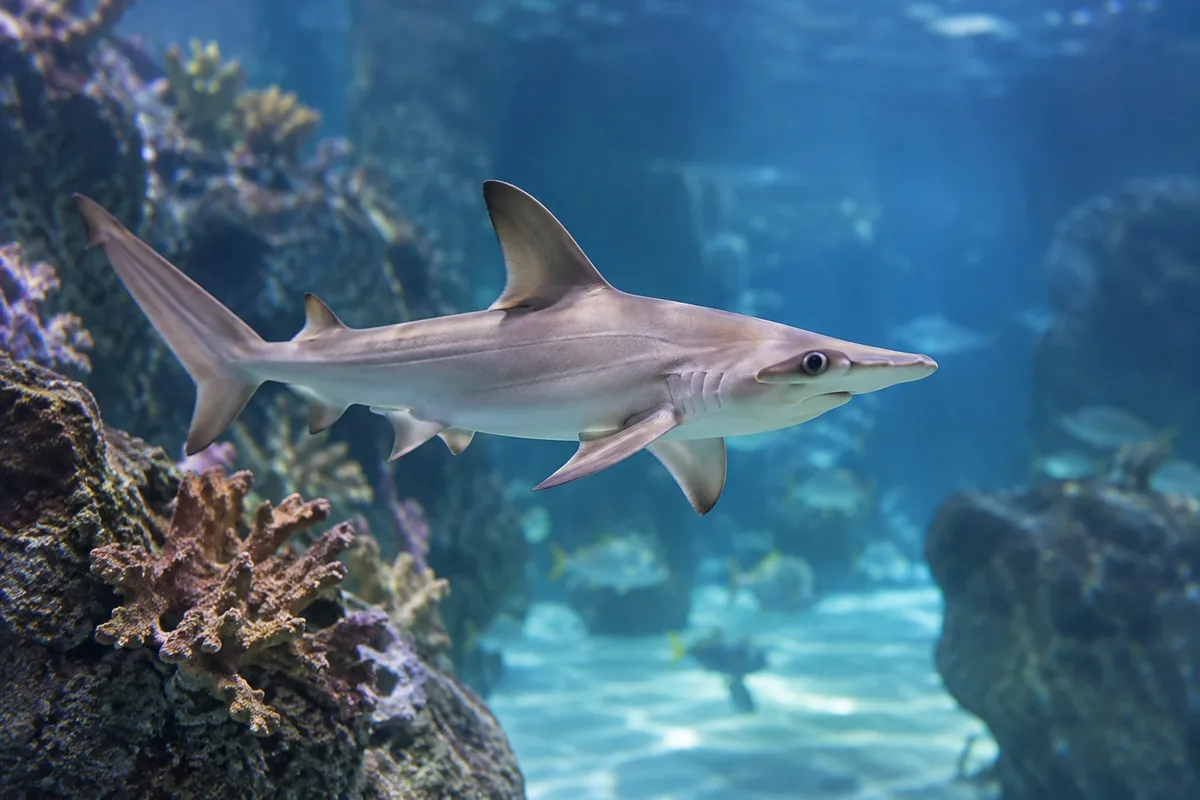
Animals that normally mate can sometimes have young without a partner. Biologists call it facultative parthenogenesis: a female of a normally sexual species produces young from an unfertilized egg when no male is available. OpenStax lists two female Komodo dragons, a hammerhead shark and a blacktop shark that did this after being kept away from males in zoos and aquariums. In vertebrates these births are rare and tend to follow unusual conditions, such as long isolation from males.
Komodo dragons: all-male offspring from isolated females
The first well-known cases came from two English zoos. Scientific American reported that the only two sexually mature female Komodo dragons in Europe had laid viable eggs without a mate. Flora, at Chester Zoo, had never lived with a male, yet laid 11 eggs, 8 of which were developing normally. Sungai, at London Zoo, laid 22 eggs that produced four normal males after two and a half years without male contact.
Long-term sperm storage was the obvious alternative, since some reptiles hold sperm for years. Genetic testing ruled it out.
The sex of the babies is the giveaway. In Komodo dragons the sex chromosomes are called Z and W: a ZZ animal is male and a WZ animal is female. An unfertilized egg carries either a Z or a W, and parthenogenesis doubles it. WW embryos do not survive, so every hatchling is a ZZ male.
This also explains why the young are not clones. Each egg carries only half the mother’s genes, doubled up, so every offspring is a reshuffled and simplified copy of her. Researchers have speculated that the ability could let a lone female start a new colony on an empty island.
Sharks: the bonnethead born in an aquarium tank
On 14 December 2001, a bonnethead shark, a small species of hammerhead, gave birth to a live female pup in captivity. Her tank held three adult females and no males. All three had been captured as immature animals under 1 year old and kept without males for 3 years.
Before this case, such births were blamed on stored sperm. The team behind a 2007 paper in Biology Letters tested that idea with DNA profiling. They identified the mother and found no genetic markers from any father. The pup was homozygous, meaning it carried two matching copies, at all four markers tested. The odds of that from normal mating were below 1 in 10 million. It was the first genetic evidence of parthenogenesis in sharks and their relatives.
More cases followed. In 2016, a zebra shark called Leonie at an Australian aquarium, housed only with females, had eggs that hatched into three pups.
Wild populations are the open question. Wild cases are hard to track, so most documented virgin births come from animals in human care. Because this kind of parthenogenesis makes offspring more inbred, the bonnethead researchers flagged a concern for small, threatened populations. Whether it happens often in the wild, and whether those offspring do well, is still largely unknown.
Asexual as a sexual orientation: a separate meaning
As a sexual orientation, asexual describes a person who experiences little or no sexual attraction to other people. A 2023 summary in the Canadian Medical Association Journal puts the estimated prevalence between 0.4% and 4%. People often shorten the word to “ace.”
Asexuality works as an umbrella term. It includes demisexual people, who feel sexual attraction only after a strong emotional bond forms, and greysexual people, who feel it rarely or only in certain situations. Some asexual people have sex, and many feel romantic attraction and form close relationships. The Trevor Project, an LGBTQ+ youth organization, stresses that being ace is a natural orientation, not celibacy by choice, and that asexual people’s hormone levels fall within average ranges. The CMAJ summary also separates asexuality from desire and arousal disorders, which involve a distressing drop from a person’s usual level.
The shared word causes real confusion. Both meanings add the prefix “a-,” meaning without, to the word sexual. Yet they describe unrelated things. One is a way cells and organisms copy themselves, and the other is how a person feels attraction. Asexual people reproduce the same way everyone else of their species does, and nothing in the biology above describes them. Jokes that compare ace people to amoebas or plants mix up the two meanings and can be hurtful.
For the full picture, including the wider ace spectrum, relationships and common misconceptions, see our guide to what asexuality is.
Frequently asked questions
Can humans reproduce asexually?
No. No mammal is known to reproduce by natural parthenogenesis. The barrier is genomic imprinting, a chemical tagging system that switches certain genes on only when they come from the mother and others only when they come from the father. With one parent, some essential genes never switch on, so an embryo cannot develop normally. Scientists have made fatherless mice in the lab, such as the famous mouse Kaguya, but only by editing imprinted genes, and nearly all of the lab-built embryos failed. Identical twins are also not asexual reproduction, since they start from one fertilized egg.
What animals are only asexual?
A few vertebrates reproduce only by parthenogenesis. The desert grassland whiptail lizard is the best-known example, and every member of the species is female. Among invertebrates, the classic all-female group is the bdelloid rotifers, tiny water animals in which no males have ever been found. OpenStax also lists water fleas, stick insects, aphids and rotifers in general as animals that use parthenogenesis. Using it is different from relying on it alone, though. Water fleas and aphids switch back to sex at times, and aphids, for one, still keep a sexual generation. Komodo dragons and sharks are not on this list, because they normally mate.
What is asexual reproduction in short answer?
It is reproduction by one parent without fertilization, producing offspring that are copies or near-copies of that parent. Most types make true clones, but some forms of parthenogenesis shuffle the mother’s genes a little, so those young are close relatives rather than exact copies. Bacteria splitting in two, a potato sprouting from a tuber, and a hydra growing a bud are all asexual reproduction.
What are 5 types of examples of asexual reproduction?
Five standard examples are binary fission in bacteria, budding in yeast and hydra, fragmentation in sea stars, vegetative propagation in potatoes and strawberries, and spore formation in fungi. A sixth, parthenogenesis, covers animals such as aphids and whiptail lizards.
Two meanings, one spelling
In biology, asexual reproduction means one parent, no fertilization, and offspring that are close genetic copies. You see it when bacteria split, hydras bud, potatoes sprout and fungi release spores. You also see it when eggs grow without sperm in aphids, whiptail lizards and, now and then, a Komodo dragon or a shark. Its appeal is speed and its weakness is sameness, which is why so many species keep sex in reserve.
As an orientation, asexual describes people who feel little or no sexual attraction. That meaning sits on a spectrum and belongs to human identity, not to cell biology.
The two meanings share a spelling and nothing more. When you see the word, the context tells you which one is meant, and neither one tells you anything about the other.
Related reading
- What Is Asexuality? Meaning, Spectrum, Myths and Research
- The Asexual Spectrum: Labels Grouped by What They Describe
- Am I Asexual? Questions to Think Through Instead of a Quiz
- What Is the Difference Between Sex and Gender?
Sources
- 2.36: Asexual vs. Sexual Reproduction - Biology LibreTexts (CK-12 Introductory Biology)
- Growth, Development, and Reproduction - University of Hawai’i at Manoa, Exploring Our Fluid Earth
- Introduction to the Evolution of Sex - University of Minnesota, Introductory Biology (open textbook)
- Strange but True: Komodo Dragons Show that “Virgin Births” Are Possible - Scientific American
- How some animals have ‘virgin births’: Parthenogenesis explained - National Geographic
- 43.1 Reproduction Methods (Biology 2e) - OpenStax, Rice University
- Asexual Reproduction in Plants (Biology for Majors II) - Lumen Learning (adapted from OpenStax Biology)
- Asexual reproduction - Definition and Examples - Biology Online Dictionary
- Virgin birth in a hammerhead shark - Biology Letters (Chapman et al., Royal Society)
- The two-fold cost of sex: Experimental evidence from a natural system - Evolution Letters (Gibson, Delph and Lively, Indiana University)
- Sexual vs. Asexual Reproduction - Genetic Science Learning Center, University of Utah
- Eggs and embryos: how aphids develop without sex - Blackman & Eastop’s Aphids on the World’s Plants
- Asexuality (Five things to know about) - CMAJ, Canadian Medical Association Journal (Schneckenburger, Tam and Ross)
- Understanding Asexuality: FAQs & Supportive Resources - The Trevor Project
- You (Don’t) Got Male: Parthenogenesis and its Applications in Biomedical Research - Lions Talk Science (Penn State student science blog)