What Is Asexuality? Meaning, Spectrum, Myths and Research
Asexuality means little or no sexual attraction. Learn how the spectrum works, how it differs from celibacy, low libido and HSDD, and what research shows.

General education, not medical advice. If something here worries you, talk with a clinician.
Table of Contents
Asexuality means feeling little or no sexual attraction to other people. The Asexual Visibility and Education Network (AVEN) says it is a core part of who a person is, like other sexual orientations.
That is the short answer. The word covers a wide range of lives. Some asexual people have a sex drive. Some have romantic relationships. Some have sex for reasons that have nothing to do with attraction.
This guide explains what asexuality means and how the spectrum works. It also compares asexuality with celibacy, low libido and desire disorders, then covers common myths, research and support.
What asexuality means
Sexual attraction, defined
Healthline defines sexual attraction as finding a specific person sexually appealing and wanting to have sex with them. Young Scot puts it simply. An asexual person does not look at someone and feel a wish to have sex with them.
AVEN says orientation is about attraction toward other people, not physical reactions. The site whatisasexuality.com adds that dating, sex, masturbation and falling in love can all fit with being asexual.
Attraction is not the same as desire or arousal
Healthline separates three ideas that people often blur. Libido is your sex drive. Sexual desire is wanting sex. Sexual attraction is being drawn to a particular person. Plenty of people who are not asexual have a low libido. Many asexual people have a libido and may feel sexual desire.
AVEN says some asexual people have fairly regular arousal that is not tied to wanting a partner. Others have little or no arousal. AVEN calls them non-libidoist asexuals. Both are equally valid, because orientation is about attraction toward other people, not physical reactions.
Asexual people can also feel other kinds of attraction. These include romantic, aesthetic, sensual, platonic and emotional attraction.
The asexual spectrum and types of attraction
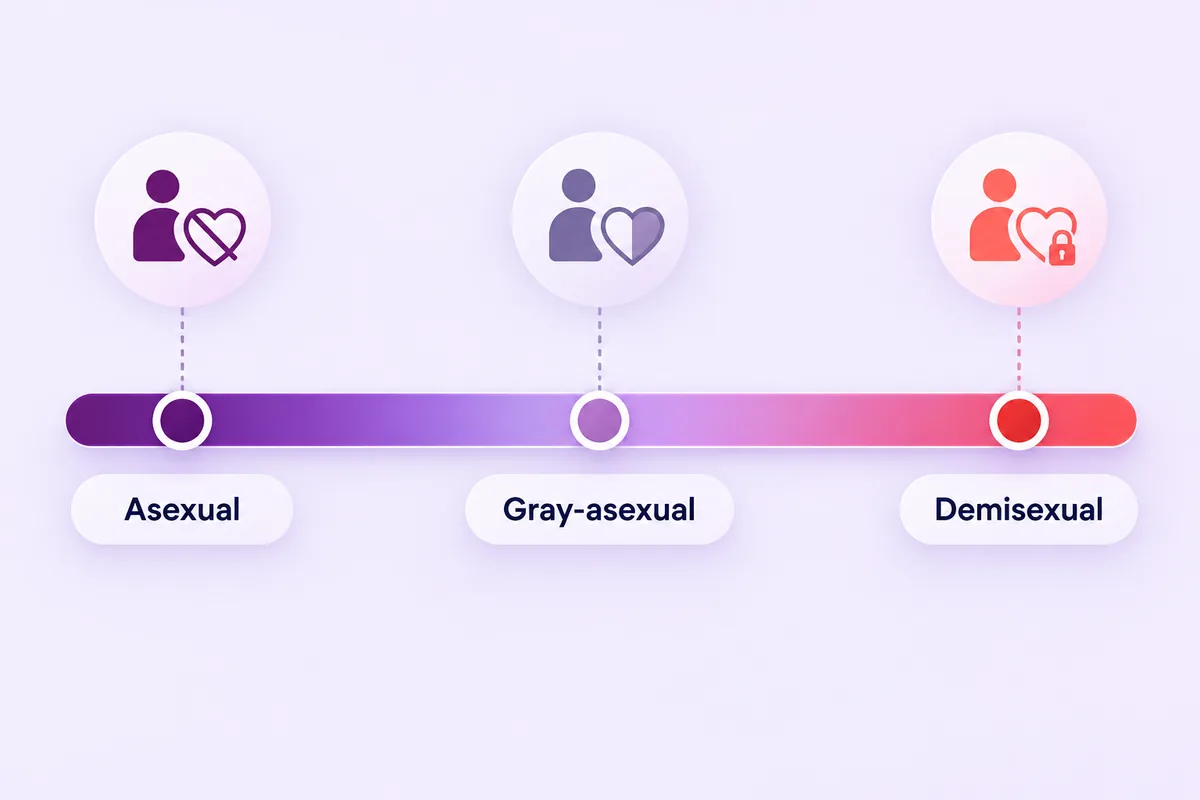
The Trevor Project calls asexuality an umbrella term that exists on a spectrum. The Human Rights Campaign (HRC) says asexual people may feel no, little or conditional sexual attraction.
Gray-asexual and demisexual
Gray-asexual people rarely feel sexual attraction, or feel it at very low intensity. Many see this as a midpoint between sexuality and asexuality.
Demisexual people feel sexual attraction only after they form a strong emotional connection. HRC counts both identities as part of the asexual spectrum.
Romantic attraction is separate
AVEN describes the split attraction model. It treats sexual attraction and romantic attraction as two separate things. Someone who is asexual but wants relationships with the opposite sex might call themselves a heteroromantic asexual. Aces often add hetero-, homo-, bi- or pan- before “romantic” to show who they feel romantic attraction toward.
Aromantic people feel little to no romantic attraction. Some, but not all, asexual people are aromantic. Splitting the two kinds of attraction is not unique to asexual people. The site whatisasexuality.com notes that an aromantic heterosexual person is also possible.
Close bonds can take other forms. Queerplatonic relationships are one example. They are very close and committed, and they involve no romance.
Common myths about asexuality
A few myths about asexuality come up again and again.
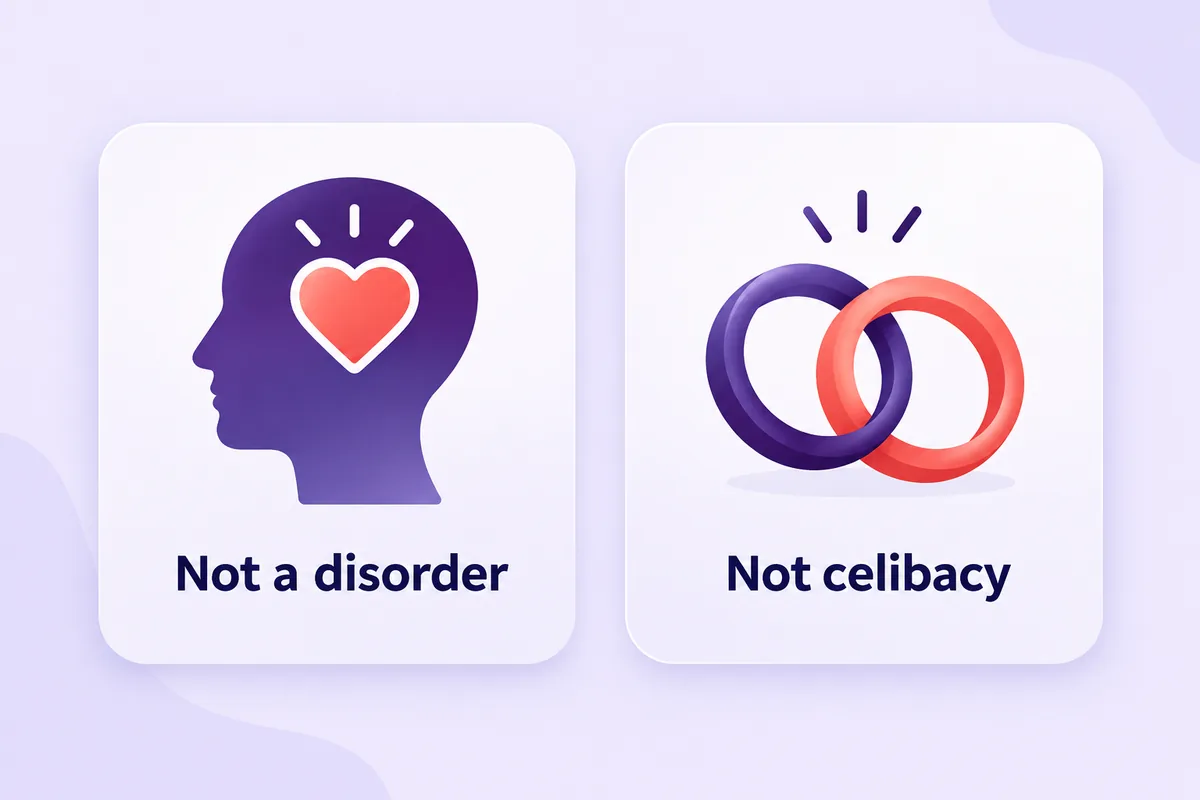
A phase, or the wrong partner? HRC says asexual people are often told it is a phase, or that they have not met the right person. Healthline explains that asexuality is not a matter of finding the right partner. AVEN says most asexual people have been asexual their whole lives. A minority use the label briefly while questioning.
Is something wrong? Healthline says asexuality is not a medical concern or something that needs to be fixed. It also says there is no underlying cause, and that asexuality is not genetic or the result of trauma. Mental Health America notes that asexuality is now recognized as a variation in human sexuality.
No love and no relationships? Many asexual people want and have romantic relationships. Others are happiest with close friendships or on their own.
Can pressure change it? HRC reports that some people pressure asexual people into sex, wrongly believing it will change their lack of sexual attraction. Media can reinforce the myths. HRC says characters who do not want sex are often shown as immature, shy or insecure rather than simply uninterested. Stigma of this kind is one reason mental health support matters, as covered below.
Asexuality vs celibacy, low libido and HSDD
Four ideas often get mixed up: asexuality, celibacy, low libido and hypoactive sexual desire disorder (HSDD). The table shows how they differ.
| Term | What it is | Where distress fits |
|---|---|---|
| Asexuality | A sexual orientation marked by little or no sexual attraction | Asexual people generally do not see a lack of sexual arousal as a problem to correct |
| Celibacy | A choice to abstain from sexual activity | Not part of the definition; it is a decision about behavior |
| Low libido | A low sex drive, which people of any orientation can have | Can be free of distress; a 2015 study included 59 people with low-desire symptoms that were nondistressing |
| HSDD | A sexual dysfunction marked by a lack of interest in sex and significant distress | Central to the diagnosis: underlying sexual needs go unmet to the point of personal distress |
What the DSM and research say
According to AVEN, HSDD is listed in the DSM-V and asexuality is not. In 2013 the DSM-5 split HSDD into two disorders, one for men and one for women, with new names. Each of the two has a line saying that someone who identifies as asexual should not be given the diagnosis.
Research backs up the difference. A 2015 study compared 192 people who scored above the asexuality cutoff with 231 sexual people, of whom 50 had HSDD. The asexual group was less likely to report sex-related distress than the HSDD group. The authors wrote that these results challenge the speculation that asexuality should be classified as a sexual dysfunction of low desire.
A 2011 study of arousal included 38 women, only 7 of them asexual, so it is very small. It found no significant group differences in genital or self-reported sexual arousal to an erotic film. Asexual women did report less positive affect and less sensuality-sexual attraction. The authors read this as normal arousal capacity.
Timing matters too. Young Scot notes that a sudden drop in sex drive in someone who used to feel attraction could come from medication or a change in mental health. That is worth raising with a doctor.
Relationships, sex drive and intimacy
Romantic and sexual relationships
A Williams Institute study of US sexual minority adults compared asexual people with non-asexual LGB people. Both groups were about equally likely to be in a romantic relationship, at 59 percent and 61 percent. Just over a third of the asexual respondents were sexually attracted, and more than half had had sex. People were counted by how they identified, not by an attraction cutoff. In its data, asexuality is not synonymous with a lack of attraction, behavior or intimate relationships. The study covered only asexual people who also identify as lesbian, gay or bisexual. It describes one part of the community.
The asexual dating pool is very small. As a result, AVEN says, many asexual people end up in mixed relationships with sexual people, which often need compromise. In a 2010 study, asexual people with sexual partners said they had to negotiate sexual activity.
Healthline advises honest talks about the activity each partner is open to, plus any boundaries. It also says it generally will not help to assume an asexual partner will suddenly feel sexual attraction. Some asexual people choose to have sex to please a partner, enjoy the physical pleasure, or show affection.
Arousal and masturbation
Some asexual people occasionally masturbate while feeling no desire for partnered sex. Others have little or no arousal. In the 2010 study, asexual men masturbated about as often as the available data for sexual men. Overall sexual response was lower than normal data, and people did not find that distressing.
AVEN says feeling arousal is not in conflict with being asexual.
Attitudes toward sex vary too. Healthline says some asexual people feel repulsed by sex, some feel indifferent, and some enjoy it. Scientific American adds that aces can be sex-repulsed, sex-neutral or sex-favorable, and may have sex often or never.
How common asexuality is and what research shows
Prevalence figures
The best-known figure comes from Bogaert’s 2004 study of a national sample of more than 18,000 British residents. Approximately 1% (n = 195) said they were asexual, defined as having no sexual attraction to a partner of either sex. AVEN calls roughly 1% the most widely cited figure. It adds that estimates are limited and vary.
Other numbers measure different things. The Williams Institute estimated that 1.7% of US sexual minority adults identify as asexual. HRC says the exact number is unknown.
Bogaert’s study also linked asexuality with factors such as gender (more women than men), short stature and low education. The author suggested that both biological and psychosocial pathways contribute. Healthline, in contrast, says asexuality has no underlying cause. Sources do not fully agree on this point.
A short research history
In the 1940s Alfred Kinsey created a “Category X” for people who reported no sociosexual contacts or reactions. He estimated they made up 1.5 percent of males aged 16 to 55 in the US. Brotto and Yule note that Kinsey was the first to measure a lack of sexual attraction. Large-scale research only began over the decade before 2017.
People began finding one another on internet forums in the early 2000s. A 2010 study by Brotto and colleagues surveyed 187 asexual people and interviewed 15. It found that asexuality is best understood as a lack of sexual attraction. Rates of mental health problems were not higher.
Brotto and Yule’s 2017 review found too little evidence to class asexuality as a psychiatric condition or a disorder of sexual desire. They concluded that it likely meets the conditions for a sexual orientation.
How people come to the label
No test can decide it. AVEN says there is no test to determine whether someone is asexual, and that an Asexual Identification Scale exists only to help research. The label is a word people use to understand themselves and explain that part of who they are to others.
Sources suggest a few reflection questions instead. Healthline suggests asking what sexual attraction means to you, whether you experience it, and whether you feel you should be interested in sex only because others expect it. Asexuality education site whatisasexuality.com adds questions about feeling left out when others discuss sex, or pretending to be interested to fit in. It stresses that these are not a checklist to diagnose asexuality.
The term itself can get in the way. The same site notes that sexual attraction is a vague phrase. Mental Health America says low visibility makes it hard to realize you are asexual, and that this can lead to self-questioning.
One unpleasant first kiss does not make someone asexual. The Trevor Project says attraction can be discovered over time. Healthline adds that attraction can shift, and that an earlier experience of attraction does not erase an asexual identity. AVEN notes that some people use the label only for a short time while questioning. The Trevor Project’s advice is that you do not have to adopt a label until you are ready.
Coming out, support and seeing a clinician
Coming out and finding community
The Trevor Project says coming out can be scary. Some people face risks such as rejection by a partner or love interest. It also says nobody should feel pressured to have sex. Mental Health America adds that you get to decide when and whether to tell people you date.
Community can help. Mental Health America suggests meeting other asexual and LGBTQ+ people through events or online groups. It points readers to AVEN for resources written by asexual people.
Stigma is a real concern. In HRC’s analysis of a 2021 survey, 82% of asexual people said that mental health challenges, such as depression and anxiety, were their top health priority. The Williams Institute study found that asexual respondents reported more everyday discrimination and stigma than non-asexual LGB respondents.
When to see a clinician
You do not need a clinician to be asexual, because it is not a medical condition. AVEN advises seeing a medical professional if lack of arousal or a sudden loss of interest in sex is distressing. Healthline also suggests an LGBTQIA+-affirming therapist if you feel distress or uncertainty about your orientation.
Be aware that some providers get this wrong. A 2020 study, reported by Scientific American, looked at disclosure in medical settings. Of respondents who told a doctor or therapist about their asexuality, 30 to 50 percent said it was blamed on a health condition. Mental Health America recommends finding LGBTQ-competent doctors and therapists. An NHS community trust guide for staff also warns clinicians not to assume every patient is sexually active.
Frequently asked questions
What is an asexual person like?
The site whatisasexuality.com says there is no asexual type and that aces can be any sex, gender, age or background. What they share is little or no sexual attraction. Beyond that, many questions get the same answer: some do, some don’t. That includes dating, having sex and masturbating.
What are the signs of being asexual?
There is no test. The site whatisasexuality.com adds that there are no outward signs. People often reflect on whether they feel sexual attraction at all. They also ask whether their interest in sex comes only from what others expect, and how they feel about the idea of sex. The questions earlier in this article are a starting point.
Do asexual people fall in love?
Many do. An asexual person might not feel sexual attraction but can feel romantic attraction, and many asexual people want and have romantic relationships. Some asexual people are aromantic and feel little to no romantic attraction.
Can asexual people have sex?
Some do. Healthline says asexual people might have sex to satisfy a libido, make a partner happy, experience physical pleasure, or show affection. Having sex does not cancel the label, because the label describes attraction, not behavior.
Is asexuality a mental disorder?
No. A 2017 review by Brotto and Yule found there was not sufficient evidence to categorize asexuality as a psychiatric condition or a disorder of sexual desire. The 2013 DSM-5 also says someone who identifies as asexual should not be given the diagnosis for its low-desire disorders.
Can asexuality change over time?
AVEN says most asexual people have been asexual their whole lives. Healthline notes that some people find their capacity for attraction shifts, and that this does not mean they were wrong or confused earlier.
The short version
Asexuality means little or no sexual attraction, and it sits on a spectrum alongside gray-asexual and demisexual identities. It is distinct from celibacy, low libido and HSDD, and research has not found support for treating it as a disorder.
If you are questioning, take your time with the label. The Trevor Project points people to AVEN for community support, and AVEN hosts the largest online asexual community.
This article is general educational information, not medical advice. For personal concerns about desire or distress, talk with a qualified clinician.
Related reading
- What Is Demisexuality? Meaning, Signs and How It Differs
- What Is Sexual Arousal?
- Sexual arousal vs. sexual attraction
Sources
- Asexual: What It Means, Facts, Myths, and More - Healthline (medically reviewed)
- Overview - The Asexual Visibility and Education Network (AVEN)
- What is Asexuality? - Young Scot
- What Is Asexuality? - whatisasexuality.com (asexuality education site)
- Understanding Asexuality: FAQs & Supportive Resources - The Trevor Project
- Understanding the Asexual Community - Human Rights Campaign
- Asexuality and mental health - Mental Health America
- Asexuality: an extreme variant of sexual desire disorder? - The Journal of Sexual Medicine, via PubMed
- Asexuality Is Finally Breaking Free from Medical Stigma - Scientific American
- Physiological and subjective sexual arousal in self-identified asexual women - Archives of Sexual Behavior, via PubMed
- 1.7% of sexual minority adults identify as asexual - Williams Institute, UCLA School of Law
- Asexuality: a mixed-methods approach - Archives of Sexual Behavior (Brotto et al., 2010), via PubMed
- Asexuality: prevalence and associated factors in a national probability sample - Journal of Sex Research (Bogaert, 2004), via PubMed
- Asexuality: Sexual Orientation, Paraphilia, Sexual Dysfunction, or None of the Above? - Archives of Sexual Behavior (Brotto & Yule, 2017), via PubMed
- Asexuality and medical appointments - a guide for DCHS colleagues - Derbyshire Community Health Services NHS Foundation Trust (LGBTQIA+ staff network)