What Is Demisexuality? Meaning, Signs and How It Differs
Demisexuality means feeling sexual attraction only after an emotional bond forms. Learn the meaning, how it differs from asexual and graysexual, and more.

General education, not medical advice. If something here worries you, talk with a clinician.
Table of Contents
A demisexual person can feel sexual attraction or desire only after an emotional bond has formed, according to the Asexual Visibility and Education Network (AVEN). The word sits on the asexual spectrum, next to gray-asexuality. Plenty of people hear that and ask whether everyone is like that.
This guide explains what the term means, how it differs from waiting for a connection, and how it relates to asexual, graysexual and sapiosexual labels. It also covers dating, myths, whether it is a disorder, how common it is, and where to find support. One caution up front: no test can tell you who you are.
What demisexuality means
The definition
AVEN defines a demisexual person as someone who can only experience sexual attraction or desire after an emotional bond has been formed. Healthline explains that the prefix “demi” means half or partly. People often trace the term to a 2006 post on an AVEN forum.
Researcher Anthony Bogaert told the BBC that the word came mainly from the AVEN site and asexual advocates, not from academics.
The key word is attraction. Healthline says demisexuality is about the ability to feel sexual attraction to specific people, and it is not about having sex. A person can be attracted to someone without having sex with them. A person can also have sex without feeling attracted.
What counts as an emotional bond
The bond does not have to be love. Healthline says it may be friendship, including platonic friendship, and the person might not love the other person at all. The Asexuality Archive, an educational site, adds that a close work relationship could count.
A bond also gives no guarantee. Healthline notes that a demisexual person is not attracted to everyone they have a deep bond with. The Asexuality Archive reports that many demisexual people say attraction can take anywhere from months to years to appear. Talkspace, an online therapy company, says there is no fixed timeline.
Primary and secondary attraction
Some sources explain the pattern with two terms. Primary attraction happens when you first meet someone. Secondary attraction happens after you have known someone for a while.
WebMD says a demisexual person probably does not feel primary attraction and is more likely to feel secondary attraction. It adds that a demisexual person might never feel sexual attraction for anyone.
Where demisexuality sits on the asexual spectrum
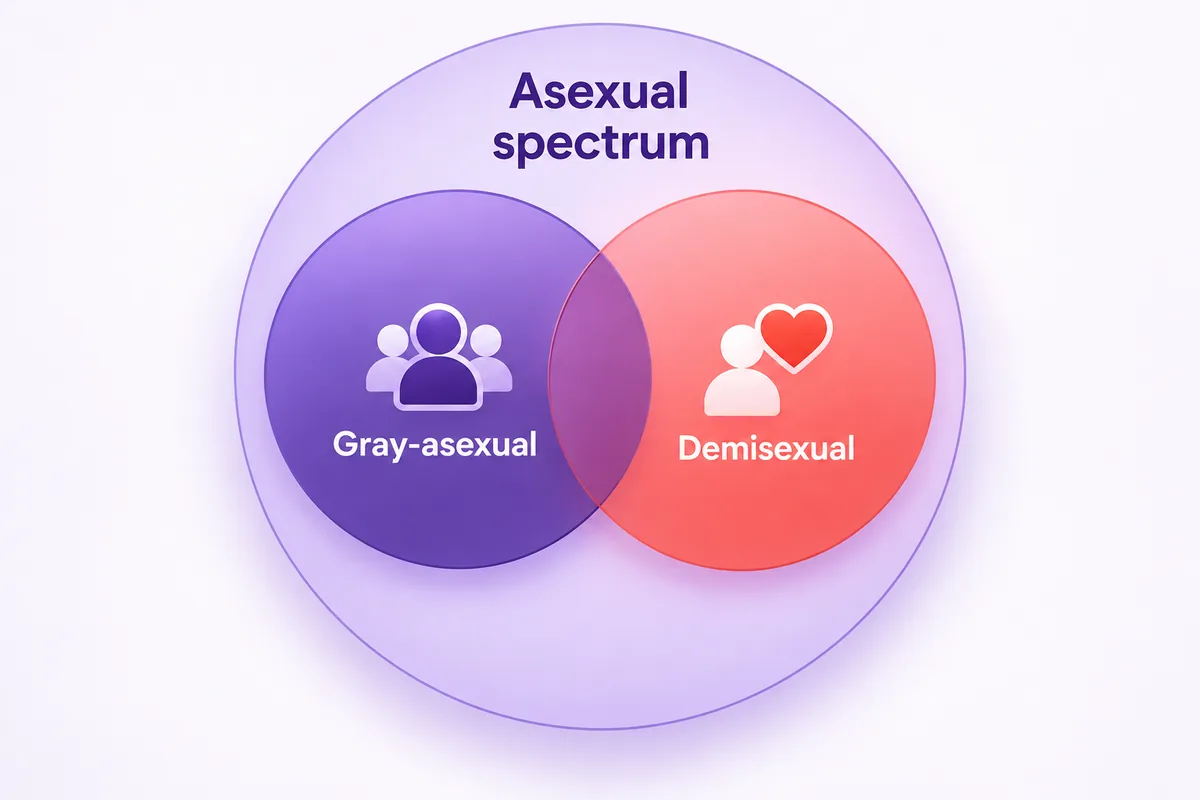
The asexual spectrum and the ace umbrella
The Trevor Project describes asexuality as an umbrella term that exists on a spectrum. HRC says asexual people may experience no, little or conditional sexual attraction, and it lists demisexual as part of that spectrum. AVEN defines the asexual umbrella as asexuality plus similar identities, such as demisexuality and graysexuality, that are closely connected in a broader community.
People who are demisexual are often linked to that community because their experiences resemble those of asexual people, AVEN says. One more idea helps here. Under the split-attraction model, HRC explains, sexual attraction and romantic attraction are separate feelings that may or may not align.
Demisexual and gray-asexual
Gray-asexuality is the middle ground. HRC says gray asexual people may rarely experience sexual attraction, or only under certain circumstances. The Trevor Project describes “Grey-A” as people who identify somewhere between sexual and asexual.
The label is often included in or paired with the graysexual category, AVEN says. Its reasoning is that demisexual people may feel essentially asexual when they have no bond with anyone, and the bond typically takes a long time to establish. WebMD adds that graysexuality is a less specific term, that demisexuality can be a type of it, and that a person can be both.
Not everyone agrees on the fit. Healthline notes that some people argue demisexuality does not belong under the asexual umbrella. Their reason is that it names only the circumstances for attraction and says nothing about how often or how strongly it occurs. Take someone who feels strong attraction to nearly all close friends and partners, but not to acquaintances. That person might call themselves demisexual and not asexual at all.
Whether graysexual people count as asexual is a semantic debate, in AVEN’s words. It adds that most of the asexual community, AVEN included, has welcomed gray people since the beginning. The practical upshot comes from Healthline: your labels are yours to choose, and you may use more than one.
Demisexual, gray-asexual, asexual and sapiosexual compared
The table lines up four labels that people often mix up.
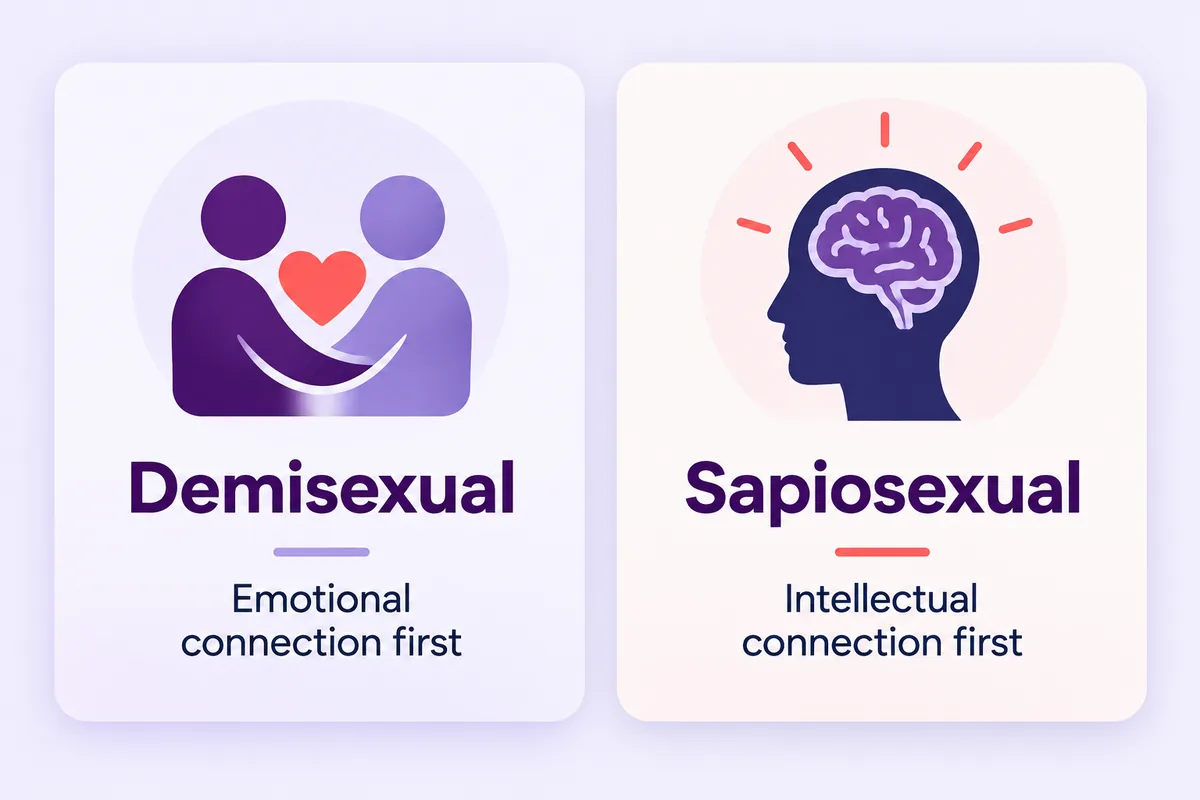
| Label | What it means | When sexual attraction appears | Source |
|---|---|---|---|
| Demisexual | Sexual attraction only with a close emotional bond | After a bond has formed, though a bond does not guarantee it | HRC, Healthline |
| Gray-asexual | Sits somewhere between sexual and asexual, and the term is less specific | Rarely, or only under certain circumstances | HRC, Trevor Project, WebMD |
| Asexual | A complete or partial lack of sexual attraction | Little, conditional or none | HRC |
| Sapiosexual | Needs an intellectual connection first | After that intellectual connection forms | WebMD |
Researchers have also compared the first three groups. Copulsky and Hammack analysed Ace Community Survey responses from 9,476 asexual, 1,698 graysexual and 1,442 demisexual people. Asexual respondents were the least likely to be in a relationship or to feel romantic attraction. Demisexual respondents were the most likely to identify as demiromantic.
On desire, asexual respondents scored lowest for sex drive, willingness to engage in sex and masturbation frequency. Graysexual respondents scored lower than demisexual respondents on the first two. An Italian study of 1,072 volunteers found a similar order. Demisexual participants scored higher than asexual participants on sexual desire in every area except negative feelings about desire.
These are group patterns from volunteers who joined surveys, so they do not predict any one person.
What demisexuality is not
Not the same as waiting for a bond
Many people want to know someone well before sex. AVEN says it is common to choose not to have sex until certain criteria are met, and it separates that choice from demisexuality. The BBC explains the gap this way. For allosexual people, waiting for a deep connection is more of a preference than a requirement for developing sexual desire.
For a demisexual person, the BBC says, the experience is closer to being asexual until the connection forms. Healthline adds that some demisexual people choose to wait before sex, but that choice is separate from their orientation.
The reverse also holds. Having sex only with people you have known for a long time does not necessarily make you demisexual, WebMD says.
Not the same as being picky or sapiosexual
The Asexuality Archive says demisexuality is about attraction, not action. It does not mean people are picky or saving themselves for the right person. It describes the experience as having no sexual feelings to repress, because attraction has not appeared.
Sapiosexual is a different label. WebMD says sapiosexual people must first feel an intellectual connection, while demisexual people must first feel an emotional one. A person can be both at once.
Demiromantic, demisexual and aromantic
The word demisexual describes sexual attraction. Demiromantic works the same way for romantic attraction. WebMD says demiromantic people must feel a strong emotional connection before they feel romantic attraction. Most people who identify as demisexual also identify as demiromantic, but you can be one without the other. Survey data point the same way, though only comparatively: demisexual respondents were more likely to identify as demiromantic than the other groups surveyed.
Aromantic is a separate label again. The Asexuality Archive says demisexual people can be aromantic and feel no romantic attraction to anyone.
Gender and orientation labels can combine with demisexual too. Healthline says demisexual describes the relationship to the people you are attracted to, so it can sit alongside homosexual, bisexual, pansexual or heterosexual. The Trevor Project notes that people commonly put hetero-, homo-, bi- or pan- in front of “romantic” to show who they feel romantic attraction toward.
Signs, experiences and why there is no test
Experiences people describe
There are no telltale signs of being demisexual, WebMD says. Any of the experiences can happen to people who are not demisexual, and demisexual people do not have all of them.
With that caveat, sources do describe some common patterns. Healthline lists feelings such as seldom feeling sexually attracted to strangers or acquaintances. It also lists having little interest in sex with someone you do not know well, even if they are beautiful or pleasant.
A few more come from WebMD. Some people find flirting pointless next to a deeper conversation. Some prefer to date friends. Others miss their own attraction when it appears, because it can feel like the warmth of friendship.
Questions that help you reflect
Healthline suggests asking yourself who you feel sexually attracted to, how often, how intensely, and whether you ever feel it toward strangers or acquaintances. It adds that there are no right or wrong answers.
ELLE UK quotes sex and relationship therapist Shadeen Francis. She suggests asking whether you felt attracted at the beginning or only later, and how well you need to know someone before you feel interested.
The final call is yours, since only you can choose your labels, as WebMD puts it. The Trevor Project agrees that nothing is set in stone and that you do not have to adopt a label until you are ready.
Dating, relationships and communication
Pace and meeting people
Time is the main ingredient. WebMD says dating a demisexual person takes time to build a strong emotional connection. It suggests meeting new people and making friends in a low-pressure, non-romantic setting. Online dating can also help, since people can talk before they meet.
Healthline stresses that every demisexual person is different. Some feel their bond with a partner is not yet close enough for attraction. Some choose to wait until it is, and some opt out of sex altogether. Some might have sex with a partner without feeling sexually attracted to them.
Talking with a partner
Demisexual and non-demisexual people can date and have successful relationships, which need communication and compatibility, according to WebMD. It suggests telling a date early that you are looking for a strong emotional bond before you think about sex.
Boundaries matter too. WebMD advises being clear about what you want, and it says partners should respect the limits and the pace you set.
A bond does not promise attraction, so honesty about that uncertainty can spare both people confusion. Talkspace says a licensed therapist can help people understand their attraction and improve communication in relationships.
Misconceptions, disorder and how common it is
Isn’t everyone like that?
One of the most common misconceptions is that everyone is like this. A podcast host quoted by the BBC says people often respond to the word by asking exactly that. The answer depends on the difference between a choice and a capacity. Healthline says wanting sex only after getting to know someone is common, but it does not mean a person is demisexual.
The Asexuality Archive adds a frequency point. It says most people feel sexual attraction fairly frequently, including toward people they barely know, while demisexual people may have only one person who has ever caught their eye.
Is it a phase, a trauma response or a disorder?
HRC reports that asexual people are often told their identity is a phase or that they have not met the right person yet. Talkspace describes demisexuality as a consistent pattern of attraction, not a phase. Labels can still shift for some people. Healthline says sexuality can be fluid and that fluctuating between orientations is fine.
On trauma, Talkspace says life experiences can shape how people relate to intimacy, but demisexuality itself is not a trauma response. That is one company’s view, and its page comes from an online therapy provider.
None of the sources here describe demisexuality as a disorder. Healthline and WebMD both call it a sexual orientation. AVEN hopes for wider understanding of asexuality as an orientation rather than a dysfunction.
Most formal research is on asexuality in general. Brotto and Yule reviewed the evidence and found it was not sufficient to classify asexuality as a psychiatric condition or a disorder of sexual desire. They concluded it likely meets the conditions for a sexual orientation. Scientific American reports that in 2013 the DSM-5 added a line to two desire disorders saying someone who identifies as asexual should not be given the diagnosis.
The same article makes a fair point. Sexual desire can dip for reasons such as hormone changes or mental health, and a person with significant distress about that may benefit from diagnosis and treatment.
How common is it?
No reliable figure exists. ELLE UK says the exact number of demisexual people in the UK is unknown. HRC says the same about asexual people in the United States. AVEN describes demisexual people as a small minority, but gives no measured proportion.
The best-known survey figure is about asexuality. Bogaert analysed a national sample of more than 18,000 British residents, and about 1% said they were asexual. That study did not measure demisexuality.
Research on demisexuality is thin. The authors of an Italian study say demisexual and gray-asexual identities have never been subjected to research, except for a few exceptions. A review of 28 studies from 2020 to 2022 called for more work on demisexual and graysexual people.
One number does circulate. In the Ace Community Survey of 14,694 respondents, 8.8% identified as demisexual. That figure describes people who joined an ace community survey, so it says nothing about the general population.
Coming out, community and support
Coming out and explaining it
Coming out is optional. Healthline says you do not have to come out unless you feel comfortable, and WebMD calls it a personal decision. Mental Health America, writing about asexual people, advises that people choose when and whether to tell the people they date.
If you do share, Healthline offers some ideas. You can pass along articles and videos, say how you would like to be supported, and tell people whether it is fine to share the news. It also reminds readers that loved ones do not have to understand demisexuality completely to support you.
Community and when a therapist can help
The world’s largest online asexual community is hosted by AVEN, which also runs a forum for gray-area discussions. Healthline points readers to the AVEN forum, a demisexuality subreddit and local LGBTQIA+ groups. Mental Health America suggests community events or online groups. It recommends LGBTQ-competent doctors and therapists, because many providers are still ill-informed.
None of these sources frame therapy as a treatment for demisexuality. Talkspace describes a therapist as someone who can help you explore what fits your experience. Scientific American adds that someone with significant distress about a dip in desire may benefit from diagnosis and treatment.
Frequently asked questions
What is a demisexual man?
The label is not tied to gender. Healthline says the label describes your relationship to the people you are attracted to, and WebMD says a demisexual person can have any gender identity. A demisexual man is simply a man who feels sexual attraction only after an emotional bond forms.
Can demisexual people fall in love?
Yes, many can. Healthline says demisexual people can feel romantic attraction, though some do not want a romantic relationship at all. The Asexuality Archive says demisexual people come in all romantic orientations, including aromantic.
Is demisexual the same as sapiosexual?
No. WebMD says demisexual people need an emotional connection before sexual attraction, while sapiosexual people need an intellectual one. The two can overlap, and a person can be both.
Is demisexuality part of LGBTQ+?
Sources place it on the asexual spectrum. HRC, an LGBTQ advocacy group, includes demisexual in its explainer on the asexual community, which is one reason it is often discussed within LGBTQ+ spaces. No source here states a single rule for membership. WebMD notes that demisexual people are not necessarily LGBTQ and can be straight. Whether you feel a place in that community is your choice.
Can demisexuality change over time?
It can for some people. Healthline says sexuality can be fluid and that it is fine to fluctuate between orientations. The Trevor Project says feelings may or may not change over time, and that nothing is set in stone.
Key takeaways
Demisexuality describes sexual attraction that shows up only after an emotional bond forms. It differs from choosing to wait, because the BBC and Healthline both place the difference in attraction, not in behavior. Most sources list it on the asexual spectrum next to graysexuality. Some people disagree that it fits there.
There is no test, so reflection and your own words matter most. The research base is small, and population figures are unknown. If the label fits and helps, it is yours to use. Nothing is set in stone, and feelings may or may not change over time.
This article offers general educational information, not medical advice.
Related reading
Sources
- General FAQ - The Asexual Visibility and Education Network (AVEN)
- The Gray Area - The Asexual Visibility and Education Network (AVEN)
- Understanding the Asexual Community - Human Rights Campaign
- Why demisexuality is as real as any sexual orientation - BBC Worklife
- Demisexuality: What Does It Mean? - Healthline (medically reviewed by E. Mimi Arquilla, DO)
- Under the Ace Umbrella: Demisexuality and Gray-asexuality - Asexuality Archive (educational site)
- What is Demisexuality? Meaning, Signs, and How It Shapes Attraction - Talkspace (therapist-reviewed)
- How to Know If You’re Demisexual: Meaning, Signs, History - WebMD (medically reviewed by Jabeen Begum, MD)
- Understanding Asexuality: FAQs & Supportive Resources - The Trevor Project
- Asexuality, Graysexuality, and Demisexuality: Distinctions in Desire, Behavior, and Identity - Journal of Sex Research (Copulsky & Hammack, 2023), via PubMed
- Deepening Sexual Desire and Erotic Fantasies Research in the ACE Spectrum - Archives of Sexual Behavior (Nimbi et al., 2024), via PubMed Central
- Demisexuality - Meaning and How to Tell If You’re Demisexual - ELLE UK
- Asexuality: Sexual Orientation, Paraphilia, Sexual Dysfunction, or None of the Above? - Archives of Sexual Behavior (Brotto & Yule, 2017), via PubMed
- Asexuality Is Finally Breaking Free from Medical Stigma - Scientific American
- Asexuality: prevalence and associated factors in a national probability sample - Journal of Sex Research (Bogaert, 2004), via PubMed
- Beyond sex: A review of recent literature on asexuality - Current Opinion in Psychology (Hille, 2023), via PubMed
- Asexuality and Mental Health - Mental Health America