What Is Impact Play? Caning, Control Play, Subspace, CBT and SPH Explained
What is impact play? Plain meanings of caning, control play, subspace, CBT and SPH, plus body areas to avoid, injury signs, sub-drop and aftercare.
General education, not medical advice. If something here worries you, talk with a clinician.
Table of Contents
Impact play is a BDSM practice where one consenting adult strikes another, by hand or with a tool, for sensation and erotic release. It can be as light as a playful swat or far more intense, and what keeps it play is consent, a clear plan, and care afterward.
You may have run into impact play next to other terms: caning, control play, subspace, CBT, and SPH. This guide explains what each one means in plain language, then spends most of its time on safety, because that is the part the slick videos leave out. You will find the body areas to avoid, the injury signs that need a doctor, and the genital risks of CBT stated plainly. You will also learn what subspace and sub-drop are, and why aftercare matters for both partners.
What impact play means
A plain definition
At its simplest, impact play means striking a willing partner to create pleasure for both people. The hit can come from a hand or from an object such as a paddle, flogger, crop, or cane. Spanking is the version most people know, but the range also includes slapping and, at the far end, impact to the genitals.
This kind of play sits under the wider BDSM umbrella, which stands for bondage, discipline or domination, sadism or submission, and masochism. People mix and match these elements, so impact play can be part of a larger power dynamic or simply a sensation someone likes. If you are still sorting out where kink starts and ends, our guide to what is considered kinky sex covers the wider map.
Thuddy and stingy sensations
Those who practice it often sort sensations into two kinds. A wide tool landing over a large area feels thuddy, a deep and heavy pressure. A narrow tool such as a cane, crop, belt, or whip feels stingy, a sharp sensation on the surface of the skin.
That difference matters for safety as well as feel. Narrow tools concentrate force on a small strip of skin, which is why canes and crops are more likely to leave welts and bruises. In other words, a tool’s shape changes the risk long before anyone decides how hard to swing it.
Why some people enjoy it
There is no single reason. For some, the rush is the point, since intense sensation can release adrenaline and endorphins, the body’s own pain-dulling, mood-lifting chemicals. Others describe a sense of physical release, as if stress drains out during a scene.
For many people, the appeal is less about the sensation and more about trust. Handing control to a partner can bring on a calm, floaty headspace often called subspace. Those feelings only work when both people chose them freely, which is why every boundary is talked through and agreed before the scene starts.
Caning, control play, CBT and SPH: the terms side by side
These terms often turn up together in profiles, forums, and porn titles, but they describe quite different things. The table puts them side by side so you can see how they differ.
| Term | What it means | Main concern |
|---|---|---|
| Impact play | Striking a consenting partner by hand or with a tool for sensation | Where the blows land and how hard |
| Caning | Impact with a thin cane, usually wooden | Welts, bruises, and broken skin |
| Control play | Power exchange, where one partner follows rules or orders set by the other | Pressure that slips past what was agreed |
| Subspace | A trancelike, floaty state some submissives reach during intense play | The person may not be able to judge limits or consent |
| CBT | Short for cock and ball torture, meaning consensual pain or pressure to the penis or testicles, including a hit to the crotch | Testicular injury that can need emergency surgery |
| SPH | Short for small penis humiliation, meaning consensual verbal teasing about penis size | Words that hurt after the scene ends |
Why caning is not a beginner activity
A cane is a thin rod, and caning is impact with one. Because the force lands on a narrow line, a cane gives one of the sharpest sensations in impact play, and it can leave clear welts and bruises. Beginner guides put canes and crops on the list of tools to avoid at first, because using them safely takes real skill.
The marks are also a health issue. If the skin breaks during play, it needs cleaning and watching for infection, as covered in the injury section below.
How rules replace hitting in control play
Control play is a casual name for power exchange, in which one partner agrees to follow the will of the other within limits they both set. The rules can cover sex, but many do not, and couples may agree on how they address each other, on chores, on schedules, or on what to wear. No hitting is needed, and it does not have to involve intercourse at all.
The same ground rules apply as with physical play. Consent has to be informed and clear, and it can be withdrawn at any time for any reason. A rule that one partner can no longer question has stopped being part of a game.
Consent, negotiation and safewords come first
Every safe impact scene starts with a conversation, before anyone lifts a hand. Partners agree on what will happen, what is off limits, and how either one can stop it.
Talking before anything happens
Negotiation covers more than a simple yes or no. Partners talk through hard limits, which are things one person will never do, and soft limits, which they might try with care. They also agree on safewords and on what aftercare will look like. Health belongs in this talk too, including old injuries, medicines, and conditions that make a person bruise or bleed easily.
Many people who play use a framework called RACK, short for Risk-Aware Consensual Kink. It accepts that no BDSM activity is free of risk, so the goal is for everyone to understand the risks before they agree.
Sober minds matter here. Consent has to be given freely, without pressure and without drugs or alcohol clouding the choice. Planned Parenthood notes that people who are drunk or high cannot consent at all. Alcohol also dulls pain, so a person may not notice an injury until much later.
Safewords and checking in
The most common system is the traffic light, where green means keep going, yellow means slow down and check in, and red means stop now. Some people use amber in place of yellow.
Words are not always available, because a gag, a hood, or simple overwhelm can make speech hard. Partners can agree on a signal for that moment, like tapping a surface or dropping a held object.
Consent also keeps running during the scene, so a yes at the start is not a yes for the whole night. Anyone can change their mind at any time, even after saying yes earlier. The person giving the impact should check in often, even if no safeword has come up.
Body areas to avoid in impact play
The short answer is to keep impact away from the kidneys, spine, tailbone, joints, neck, head, and belly. Those areas have organs, nerves, or bones close to the surface, with little padding to absorb force.
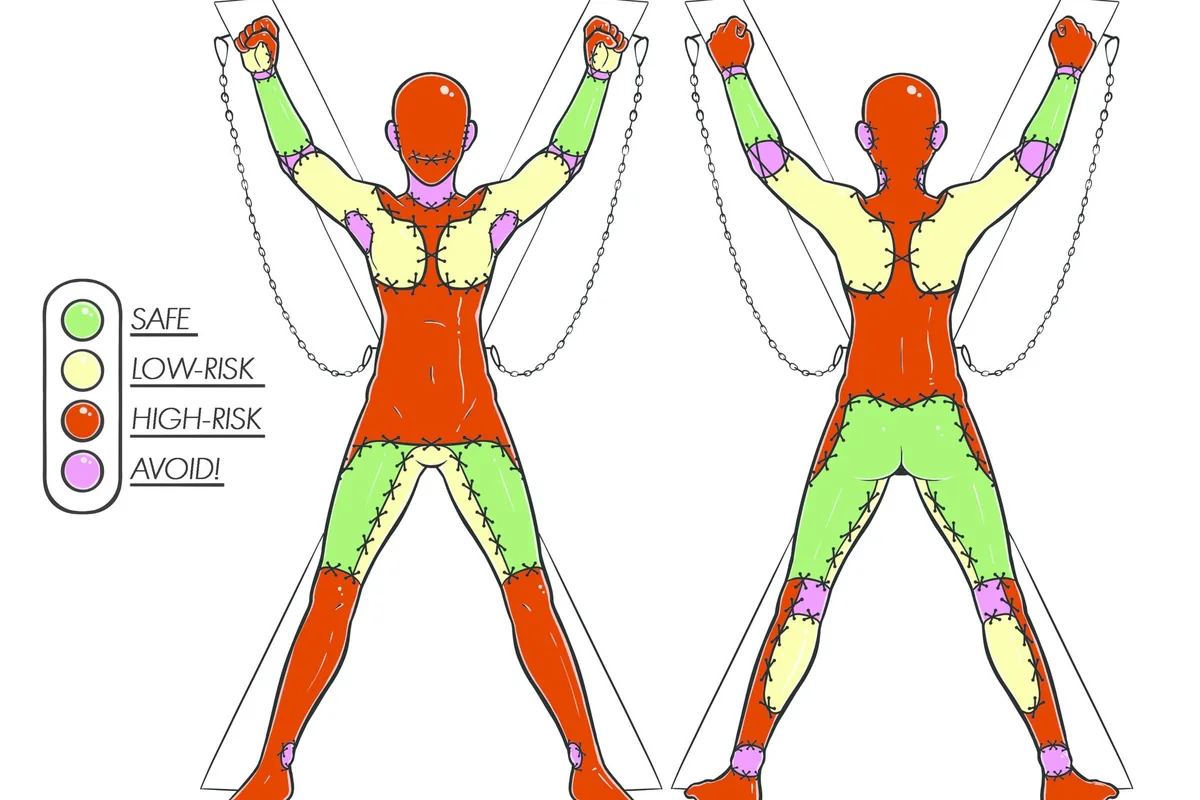
High-risk areas
Most guides stress the kidneys first. They sit high in the back of the belly, with their tops tucked under the lower ribs and their lower ends below the 12th rib. That puts them in the flank, the soft strip just under the ribs on each side of the spine. A direct blow to the flank is a known cause of kidney injury. A guide from the magazine them lists the kidneys among the no-go zones along with the head, neck, spine, and stomach.
The spine comes next. The vertebrae protect the spinal cord, but they do not handle direct blows well. The tailbone at its base is delicate and bruises badly, while the hips are bony and carry nerves that can be hurt.
The neck holds tendons, glands, arteries, and the airway, so it is a no-impact area. The face and head belong on the same list. Face slaps can look easy, yet they can seriously harm someone when done wrong.
Two more areas round out the list. Joints such as knees, elbows, and ankles have bone close to the skin with little cushioning. The abdomen holds vital organs with no bony shield in front of them.
Why padding matters
The lower-risk areas share one trait: muscle and fat between the skin and anything fragile. The buttocks are the usual choice, since they are padded and sit away from major organs. The backs of the upper thighs can also work, though they tend to be more sensitive. The same them guide adds the shoulders, the chest, and the upper back, as long as the spine is left out. On the chest, that means the fleshy upper part only. The breastbone and ribs over the heart have little padding, and a sharp blow there carries a rare but serious risk to the heart.
Lower risk still means some risk. Even well-padded areas bruise, and a narrow tool can raise welts there too. The safer zones reduce the chance of deep injury, but they do not make every level of force safe.
Health conditions that change the picture
People differ in how easily they bleed and bruise. Blood thinners and aspirin make bruising more likely, according to Cleveland Clinic. Cleveland Clinic also lists bleeding disorders such as hemophilia and von Willebrand disease among the conditions that cause easy bruising. Kink safety guides say impact play may not be safe at all for people in these groups. They add bone-thinning conditions such as severe osteoporosis to the list, which is a question to put to a doctor.
Any injury in a target area should be fully healed before play. If you have a health condition and are unsure, a doctor can tell you what is safe for your body. You do not have to share details of the scene to ask about bruising or blood thinners.
Injury signs and when to get medical care
Redness and ordinary bruises are common after impact play and usually heal on their own. Dark or bloody urine, a growing lump, numbness, or pain that keeps getting worse are signs that something deeper needs checking.
Marks that usually settle on their own
A bruise forms when small blood vessels under the skin break and blood pools there. It may start red or purple and then fade to green, yellow, or brown as it heals. Cleveland Clinic says most bruises fade within two weeks without treatment. Beginner guides to impact play give a similar range for marks, about a week or two.
Simple first aid helps the skin recover. Rest the area and raise it if you can. Use an ice pack wrapped in a towel for up to 15 minutes at a time during the first 24 to 48 hours. After two days, gentle heat can take over from the ice. Keeping a first aid kit nearby during play is a sensible habit.
Broken skin needs a bit more care. Clean it well, cover it, and watch it for signs of infection over the next few days.
Warning signs that need a doctor
Some symptoms point to damage below the skin. Cleveland Clinic advises calling a healthcare provider for any of these:
- A bruise that lasts longer than two weeks
- A hard lump in the bruised area, which can be a pooled blood collection called a hematoma
- Pain that lingers for days after the injury
- Blood in your pee
After a blow to the flank or lower back, blood in the urine is an emergency sign rather than something to book an appointment for. A direct blow to the flank can injure a kidney, and doctors check for flank or belly pain and blood in the urine first. Blood in urine may look pink, red, or dark brown.
Go to an emergency department after such a blow for any of these:
- Pink, red, or brown urine, or being unable to pee
- Back or side pain that keeps getting worse
- Feeling dizzy or faint, or a racing pulse
A hurt kidney can bleed inside the body where no bruise shows. Even without an injury, the NHS says any blood in the urine needs an urgent check, even a small amount.
Heavy, repeated impact can also damage muscle. Rhabdomyolysis is a rare breakdown of muscle that can follow crushing injury or other trauma, and the released muscle contents can harm the kidneys. Its signs include sore, weak, or swollen muscles and dark pee that looks brown, red, or tea-colored. These usually appear one to three days after the injury, and they need a doctor right away.
Numbness, tingling, or severe pain that does not fade soon after stopping also needs medical attention. Telling a clinician honestly how the injury happened helps them check the right things.
CBT (cock and ball torture): the injury risks, stated plainly
CBT is short for cock and ball torture, a blunt name for any consensual practice that puts pain or pressure on the penis or testicles. It sits at the high-risk end of BDSM, because the testicles are easy to damage and some injuries can cost a testicle within hours.
What the term covers
The label is broad, covering squeezing, pressure, and restraint, and impact to the crotch is one form that falls under impact play. Some people enjoy the intensity itself, while others are drawn to the power exchange or the humiliation that surrounds it.
The name sounds extreme, and some of the risks are, but that does not make curiosity about it rare or shameful. It does mean the injury risks deserve a plain look before anyone agrees to it.
Why the genitals are easy to injure
The testicles hang outside the body in the scrotum, and unlike most organs they have no muscle or bone around them for protection. A urologist at Greater Boston Urology puts it simply: they are not built for contact sports, let alone hard hits.
Several kinds of serious injury can follow a hard blow. A rupture is a tear in the tough covering of the testicle, called the tunica albuginea, so tissue pushes out through it. A contusion means bleeding and bruising inside the testicle. An injury can also twist the spermatic cord, the bundle that carries blood to the testicle. That twist, called torsion, cuts off the blood supply and can permanently damage the testicle.
Even a hit that seems minor can cause internal damage, so small injuries are worth taking seriously. After a rupture or torsion, a testicle can also shrink over time, a change called atrophy.
The penis has its own emergencies. A penile fracture is a tear in the lining of the erection chambers, usually from the erect penis being bent hard or struck. People describe pain, a popping sound, a sudden loss of erection, and fast bruising and swelling. It is a urologic emergency, and leaving it unrepaired is linked to lasting curvature and erection problems.
Squeezing and restraint carry a separate risk. A ring, cord, or other device that will not come off can trap swelling and cut off blood flow. So can an erection that will not go down for hours, called priapism. Both need emergency care, not home attempts to cut or force a device free.
Signs that mean go to an emergency room
Speed matters more here than almost anywhere else in this guide. With torsion, MedlinePlus says surgery within 6 hours usually saves most of the testicle, and the chance of losing it rises after that. A ruptured testicle explored as an emergency is saved in 80% of cases.
Go to an emergency department, or call emergency services, for any of these:
- Sudden, severe pain in a testicle
- Testicle pain with nausea, vomiting, or belly pain
- Pain that lasts more than an hour or continues while resting
- Swelling that keeps growing, or bruising that spreads across the scrotum, groin, or thighs
- A “pop” felt at the moment of impact, which can mean a rupture
- One testicle sitting higher than the other with pain
- Blood in the urine or trouble peeing
- A pop, a sudden loss of erection, and fast swelling of the penis
- A ring or device that will not come off, or a penis that turns dark, cold, or numb
Do not drive yourself, so ask someone to take you or call an ambulance. MedlinePlus advises going to an emergency room rather than urgent care, in case surgery is needed right away. Doctors usually check testicular injuries with an ultrasound. Embarrassment is a poor reason to wait, because emergency staff see genital injuries of every kind and the clock on a testicle keeps running.
SPH as consensual verbal play
SPH stands for small penis humiliation, a form of consensual verbal play about penis size. One partner teases the other because the person on the receiving end has asked for it, and no impact or physical contact is involved.
What SPH is
SPH belongs to a wider kink called erotic humiliation. Sex educators quoted by Mashable explain that the play can draw on a person’s own insecurities. Someone who worries about penis size may find that the shame turns into arousal when it is played with on purpose. The receiving partner is the one who sets this up, and they choose the words, the tone, and the limits.
Keeping verbal play from doing real harm
Words can leave marks too, just not visible ones, so the safeguards look much like those for physical play. Consent must be enthusiastic and revocable, the language should be agreed in advance, and aftercare should close the scene. Mashable likewise calls enthusiastic consent a must.
A guide to humiliation play from the dating app 3Fun offers one useful test. If the words would still wound after the scene ends and aftercare is over, they do not belong in play. The same guide lists red flags: consent given under pressure, aftercare that keeps getting skipped, and teasing that targets real insecurities the partner never agreed to.
A later check-in helps too, and talking a day or two after, about what landed well and what still stings, keeps scene talk separate from real life. If SPH starts to feed real body-image distress that lingers between scenes, it is worth pausing, and some people find it useful to talk that through with a kink-aware therapist.
Subspace, sub-drop and why aftercare matters
Subspace is the floaty, altered state some people reach during intense play, and sub-drop is the low that can follow hours or days later. Aftercare is how partners soften that landing and check that nobody got hurt.

What subspace is
Those in subspace often describe feeling light, floaty, or like mush, and some say it is hard to put words together. It may come from the rush of adrenaline and endorphins during a scene. Healthline cites a small 2017 study that linked subspace to an altered state of consciousness, similar in some ways to hypnosis. Research on kink is still limited, so it makes sense to treat any single explanation as a theory.
The safety point is plain. A person in subspace cannot give meaningful consent, and their judgment can be affected the way it is when drunk or high. They may ask for more than they would agree to with a clear head, and they may find it hard to say a safeword. That is why the scene should never be renegotiated while someone is in that state. It is also why the active partner keeps watching for non-verbal cues rather than waiting to hear a word.
What sub-drop feels like
Sub-drop is a crash after the high, and it often shows up within 24 hours, but it can arrive two or three days later. Common signs include sadness, tearfulness, brain fog, tiredness, anxiety, and feeling cold. Some people also feel a wave of shame about a scene they fully wanted.
Dominant partners can drop too. Uncommon Bonds, a New Zealand kink community resource, says drop can affect either partner, though tops report it less often. For the dominant partner, it can show up as anxiety and self-doubt about whether they did things right.
Drop usually lifts within a few days. If low mood lasts more than a week, or thoughts of self-harm appear, it is time to talk to a professional. A kink-aware therapist is the better choice, since they will not mistake the play itself for the problem.
What aftercare involves
Aftercare is any care partners give each other once a scene ends, to help both people come back to their usual selves. It has a physical side and an emotional side.
On the physical side, check for marks, treat any broken skin, and offer water and a blanket, since many people underestimate how dehydrating BDSM play can be. A shower, a bath, food, or simply lying close can help the body settle.
The emotional side matters just as much. It might mean cuddling, talking about the best parts of the scene, or a quiet text the next day if you live apart. A planned check-in a day or two later can catch drop early. Aftercare is not only for kink, and our guide to aftercare after sex covers ways to reconnect after any kind of intimacy.
Frequently asked questions
What happens when someone goes into subspace?
They often become quiet, relaxed, and a little dazed. Many describe feeling floaty or slightly drunk, and some find it hard to put words together. Because judgment is affected, a person in subspace cannot meaningfully consent to anything new. The active partner should slow down, watch closely, and keep the scene inside what was agreed beforehand.
What does sub drop feel like?
Sub drop often feels like a sudden emotional hangover, with people reporting sadness, crying spells, fatigue, brain fog, anxiety, or feeling cold. It usually appears within 24 to 72 hours of an intense scene and resembles a short bout of low mood. Rest, food, water, and contact with a caring partner or friend tend to help, but low mood that lasts beyond a week needs professional support.
Is bruising normal after impact play?
Some bruising is common, especially while people are still learning. Most bruises fade within two weeks. See a doctor for bruising that lasts longer than that, a hard lump under the bruise, pain that lingers for days, or blood in your urine. Easy bruising can also signal that someone is on a medicine or has a condition that makes impact play unsafe for them.
Is impact play the same as abuse?
No, and the difference comes down to consent and control. Consensual impact play is wanted by both people, negotiated ahead of time, and can be stopped by either partner at any moment. Abuse is used as punishment, and the person on the receiving end cannot stop it. As one therapy practice puts it, dominance without consent is abuse.
What is considered a kink example?
Spanking and other impact play rank among the best-known kinks. Others include bondage, power exchange, role play, and verbal humiliation such as SPH. Put simply, a kink is a sexual interest that falls outside what a person sees as conventional. For a fuller list and how people define the line, see what is considered kinky sex.
The bottom line
Impact play, caning, control play, CBT, and SPH all sit under the BDSM umbrella, but they carry very different risks. Impact play and caning are about sensation, control play is about rules, and SPH is about words, while CBT is the riskiest of the group for the body.
What ties them together is the safety frame. Talk first, agree on limits, and use a safeword that both people respect. Keep impact away from the kidneys, spine, neck, head, joints, and belly. Get emergency care for genital pain that is sudden, severe, or still there after an hour, rather than trying to sleep it off.
Then make room for aftercare. Subspace and sub-drop are normal parts of intense play for many people. Caring for each other afterward is what lets both partners feel good about a scene the next day.
Related reading
- BDSM Roles Explained: Dom, Sub, Switch, Brat, Bottom, and Rigger
- What Is Considered Kinky Sex? Kink, BDSM and S&M Explained
- What Is Rough Sex? Meanings, Consent, and Real Safety Risks
- Aftercare After Sex: What It Is and How to Do It Well
Sources
- Impact Play 101: Everything You Need to Know About Erotic Hitting - them
- Impact Play 101: Everything You Need to Know - Bondesque
- A BDSM Beginner’s Guide to Subspace - Healthline
- Power Exchange in Relationships: A Crash Course - MyTherapyNYC
- Testicular torsion - MedlinePlus (U.S. National Library of Medicine)
- Why we enjoy being humiliated during sex - Mashable
- What Is a Humiliation Kink? A Complete Guide - 3Fun
- Safe Impact Play for Beginners: How to Start With Your Partner - Strawberry Patch
- What Is Sexual Consent? - Planned Parenthood
- Renal Trauma: Practice Essentials, Problem, Epidemiology - Medscape
- Bruises (Ecchymosis): Symptoms, Causes, Treatment & Prevention - Cleveland Clinic
- Blood in urine - NHS
- Rhabdomyolysis: Symptoms, Causes & Treatments - Cleveland Clinic
- My Balls Took a Hit - Should I Be Worried? - Greater Boston Urology
- Houston Testicular Trauma - Larry Lipshultz, MD (urology practice)
- Scrotal Trauma: Background, Relevant Anatomy, Etiology - Medscape
- Penile Fracture | Patient Care - Weill Cornell Medicine
- Testicle pain - NHS
- Sub Drop and Dom Drop: What They Are and How to Handle Them - SubTasks
- Drop - Uncommon Bonds (New Zealand)
- Aftercare vs Sub-Drop: Know The Difference - Arcane Advice