What Is Solo Sex? A Guide to Self-Knowledge and Personal Choice
Solo sex means sexual pleasure on your own. Learn how common it is, its health benefits, how it builds self-knowledge, and why doing it is always your choice.

General education, not medical advice. If something here worries you, talk with a clinician.
Table of Contents
Solo sex is any sexual or sensual activity you do on your own, for your own pleasure. Most of the time that means masturbation, but the term covers more than genital touch. It also carries a point of view: time alone with your body counts as sex in its own right, and nobody needs to see it as a backup plan.
This guide explains what solo sex means and how common it is. It covers what health organizations say it can and cannot do for you. Two ideas run through every section. First, solo sex is one of the most direct ways to learn how your own body responds. And whether you do it, how often, and how you feel about it is your decision to make.
What solo sex means
Solo sex and masturbation
Masturbation is touching your own genitals or other sensitive parts of your body for sexual arousal or pleasure. Cleveland Clinic describes it as a common behavior among people of all sexes and ages. People use their hands, their fingers, sex toys, or objects like a pillow.
“Solo sex” usually names the same activity with a different frame. Scarleteen, a sex education nonprofit, uses the two terms side by side. The newer phrase pushes back on the old idea that masturbation is a lesser stand-in for “real” sex with a partner. Calling it sex says your own pleasure is worth time and attention.
Not everyone likes the word. Some people, including some asexual people, feel that “sex” is the wrong label for something they do alone and without attraction to anyone. That preference is fair. You can call it masturbation, self-pleasure, solo sex, or nothing at all.
What counts as solo sex
The short answer is more than most people think. A sex educator quoted by Healthline says any activity that connects you to your romantic, sensual, erotic, or sexual self counts. That can mean touching your nipples, chest, thighs, or neck as well as your genitals. It can include fantasy, erotic stories, toys, or trying something alone before you would ever share it with a partner.
Orgasm is optional. Masturbation may or may not end with one. A session that feels good and stops there is still solo sex. So is one that is mostly slow, curious touch with no goal at all.
How common is solo sex?
What surveys find
Across sexes and ages, masturbation is a common behavior. Britain’s national surveys of sexual attitudes give one of the clearest pictures, because they sample the general population rather than volunteers. Comparing people aged 16-44 in both rounds, the share who had masturbated in the past month rose between 1999-2001 and 2010-12. For women it went from 37.0% to 40.3%, and for men from 73.4% to 77.5%.
It does not stop with age. Healthline, a consumer health site, reports on an unnamed study of older adults. In it, 27% to 40% of women and 41% to 65% of men had masturbated in the past month. Treat those ranges as rough, because the study and its exact age groups are not named. The gap between men and women shows up in most surveys. Still, a large share of women of every age report solo sex, and many more may not say so to a researcher.
Normal includes not doing it
Frequency varies widely. Some people masturbate every day or more, some about once a week, and some only now and then. Planned Parenthood adds that some people never masturbate, and that this is fine too. A survey average describes a population, so it cannot tell any one person what they should be doing.
What solo sex can do for your body and mood
Yes, health organizations agree that masturbation is a healthy, normal part of sexuality, with real but modest benefits. Most of the evidence links these benefits to arousal and orgasm in general, whether alone or with a partner. So treat the list below as “can help,” with no promise attached.
Stress, mood, and sleep
Orgasm releases dopamine and oxytocin, hormones linked with pleasure and closeness. Cleveland Clinic notes that they also work against cortisol, the body’s main stress hormone. Planned Parenthood adds endorphins to the list, the chemicals that block pain and help you feel good.
That chemistry is why many people use solo sex to unwind. Planned Parenthood lists better sleep among its benefits, along with better self-esteem and body image. If you often lie awake with a busy mind, it is one low-cost option to try.
Physical effects
Planned Parenthood says masturbation can relieve menstrual cramps and general muscle tension. It also works the muscles of the pelvic floor, the sling of muscle that supports the bladder and bowel. In older people, Cleveland Clinic links it to less vaginal dryness and less pain during sex.
People with a prostate may find one research finding about ejaculation reassuring. A Harvard study followed 29,342 men and counted every ejaculation, including from masturbation. Men who ejaculated 21 or more times a month had a 31% lower prostate cancer risk than men who ejaculated 4 to 7 times. That is an association from an observational study. It does not prove that ejaculating more prevents cancer, and it is no reason to feel pressure about frequency.
A form of sex with no pregnancy risk and very low STI risk
Of all the ways to have sex, this is the safest, since it carries no risk of pregnancy. Getting a sexually transmitted infection from masturbation is rare, and the main exception is a shared toy that was not cleaned. For anyone between partners, waiting on test results, or simply not ready for partnered sex, that matters.
Solo sex as a way to know yourself
Time alone gives you honest feedback from the only person who can actually feel the touch. With no one to please or impress, you can notice what your body really does in response. Over time, that turns into knowledge you can keep using for the rest of your life.
Learning what your body likes
Planned Parenthood frames masturbation as a way to figure out what you like sexually. Where do you want to be touched? How much pressure feels good, and how fast or slow? These sound like simple questions, yet many adults have never had the chance to answer them without someone else in the room.
Scarleteen offers a useful rule here: focus on what feels good to you, not on what you have seen or heard works for someone else. Porn, films, and friends’ stories all suggest a script, and your nerves may not follow it. Trying different kinds of touch, speeds, and positions helps you find out, and so does noticing what you do not enjoy.
A simple way to start is to treat it as exploration rather than a task. Pick a time when you will not be interrupted. Start away from the genitals. Pay attention to which areas respond, and give yourself permission to stop whenever you want.
When orgasm is hard to reach
Many people first learn to have an orgasm at all through masturbation. That makes it a natural starting point for anyone who finds orgasm difficult.
Doctors use the same idea. The Merck Manual, a clinical reference, names directed masturbation as the first-line treatment for female orgasmic disorder. Directed masturbation is a structured series of prescribed exercises, which clinicians use to build up comfort and response gradually. If orgasm has never happened for you, or has stopped happening, a sex therapist or doctor can walk you through it.
Bringing what you learn to a partner
What you learn alone does not have to stay private. Learning to orgasm on your own can make it easier with a partner, because you can tell or show them what feels good. Knowing your own responses also makes it easier to say no to things that do not work for you.
Masturbating while in a relationship is common and does not, on its own, signal a problem. Single people and partnered people both masturbate. Natural Cycles points out that a partner with a higher sex drive may simply masturbate more often. British survey data add some nuance. People who masturbated were more likely to report a mismatch in desire or worry about their sex life. In other words, solo sex can fill a gap, and if that gap bothers you or your partner, it is worth an open conversation.
A personal choice, not a requirement
Healthy does not mean required. The benefits above are things solo sex can offer, and none of them means you have to do it. What you do alone is fully your call, as Scarleteen puts it, because you have no one to negotiate with.
Choosing not to
Some people never masturbate, and that is fine too. Others stop for a while or for good. Healthline notes that some people abstain for personal or religious reasons. The prostate finding above is an observational link, not proof, so it is no reason to masturbate if you would rather not.
Asexual people make the full range of choices too, since some masturbate and some do not. The Asexuality Archive, a community resource, is direct on this point: masturbating has nothing to do with whether you are asexual. The same goes for people with low desire, people on medicine that dulls arousal, and anyone who simply is not interested right now.
Values, faith, and guilt
Guilt is one of the few unwanted effects linked to masturbation. Cleveland Clinic traces it to religious, spiritual, or cultural beliefs. Planned Parenthood notes that many people learned when they were young that masturbating was wrong.
Self-knowledge here means sorting out which beliefs are yours. Ask yourself a few honest questions. Which rules did you choose as an adult? Which ones did you absorb before you could question them? Do you feel at peace with your choice, whatever it is?
A person may decide their faith asks them not to masturbate and feel settled with that. Others realize they are carrying shame they never agreed with. Both are valid outcomes. If guilt or shame is hurting your mood or your relationships, a counselor or sex therapist can help you work through it. A good one will respect your values and will not push you toward any particular answer.
Myths, side effects, and when to get help
Masturbation has no serious side effects, according to Cleveland Clinic. A few minor problems can happen, and a small number of people struggle with control. Here is how to tell a myth from a real concern.
Myths that do not hold up
Old warnings about masturbation still circulate, and none of them is backed by research. It does not make you go blind. It does not grow hair on your palms or anywhere else, and it does not shrink your genitals.
It also does not cause infertility. Frequent ejaculation lowers the number of sperm in semen for a short time, which only matters if you are trying to conceive that week. Masturbating does not mean you will become addicted, either.
Real side effects
The physical ones are mild. Rough or very frequent masturbation can leave skin chafed or tender, and it should heal within a day or two. Lube and a short break help.
Masturbating too often or too aggressively may lead to reduced sexual sensation. Healthline explains that a very tight grip on the penis can make orgasm harder during partnered sex. Changing your technique usually brings sensitivity back.
The emotional side effect, guilt, is covered in the section above, and talking it through with a counselor can ease it.
How much is too much?
There is no number that counts as too much. Planned Parenthood’s test is practical: masturbation is only a problem if it gets in the way of your job, your responsibilities, or your social life. Cleveland Clinic gives the same kind of signs, such as missing work, canceling plans, or forgetting responsibilities.
At the far end, loss of control can reach the level of a diagnosis. The World Health Organization’s ICD-11 lists compulsive sexual behaviour disorder. It describes a persistent failure to control intense sexual urges, over six months or more, that causes marked distress or harm to work, family, or social life. A high sex drive alone does not qualify. Neither does feeling bad about masturbation because it conflicts with your moral beliefs.
If you feel you cannot stop even when you want to, talk to a doctor or a therapist who works with sexual health. That is a routine request for them, and help works.
Keeping solo sex safe and comfortable
The risks are low, and a few simple habits keep them that way.
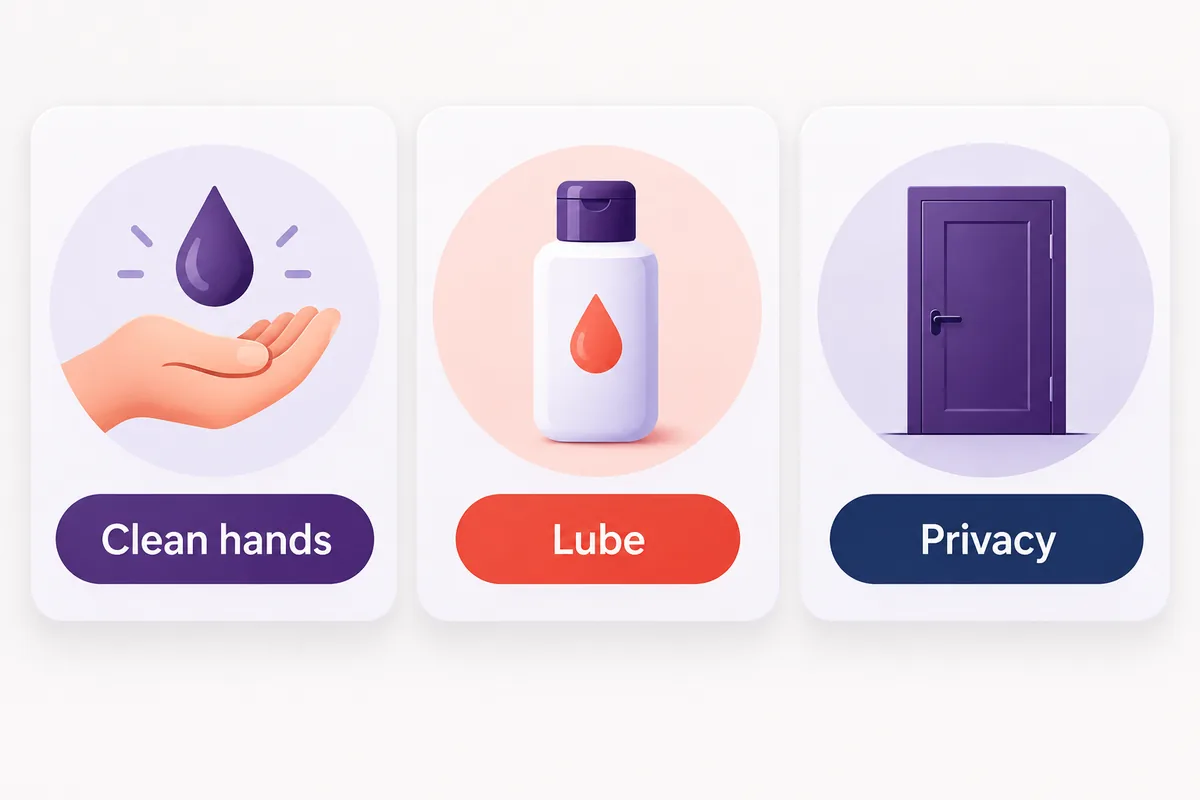
- Wash your hands first. Hands pick up germs during the day, and those germs can cause genital infections.
- Use lube when skin feels dry. Lube cuts friction and helps prevent the chafing described above.
- Clean toys after every use. A toy that is not cleaned can pass on infections, even back to you after an infection has cleared.
- Choose nonporous toys. Porous materials have tiny holes that hold bacteria even after washing, while nonporous toys can be cleaned completely.
- Pick a private place. A space where you will not be interrupted makes it easier to relax and pay attention to your body.
Frequently asked questions
Is self-sex good or bad?
Self-sex is good for most people. Medical groups describe masturbation as normal and healthy, with benefits for stress, sleep, and body knowledge. It only becomes a problem when it crowds out work, relationships, or daily life. Feeling unable to control it is another warning sign. Choosing not to do it is also fine.
What does it mean to be solosexual?
Solosexual is an informal label for someone who prefers masturbation over other kinds of sexual activity. It is a self-description, and no medical or psychological manual treats it as a diagnosis. Even among sex therapists, views differ on what the preference means. One therapist writing in Psychology Today allows that some people may simply be made that way.
How often is it normal to masturbate?
There is no normal number. Some people masturbate more than once a day, some weekly, some rarely, and some never, and all of these are normal. A better question is how it fits your life. If it feels good and does not get in the way of your responsibilities, the frequency is fine for you.
Is it good to release every day?
Daily masturbation is healthy for many people. Planned Parenthood lists every day, or even more often, among normal patterns. For people with a prostate, frequent ejaculation is linked with lower prostate cancer risk. You do not need to release daily, though. Your body clears unused sperm on its own.
What happens if I don’t masturbate?
Nothing harmful happens. The body reabsorbs unused sperm cells by itself, and fluids release on their own when needed, sometimes as a wet dream. Arousal may build for a while and then settle. Not masturbating is a healthy choice if it is the one you want.
The bottom line
Put simply, solo sex is sexual pleasure you give yourself, through touch, toys, fantasy, or whatever connects you to your own body. It is common at every age, it is safe, and it can help with stress, sleep, and orgasm.
Its biggest value may be what it teaches you, because time alone lets you learn what you like, what you do not, and how to ask for it later. That knowledge belongs to you whether you share it with a partner or not.
Whether you make solo sex part of your life is your choice, and so is how often. If guilt, worry, or a sense of lost control gets in the way, a doctor or sex therapist can help you sort it out on your own terms.
Related reading
- What Does the Bible Say About Masturbation?
- How to Choose Lube: Water, Silicone or Oil?
- What Is a Healthy Sex Life? Communication, Satisfaction, Safety and Choice
- What Is Sexual Pleasure?
Sources
- Masturbation: Facts & Benefits - Cleveland Clinic
- Going Solo: The Basics of Masturbation - Scarleteen
- Solo Sex Is for Everyone — Here’s How to Get Started - Healthline
- Masturbation: Facts, benefits & does it reduce stress? - Natural Cycles
- Trends in masturbation prevalence and associated factors: findings from the British national surveys of sexual attitudes and lifestyles - Journal of Sex Research (University of Glasgow repository)
- Masturbation: Health Benefits, Side Effects, Myths, FAQs - Healthline
- Is Masturbation Healthy? - Planned Parenthood
- Ejaculation frequency and prostate cancer - Harvard Health Publishing
- Female Orgasmic Disorder - Merck Manual Professional Edition
- An Asexual’s Guide To … Masturbation - Asexuality Archive
- Compulsive sexual behaviour disorder in the ICD-11 - World Psychiatry (Kraus et al.)
- Sex Toys and STIs: 20 Facts About Risk, Safer Sex, Cleaning, More - Healthline
- Solo- and Autosexuality 101 - The Gay & Lesbian Review
- Solosexuality and Pornosexuality: Learned or Innate? - Psychology Today