What Is Vanilla Sex? The Term, the Preference, and Why It Is Fine
What is vanilla sex? A plain, judgment-free guide to the term, how it compares with kink, how common each preference is, and what to do when partners differ.

General education, not medical advice. If something here worries you, talk with a clinician.
Table of Contents
Vanilla sex is sex that a person or a culture sees as conventional, without kink, fetish, or power play. Think kissing, touching, oral sex, or intercourse done in ways most people would call familiar. The word “vanilla” here simply means plain or standard, the way vanilla is the classic ice cream flavor.
Preferring vanilla sex is a normal preference, and so is preferring something else. The label describes taste. It says nothing about how passionate, skilled, or open-minded someone is.
This guide explains where the term comes from and how it compares with kink. It also covers what research says about sexual preferences, and what to do when partners like different things.
What vanilla sex means
Where the word comes from
Outside the bedroom, “vanilla” already means plain. The American Heritage Dictionary defines “plain vanilla” as basic or ordinary, lacking special features, and uses examples like a plain vanilla wardrobe. Nobody hears that phrase and thinks of anything sexual.
The sexual meaning grew from that everyday sense. People in kink and fetish communities began using “vanilla sex” to separate mainstream sex from everything else they did. Over time the word moved into general use. Today you will hear it in dating profiles, in conversations between partners, and in sex education.
Because it began as a contrast word, vanilla is often defined only by what it lacks. A common description is anything that is not kink or rough sex. Some sex educators push back on this. BISH, a UK sex education site, argues that treating vanilla as the “default” also makes it sound boring, and that neither idea is fair.
Why the line moves from person to person
There is no official list of vanilla acts. What feels vanilla to one person can seem quite kinky to another, so vanilla sits on a spectrum rather than behind a fixed border. For one couple, vanilla might mean slow, face-to-face sex with lots of kissing. For another, light hair pulling might still feel ordinary.
BISH also suggests vanilla is about the way you do things as much as what you do: gentle, mutual, and relaxed.
So “vanilla” is a label people choose to describe themselves. It is a shorthand for comfort and preference, and there is no test to pass.
Vanilla vs kinky sex: how the terms compare
The quick difference: vanilla describes conventional sex, while kink describes sexual tastes that a person or culture sees as unconventional. Merriam-Webster, as cited by Trojan, defines kinky as relating to or appealing to unconventional sexual tastes. A fetish is narrower. It usually means a stronger, more specific fixation, such as on feet or a material.
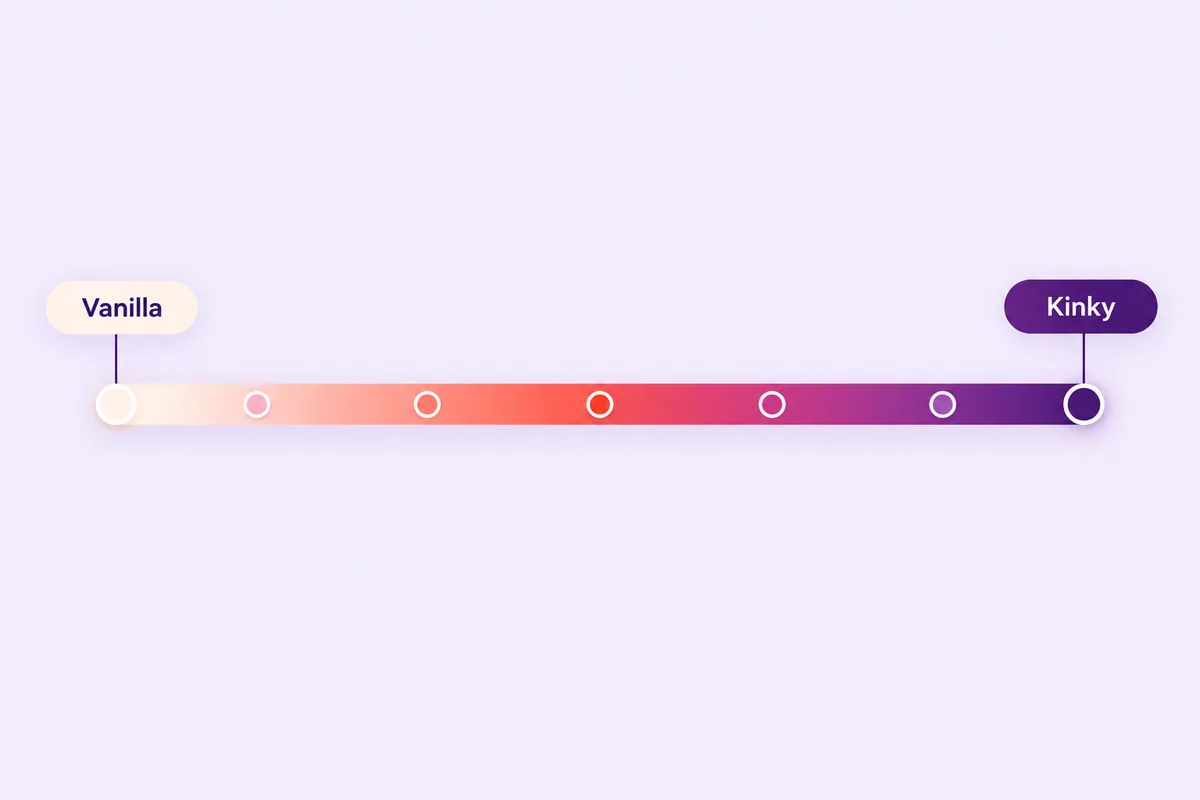
The table below shows how the three terms are commonly used. Real people often mix them, so treat it as a guide to the words rather than a set of boxes.
| Vanilla | Kink | Fetish | |
|---|---|---|---|
| Common meaning | Sex seen as conventional or familiar | Sexual tastes seen as unconventional | A strong, specific focus of arousal |
| Typical examples | Kissing, touching, oral sex, intercourse | Role play, light bondage, spanking, power exchange | An object, body part, or material |
| Needed for arousal? | No | Usually not; it adds to sex | Often more central for the person |
| Who decides what counts | The people involved | The people involved | The person who has it |
A few points the table cannot show. Vanilla and kink are not opposite teams. Many people enjoy mostly vanilla sex with an occasional kinky moment, or the reverse. BISH notes that even holding hands can be done in a vanilla, rough, or kinky way. The difference often lies in intention and mood more than in the act itself.
Condemning someone’s kink to make them feel less than has a name: kink shaming. The same courtesy runs the other way. Calling someone “too vanilla” is a judgment about their preferences, and it lands just as badly.
How common are vanilla and kinky preferences?
Nobody knows exactly how many people are vanilla, because researchers rarely ask. BISH points out that studies tend to measure kink or rough sex and skip the question of who has mostly vanilla sex. What surveys do show is that kink interest is common, and that plenty of people have none.
What surveys find
One of the larger studies comes from Finland. Researchers led by Markus Paarnio surveyed 8,137 adults, and PsyPost reported the results. About 38% of women and 36% of men said they had an interest in BDSM, which covers bondage, dominance, and sadomasochism.
The study asked about BDSM, not about kink in general, so it cannot tell us how many people are vanilla. Someone with no BDSM interest might still enjoy role play or a fetish. What it does show is that BDSM interest is common without being universal, since a majority of the sample did not report it.
Behavior split differently from interest. Interest was close between women and men. But 37% of women and 23% of men had been sexually dominated at least once. And 25% of women and 32% of men had dominated a partner. One study in one country cannot settle the question for everyone, but it shows both groups are large.
Fantasy is not the same as practice
Many people imagine things they never plan to do. Researcher Justin Lehmiller surveyed Americans about their sexual fantasies for his book Tell Me What You Want. In an excerpt covered by InsideHook, he reports that 45 percent had fantasized about fetish objects.
Lehmiller also stresses that acting on fantasies, or even sharing them, can strain people or relationships if it is done carelessly. A fantasy can stay a fantasy. Someone can enjoy a vivid imagination and still have a sex life they would call vanilla, and that is not a contradiction.
Why people prefer vanilla sex
People prefer vanilla sex for the same reason others prefer kink: it is what they enjoy. A preference does not need a deeper explanation, and it is not a problem to be solved.

Common reasons
Comfort is a big one. BISH explains that it is hard to feel turned on when the body is tense, and the slow, gentle pace of vanilla sex helps many people relax. That relaxation can lead to strong arousal and orgasm rather than less of it.
Closeness matters to many people too. Face-to-face sex, eye contact, and long kissing can feel intimate in a way that a more scripted scene does not. Some people simply have no interest in pain, restraint, or role play. That is a preference like any other.
Some people’s tastes also change over time. Someone might enjoy kink in one relationship and prefer a gentler style in the next. Stress, health, a new baby, or getting older can all shift what feels good. None of those shifts make a person less sexual.
Vanilla does not mean low desire
A common assumption is that vanilla people want sex less often. HUD App’s explainer puts it plainly: sexual preference and sex drive are separate things. How much you want sex and what kind of sex you want are two different questions.
A person can have a high sex drive and want mostly conventional sex. Another person can have a low drive and still enjoy kink when they do have sex. If you notice a real drop in desire that bothers you, that is worth raising with a doctor or sex therapist. Liking vanilla sex is not a symptom of anything.
When partners want different things
Partners with different tastes are common, and the fix starts with talking. Neither person is wrong. The goal is to find what you both enjoy and to respect what either of you does not want.

Talking about it without shame
Talking openly about sex is linked to better sex. A meta-analysis by Allen Mallory and colleagues pooled 93 studies covering 38,499 people in relationships. Couples who communicated about sex reported higher sexual and relationship satisfaction, and the quality of the talk mattered more than how often it happened. The studies show a link rather than proof of cause, but the pattern is consistent.
A few habits can make these talks easier:
- Pick a calm moment outside the bedroom, not the middle of sex.
- Describe what you like before naming what you do not.
- Try a “yes, no, maybe” list, where each partner marks activities privately and then compares.
- Treat a “no” as information, not rejection.
If one partner is curious about kink, the other can stay vanilla and still be a good partner. Some couples agree to try small steps. Others decide one fantasy stays in the imagination. Both are fair outcomes.
Consent applies to every kind of sex
Consent means a clear, freely given yes. The University of South Florida’s victim advocacy center states that consent is never implied and cannot be assumed, even in the context of a relationship. It also treats consent as a process: ask before moving to something new.
This works in both directions. Vanilla sex is not automatically consensual just because it is gentle. And no one owes a partner an activity they do not want, whether that is a new kink or a return to vanilla. A sex therapist can help if the gap feels too wide to bridge alone.
Common myths about vanilla and kinky sex
Judgments about sexual taste run in both directions. Here are the most common ones, and what the evidence says.
- Myth: vanilla means boring. Boredom comes from routine and inattention, which can happen with any style of sex. Both BISH and Grindr argue that vanilla sex can be intense and deeply pleasurable.
- Myth: vanilla people are prudes. A preference for conventional sex says nothing about someone’s openness or comfort with sex. Many vanilla people talk about sex easily and enjoy it often.
- Myth: kink is a mental disorder. Unusual interests alone are not a disorder. The Merck Manual explains that people can have unusual sexual interests and practices without meeting the criteria for a paraphilic disorder. A diagnosis requires intense, persistent patterns, generally lasting 6 months or longer, that cause distress or harm.
- Myth: kinky people have different personalities. In the Finnish study, personality differences between people with and without BDSM interest were negligible at best.
- Myth: you have to pick a side. Most people do not live at one end of the scale. Tastes can blend and change, and labels are optional.
Frequently asked questions
What does it mean when someone says they are vanilla?
It usually means they prefer conventional sex and are not into kink, fetishes, or power play. Kink and fetish communities started using the term to describe mainstream sex. It describes taste. It does not mean the person is boring, inexperienced, or uninterested in sex.
What is considered not vanilla in bed?
Anything that a person sees as unconventional, which is how kink is usually defined. Common examples are bondage, spanking, role play, dominance and submission, and fetish play. The line is personal, though. Something that feels daring to one couple may feel ordinary to another.
How do I not be so vanilla in bed?
Only change if you want to, not because someone called you vanilla. If you are curious, start with a calm conversation about what each of you might enjoy. Try one small change at a time, check in often, and stop if either of you feels unsure. Consent should be clear at every step.
Does preferring vanilla sex mean you have a low sex drive?
No. Sex drive and sexual preference are separate. Someone can want sex often and still prefer it gentle and conventional. If your desire has dropped in a way that worries you, a doctor can help check for causes such as stress, medicines, or hormone changes.
The bottom line
Vanilla sex is a simple idea with a loaded reputation. The word just means conventional, and what counts as conventional depends on the people involved. Liking it is as valid as liking kink, and many people enjoy some of both.
What matters more than any label is fit. Talk openly with your partner, respect each other’s limits, and make sure every yes is a real one. If your tastes differ and talking stalls, a sex therapist can help you find common ground.
Related reading
- What Is a Sex-Positive Relationship?
- Aftercare After Sex: What It Is and How to Do It Well
- Arousal and consent
- What Is Sexual Pleasure?
Sources
- American Heritage Dictionary Entry: plain vanilla - American Heritage Dictionary
- Gay Vanilla Sex: Exploring What Vanilla in Bed Means - Grindr
- Vanilla Sex - what is it, why people like it and how to do it - BISH
- Am I Kinky Enough? Kinky Sex Positions & Ideas to Avoid a Vanilla Bedroom Experience - Trojan
- New research from Finland suggests interest in BDSM is surprisingly common - PsyPost
- America’s Sexual Fantasies Laid Bare in New Book - InsideHook
- Vanilla Sex Explained: Fetish 101 - HUD App
- Dimensions of Couples’ Sexual Communication, Relationship Satisfaction, and Sexual Satisfaction: A Meta-Analysis - Journal of Family Psychology (via PubMed Central)
- The Importance of Consent - University of South Florida Center for Victim Advocacy
- Overview of Paraphilias and Paraphilic Disorders - Merck Manual Professional Edition