What Is Sexual Arousal?

General education, not medical advice. If something here worries you, talk with a clinician.
Table of Contents
Sexual arousal is the feeling of being turned on sexually, along with the physical and emotional changes that come with it. It begins when the brain reads something as sexual: a touch, a thought, an image, a passage you read.
The body does not always play along. Arousal can bring many physical reactions or none at all. The idea is also easy to blur with desire and with consent, and each of those has its own answer further down.
Sexual arousal in plain terms
In everyday health writing, arousal is the response of body and mind to sexual stimulation. Planned Parenthood describes it as the feeling of being turned on, and says the body undergoes physical and emotional changes.
It involves both mind and body
An association that works with sexual abuse treatment describes arousal as both a mental state and a physical state. The mental side includes emotions, thoughts and fantasy. The physical side includes more genital blood flow and a heightened sense of touch.
In a welcome sexual experience, the two usually happen together. They can also separate. A person can be mentally aroused without showing physical signs, and can be physically aroused without feeling aroused mentally.
There is no single scientific definition
Researchers do not agree on one definition. A paper on male sexual arousal states that arousal is a construct without a widely shared definition. That paper also notes that scientists disagree about how arousal relates to motivation, emotion and erection.
For that reason, this series uses the plain-language meaning from health organizations and flags where researchers use narrower definitions.
What can happen in the body
Medical sources list a range of changes. None is guaranteed, and a person may notice only some.
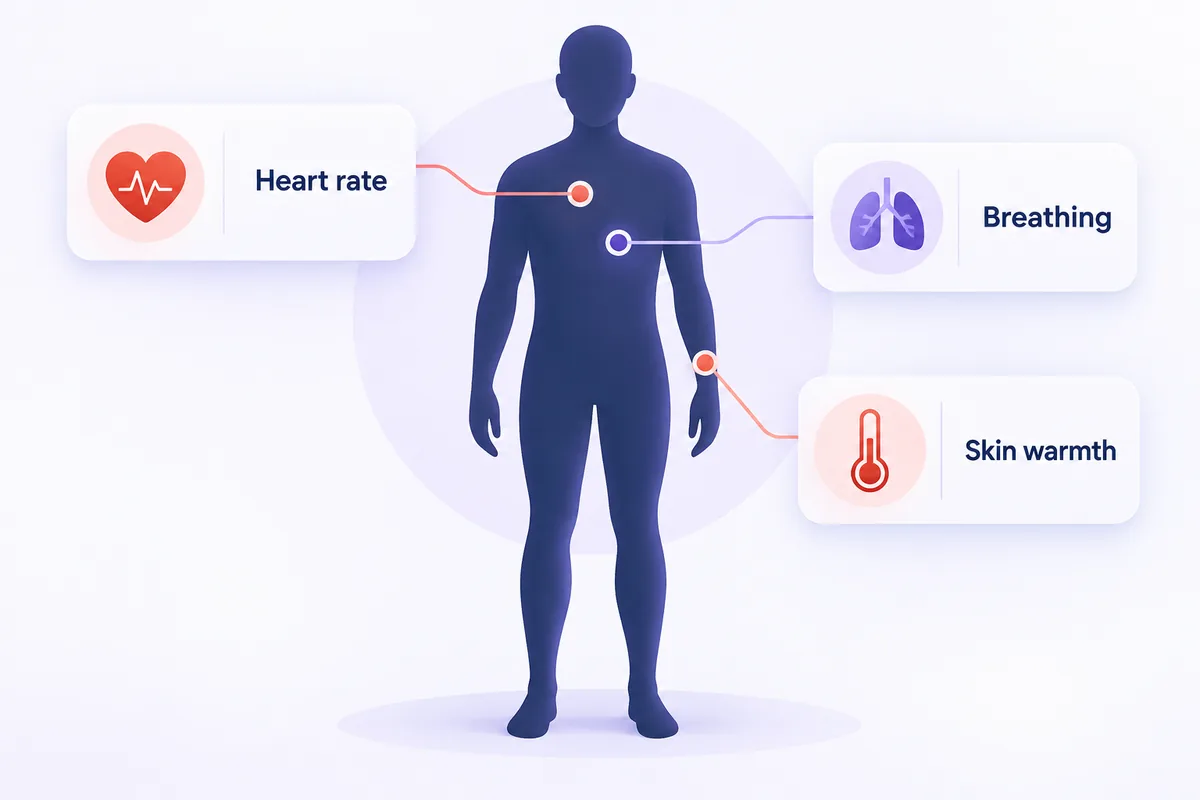
- Heart rate and breathing often quicken.
- Skin may flush, and blood pressure and body temperature can rise.
- Genitals receive more blood, which can cause the clitoris to swell and a penis to become erect.
- Vagina may produce moisture and expand.
- Awareness varies. Cleveland Clinic says a person may not consistently notice any changes when they enter the desire phase.
What sexual arousal feels like goes through these changes in more detail.
How the response differs by body is covered in female sexual arousal and male sexual arousal.
How arousal is studied
Because there is no shared definition, researchers measure arousal in different ways. In laboratory studies, volunteers watch sexual material while sensors record genital response and they rate how aroused they feel. The two measures do not always agree.

For men, an erection in a sexual context has long been treated as the most reliable indicator. A 2024 review of male arousal, drawn largely from animal models and mainly rats, proposes an autonomic response leading to erection as the definition, and separating it from sexual motivation.
These choices matter. The relation between a measure and arousal is often assumed rather than tested.
How arousal relates to desire, non-concordance and consent
Arousal is easy to confuse with ideas that sit next to it. The table sets them side by side.
| Idea | What it means | Key point | Read more |
|---|---|---|---|
| Arousal | Being turned on, with physical and emotional changes | Can bring many physical reactions or none at all | This page |
| Desire | The wish or motivation for sexual activity | Often responds to activity or stimulation, called responsive desire | Arousal vs. desire |
| Non-concordance | The body’s response and the feeling of arousal do not match | Physical response and desire for sex are not always connected | Arousal non-concordance |
| Consent | Actively agreeing to be sexual with someone | Rape Crisis England & Wales says that feeling aroused makes no difference to whether sex without consent is sexual violence | Arousal and consent |
| Attraction | Sexual interest in a person, which is complex and not based only on looks or personality | Nonsexual arousal can be confused with sexual arousal | Arousal vs. attraction |
Where arousal fits in the sexual response cycle
Arousal is one part of what clinicians call the sexual response cycle. The classic model, outlined by Masters and Johnson in 1966, has four phases: excitement, plateau, orgasm and resolution. Cleveland Clinic lists desire, arousal, orgasm and resolution, and says the order and timing can vary.
Many sexual medicine experts note that the process is not always linear, particularly for women. Models give a point of reference, not a rule.
The page on the sexual response cycle compares the models in more detail.
Why it varies from person to person
People differ widely in how they respond. A review of human sexual response says variability is marked between individuals and within one person’s life, and it is shaped by life stage, mental health and relationship happiness.

Day-to-day factors count as well. Planned Parenthood says stress, medicines and other physical, emotional or lifestyle factors can change sex drive. Cleveland Clinic notes that the order and timing of the phases of the response cycle vary, and some people skip a phase entirely.
Because of this, there is no single correct way to be aroused. Temporary changes are common. For women, the Merck Manual sets two conditions for a disorder. The problem must cause distress, and interest must be absent throughout the sexual experience.
Two of these factors have their own pages: stress and anxiety and medications.
How this series uses its sources
Health information about sex is easy to find and hard to trust. Across the series, the sources include medical centers, professional societies, government health agencies, support organizations and peer-reviewed research. Each page lists its sources at the end.
Where a source covers only one group, such as men or women, or comes from one country, the page says so. Where evidence is thin, the page says that too. The series is general education and does not replace advice from a clinician.
Explore the topic
Read more on each topic:
What does sexual arousal feel like? The sensations people describe, and why some feel very little.
What causes sexual arousal? Triggers, the brain’s role and what can get in the way.
Sexual arousal vs. desire How wanting sex and being turned on differ.
Arousal non-concordance When body and mind give different signals.
Does sexual arousal mean consent? What consent needs, and why arousal does not show it.
Difficulty getting aroused Common causes and when to get help.
Female sexual arousal What happens in the body, and how feeling and response can differ.
Male sexual arousal Erections, context, and why an erection alone is not a gauge.
Sexual arousal vs. sexual attraction Interest in a person compared with a state of body and mind.
The sexual response cycle The four-stage model and Basson’s circular model.
Stress, anxiety and sexual arousal What small studies suggest and how performance anxiety works.
Medications and sexual arousal Medicines linked to sexual side effects, and what to do.
Frequently asked questions
What is considered sexual arousal?
The feeling of being turned on sexually, together with the physical and emotional changes that go with it. Touch, fantasy, sexual thoughts, and reading, watching or listening to erotic material can all set it off.
Is sexual arousal good or bad?
Planned Parenthood and Cleveland Clinic describe arousal as a response of the body and mind, and neither frames it as good or bad. No one should feel pressured to have sex, and sexual activity without consent is sexual violence. Moral and religious views differ, and this series does not take a position on them.
Can you be physically aroused without feeling aroused?
Sometimes. A professional association describes physical arousal that occurs without mental arousal. Laboratory studies find the same gap: some women show genital responses without reporting any experience of arousal, and agreement between genital response and self-report is far from perfect.
How long does sexual arousal last?
There is no single length. Cleveland Clinic says its first phase, desire, can last from a few minutes to several hours. The arousal phase runs until just before orgasm, and orgasm, the shortest phase, lasts only a few seconds.
Does an erection always mean a man is aroused?
Not always. Researchers treat an erection in a sexual context as the usual indicator. An erection during REM sleep, or after a drug injection, is not grounds for inferring arousal.
How does sexual arousal start?
A stimulus appears, which can be physical, mental or situational. The brain then appraises it, and psychological and biological factors help decide whether arousal follows. What causes sexual arousal goes into more depth.
What to take away
Arousal is a response, not a verdict. It can be loud or nearly silent, it can come before desire or after it, and it never settles the question of consent.
To go deeper, what arousal feels like is the natural next read. If you are short on time, make it arousal and consent.
Sources
- Arousal - Planned Parenthood
- Human sexual response - Handbook of Clinical Neurology (PubMed)
- Sexual Arousal, Sexual Abuse, and Consent - Association for the Treatment of Sexual Abusers (ATSA)
- A contextual definition of male sexual arousal - Hormones and Behavior (PubMed)
- Sexual Response Cycle: Order, Phases & What To Know - Cleveland Clinic
- Agreement of self-reported and genital measures of sexual arousal in men and women: a meta-analysis - Archives of Sexual Behavior (PubMed)
- Neurophysiology of male sexual arousal-Behavioral perspective - Frontiers in Behavioral Neuroscience (PMC)
- What Is Responsive Sexual Desire? - International Society for Sexual Medicine
- Arousal Non-concordance and Involuntary Sexual Response - Psychology Professional Development (psychpd.com.au)
- What Is Sexual Consent? - Planned Parenthood
- What is sexual consent? - Rape Crisis England & Wales
- Sexual Attraction and Desire - Psychology Today
- An Overview of the Sexual Response Cycle - Sexual Medicine Society of North America (SMSNA)
- Sexual Interest/Arousal Disorder - Merck Manual Consumer Version
All pages in this guide
What Does Sexual Arousal Feel Like?
Sexual arousal can feel different from person to person. Learn the physical and emotional sensations people commonly describe, and why some feel very little.
What Causes Sexual Arousal?
Sexual arousal starts when the brain reads something as sexually relevant. Learn the triggers, how the brain and body respond, and what can switch arousal off.
Sexual Arousal vs. Desire
Desire is the wish for sexual activity; arousal is the body and mind responding to stimulation. See how they differ and why desire can come second.
Arousal Non-Concordance
Arousal non-concordance means physical arousal and feeling turned on do not always match. Learn what research shows, common examples and what it does not mean.
Does Sexual Arousal Mean Consent?
Being aroused is not the same as agreeing to sex. Learn what consent requires, why a body response cannot show it, and where to look for support.
Difficulty Getting Aroused
Trouble getting aroused is common and often has more than one cause. Learn the main causes, when it counts as a disorder, and when to see a doctor.
Female Sexual Arousal
Female sexual arousal combines mental excitement with physical changes such as more blood flow. Learn what happens, how fast, and why the two can differ.
Male Sexual Arousal
Male sexual arousal involves the mind and body, and an erection alone does not always mean someone is aroused. Learn how arousal works and why it varies.
Sexual Arousal vs. Sexual Attraction
Sexual attraction is interest in a person; sexual arousal is a bodily and mental response. See how they differ and how asexual people describe them.
The Sexual Response Cycle
The sexual response cycle describes how body and mind respond to stimulation. Compare the four stages with Basson's circular model and their limits.
Stress, Anxiety, and Sexual Arousal
Stress and anxiety can change how easily someone becomes aroused. Learn what small studies suggest, how performance anxiety works, and what may help.
Medications and Sexual Arousal
Some medicines, including antidepressants, can make arousal harder. Learn which medications are linked to sexual side effects and what to do about them.