Does Sexual Arousal Mean Consent?
Being aroused is not the same as agreeing to sex. Learn what consent requires, why a body response cannot show it, and where to look for support.

General education, not medical advice. If something here worries you, talk with a clinician.
Table of Contents
No. Being sexually aroused does not mean a person has agreed to sex. Without consent, any kind of sexual activity is sexual violence, whether or not the person felt aroused.
Genital response is an automatic reaction to stimulation, and physical response and desire for sex are not always connected. A physical response is not a reliable guide to what a person wants. If you are reading because of something that happened to you, you are not to blame. A short note on support is near the end. For the basics of arousal, see what sexual arousal is.
What consent requires
Legal definitions of consent depend on where you live. The sources used here come from the United States and from England and Wales.
Planned Parenthood says consent means actively agreeing to be sexual with someone. The CDC defines sexual violence as sexual activity when consent is not obtained or freely given. Both people must agree every time, including couples who have been together a long time.
Planned Parenthood sums up consent with the word FRIES:
| Letter | Meaning |
|---|---|
| Freely given | A choice made without pressure, manipulation, or the influence of drugs or alcohol |
| Reversible | Anyone can change their mind at any time |
| Informed | You can only consent to something if you have the full story |
| Enthusiastic | You only do what you want to do, not what you feel expected to do |
| Specific | Saying yes to one thing is not saying yes to others |
Silence is not consent.
In England and Wales, the Sexual Offences Act 2003 says a person consents if they agree by choice and have the freedom and capacity to make that choice. Someone who stays quiet, seems unsure or moves away is not agreeing.
Rape Crisis England & Wales lists situations where a person lacks that freedom or capacity:
- They are asleep or unconscious.
- They are drunk or on drugs, or have been spiked.
- They are too young.
- A mental health condition means they cannot make a choice.
- They are pressured, bullied, manipulated, tricked or scared.
- Physical force is used against them.
Age and capacity
Consent also depends on whether a person is legally able to give it. In England and Wales, the age of consent is 16, and sexual activity is always unlawful if one person is under 16. Planned Parenthood, a US source, says laws set who can and cannot consent. Planned Parenthood says people who are drunk, high or passed out cannot consent, and that the age of consent varies between parts of the US and between countries. In England and Wales, being drunk or on drugs can mean a person lacks the freedom or capacity to choose.
If you are unsure about the rules where you live, check your local laws or a local sexual assault service.
Why a body response does not show consent
Physical sexual response and desire for sex are not always connected, according to a clinical psychologist who works with trauma survivors. The same source explains that the body can respond to stimulation even when the person does not want what is happening. If a person has a sexual response during a traumatic event, it does not follow that they wanted the event or were complicit.
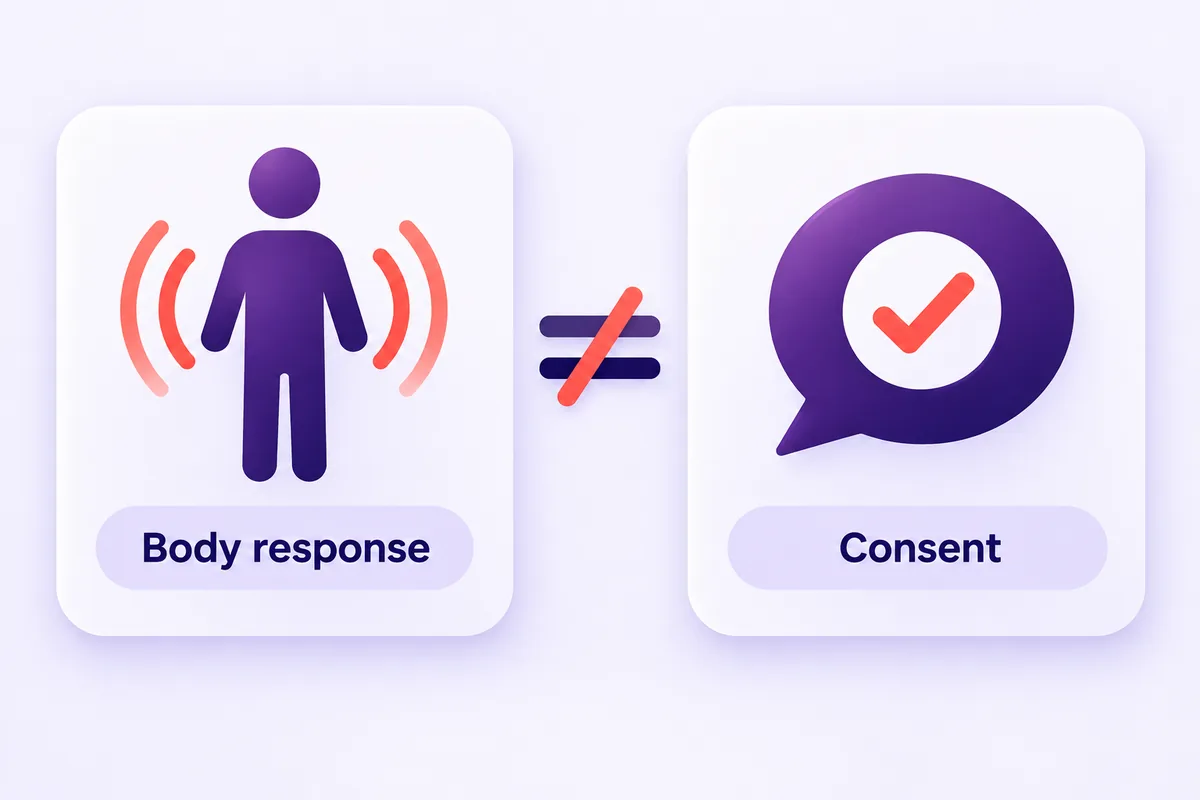
The Association for the Treatment of Sexual Abusers makes a related point. It says arousal or orgasm during sexual assault can be very confusing for victims. It can also help support a false belief, held by the person responsible, that the assault was consensual.
Rape Crisis England & Wales is direct about this. It says it does not matter whether a person experienced feelings of arousal. The gap between physical response and feeling is explained in arousal non-concordance.
How arousal can affect judgments about consent
Arousal may also shift attitudes about consent. In a 2024 study, researchers primed arousal with a short narrative writing task and then asked about attitudes toward consent. Sexual arousal led all participants to be more likely to endorse belief in female token resistance, the idea that a woman who says no may mean yes. It also led women to more strongly endorse men’s assertive sexual strategies.
The study measured attitudes, not behavior. The finding is a reason to slow down and check in, and it is never an excuse. Everyone has a responsibility to ask and to respect the answer.
How to check in
Rape Crisis England & Wales suggests these steps for checking in:

- Talk about what you do and do not want.
- Listen to what the other person wants.
- Ask during the activity, with questions such as “is this okay?” or “do you want to slow down?”
- Stop if you see or suspect discomfort.
- Respect a no, and never try to change someone’s mind or pressure them.
Consent can also change. Anyone can change their mind at any time, even if they have done the same thing before. A person who wanted sex last night may not want it this morning.
If this has happened to you
If you experienced unwanted sexual contact, the responsibility lies with the person who did it. Rape Crisis England & Wales says that when someone does not consent, all of the blame lies with the perpetrator. Planned Parenthood adds that a victim does not need to have fought back, screamed or said no repeatedly for it to count as sexual assault. A physical response during the event does not change any of this.

Rape Crisis England & Wales invites people affected by sexual violence to contact them. If you are elsewhere, search for a local sexual assault service or a trauma-informed therapist. If you are in danger now, contact your local emergency services.
Frequently asked questions
What is not considered consent?
Silence is not consent. Planned Parenthood, a US source, says that anyone who is drunk, high or passed out cannot consent. Continuing despite non-verbal signs, such as pulling away, freezing or seeming uncomfortable, is not consent either. Nor is assuming someone wants sex because of how they dress or act.
Does saying yes always mean consent?
Not if it was given under pressure. Consent has to be freely given, without pressure or manipulation. Fear, trickery or bullying can take away the ability to make a real choice, and a yes given under those conditions is not consent.
Can consent be withdrawn?
At any time. Consent is reversible, and agreeing to one thing is not agreeing to others. Everyone has the right to change their mind.
Can arousal be a sign that someone wants sex?
Not by itself. Physical response and desire are not always connected, and arousal does not change whether activity without consent is sexual violence. The only way to know is to ask.
What if I had a physical response during an assault?
A physical response does not mean you wanted it or agreed to it. A clinical psychologist who works with trauma survivors writes about clients who had a sexual response during a traumatic event. It does not follow that they wanted it or were complicit. Arousal or orgasm during an assault can be very confusing for victims. Support services exist for people affected by sexual violence, such as Rape Crisis England & Wales.
If you remember one thing
Arousal is not consent. Only a freely given yes counts, and anyone can take it back at any time. If you are unsure what someone wants, ask. If you are the one who is unsure, you can say so, and you can say no.
For the science of why body and mind can differ, read arousal non-concordance.
Sources
- What is sexual consent? - Rape Crisis England & Wales
- Arousal Non-concordance and Involuntary Sexual Response - Psychology Professional Development (psychpd.com.au)
- What Is Sexual Consent? - Planned Parenthood
- About Sexual Violence - Centers for Disease Control and Prevention
- Sexual Arousal, Sexual Abuse, and Consent - Association for the Treatment of Sexual Abusers (ATSA)
- Let’s just do it: sexual arousal’s effects on attitudes regarding sexual consent - Journal of Social Psychology (PubMed)