Arousal Non-Concordance
Arousal non-concordance means physical arousal and feeling turned on do not always match. Learn what research shows, common examples and what it does not mean.

General education, not medical advice. If something here worries you, talk with a clinician.
Table of Contents
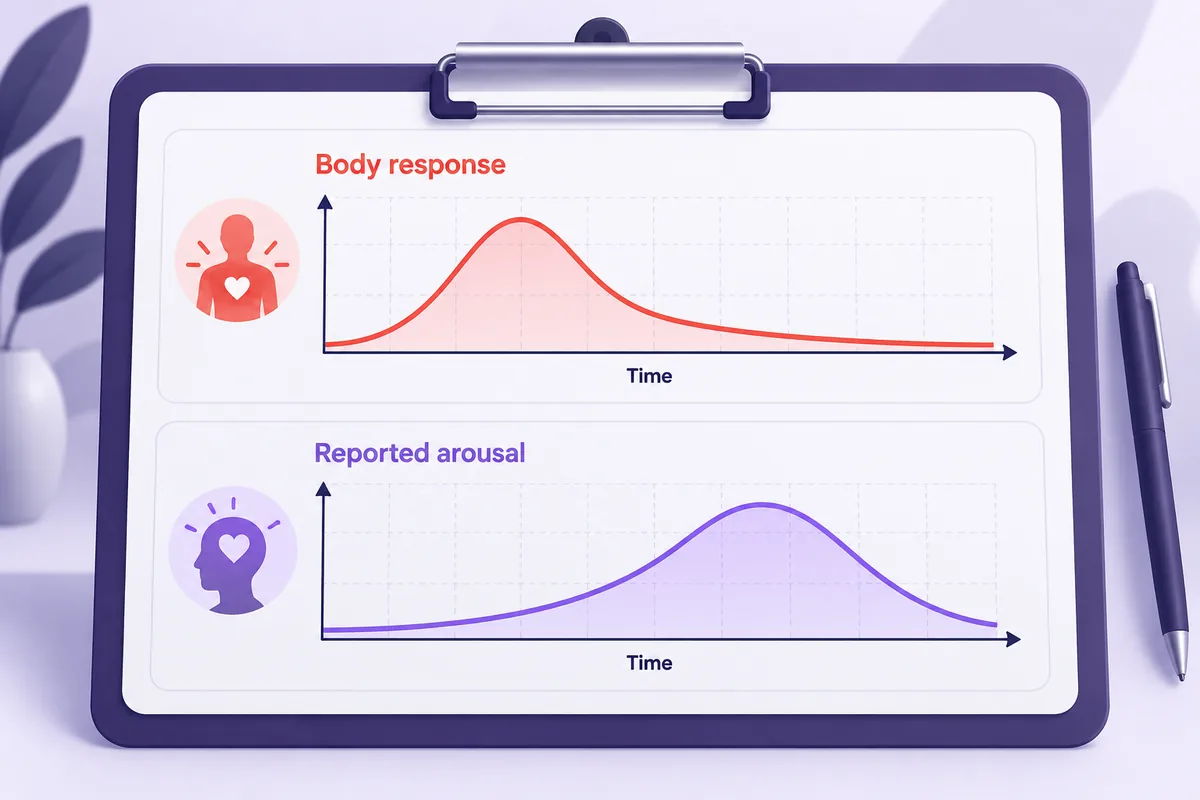
Your body can respond to something you do not want, and it can stay quiet when you do. Arousal non-concordance is the name for that gap between a physical response and the feeling of being turned on.
Many people read their body’s reaction as a statement about what they want. The research suggests that reading is unreliable, because agreement between body and feeling is far from perfect. The gap appears in studies of both men and women. This is general education, not medical advice.
What the term means
Sex educator Emily Nagoski defines the term as a lack of overlap between genital blood flow and how turned on a person feels. A clinical psychologist who works with trauma survivors quotes this definition.
Researchers use the word concordance for the opposite idea. Sexual concordance is the relationship between genital response and subjective sexual arousal, meaning what a person reports feeling. Non-concordance is the gap in that relationship.
The term is about arousal, not consent or wanting. Physical sexual response and desire for sex are not always connected.
What research has found
The strongest evidence comes from laboratory studies. Volunteers watch sexual material while a sensor measures genital response, and they rate how aroused they feel. Three studies show the range of findings.
| Study | Who took part | Main finding |
|---|---|---|
| Chivers and colleagues, 2010 (meta-analysis) | 132 laboratory studies from 1969 to 2007, with 2,505 women and 1,918 men | Agreement between self-report and genital response was greater in men (r = .66) than in women (r = .26) |
| Handy and colleagues, 2020 | 27 women with arousal concerns and 28 without | Tremendous between-person variability in both groups; awareness of body changes (interoception) shaped agreement |
| Alvarez-Muelas and colleagues, 2022 | 104 young adults, 42 men and 62 women | Agreement depended on beliefs about the sexual double standard |
In the Chivers analysis, the gap also depended on stimulus variability and on when self-reported arousal was assessed. In the 2022 study, concordance appeared in people with egalitarian or man-favorable views of the double standard.
The 2020 and 2022 studies are small, with 55 and 104 participants. Together with the larger meta-analysis, they describe patterns across groups. They do not predict what any one person will experience.
Each body has its own physical response. See female sexual arousal and male sexual arousal.
Why it may happen
Researchers are still working out why. The studies above point to a few factors, and none is a full explanation.
- Awareness of the body. Interoception, the awareness of changes within the body, shaped how closely physical and subjective arousal matched.
- Beliefs about gender and sex. Agreement between genital response and arousal depended on adherence to the sexual double standard.
- How a study is built. The size of the gender gap depended on stimulus variability and on when self-reported arousal was assessed.
- Large differences between people. Even women without arousal concerns varied widely.
Arousal involves a network of cognitive, motivational, emotional and autonomic components. It is plausible that the feeling and the body response can diverge within that network. That is an interpretation, not a tested finding.
What it can look like
Clinicians and researchers describe the pattern in a few ways.
| Pattern | What happens |
|---|---|
| Subjective type (women) | A woman does not feel aroused by any stimulation but may still have a physical response, such as clitoral swelling and more vaginal secretions. |
| Genital type (women) | A woman feels aroused by non-genital stimulation, such as an erotic video, but does not respond to genital stimulation. |
| Arousal without genital change (men) | Some men report feeling aroused without any genital change. |
Some people also feel disgust at a physical response that happened without mental arousal.
What it does not mean
A physical response is not agreement. The sources say that it:

- Does not show that a person wanted what happened, or was complicit in it.
- Does not change whether sexual activity without consent is sexual violence, according to Rape Crisis England & Wales.
- Can be very confusing for victims, and can feed a mistaken belief in the person responsible that the contact was consensual.
The full discussion is on arousal and consent.
What may help
No treatment is designed specifically for non-concordance, and the sources used here do not test one. The steps below come from sources on arousal difficulties in general, so they may be relevant if the mismatch distresses you, but they were not tested for it:

- Talk with a partner about likes and dislikes.
- See a counselor who specializes in sex and relationship problems.
- Consider psychotherapy to address past trauma, anxiety, guilt and poor body image.
The authors of the 2020 study caution that concordance may not be a useful clinical outcome, because it varies so much even in women without concerns.
When to talk to someone
If a past experience or a pattern in your body worries you, a therapist or doctor who works in sexual health or trauma can help. You do not need a diagnosis to ask.
For women, the Merck Manual describes lack of interest and inability to be aroused as a disorder only when they cause distress and interest is absent throughout the sexual experience. Cleveland Clinic suggests contacting a provider if sexual problems last three months or longer or cause distress.
How clinicians use the idea
Clinical sources describe patterns in which feeling and body diverge, such as the Merck Manual’s subjective and genital types of arousal problem. The Merck Manual does not use the term non-concordance, so the link is an interpretation.
The authors of the 2020 study found large differences between women even without arousal concerns. They question using concordance as a clinical outcome in treatment research.
Frequently asked questions
What does arousal non-concordance feel like?
It differs. Some people notice a physical response with no sense of wanting, as in the subjective type described by the Merck Manual. Others feel aroused with little physical sign. Some feel disgust at the response.
Can you give an example of arousal non-concordance?
One clinical example is a woman who does not feel aroused by any stimulation but still shows clitoral swelling and more vaginal secretions. Another is a man who reports feeling aroused with no genital change.
Is it more common in women than in men?
On average, agreement was lower in women (.26) than in men (.66) in the best-known meta-analysis. A later study found tremendous variability between women. Averages do not tell you what any one person will experience.
Is it a disorder?
Not by itself. It describes how physical and subjective arousal relate, and the 2020 study found large variability even in women without arousal concerns. For women, the Merck Manual describes arousal problems as a disorder only when they cause distress and interest is absent throughout the sexual experience.
Can men have arousal non-concordance?
They can. A summary of the Chivers meta-analysis reports that some men feel aroused without genital change. Men on average showed greater agreement than women, though agreement was far from perfect.
A closing note
A body’s response is information about the body. It is not a verdict on what a person wanted. Researchers are still learning why the gap appears and how large it is for any one person.
If the mismatch troubles you, a clinician or therapist can help you make sense of it. The overview of sexual arousal and what causes it put the pattern in context.
Sources
- Arousal Non-concordance and Involuntary Sexual Response - Psychology Professional Development (psychpd.com.au)
- Sexual Arousal, Sexual Abuse, and Consent - Association for the Treatment of Sexual Abusers (ATSA)
- Agreement of self-reported and genital measures of sexual arousal in men and women: a meta-analysis - Archives of Sexual Behavior (PubMed)
- Study of Sexual Concordance in Men and Women with Different Typologies of Adherence to the Sexual Double Standard - International Journal of Clinical and Health Psychology (PMC)
- The Relationship between Subjective and Physiological Sexual Arousal in Women with and without Arousal Concerns - Journal of Sex & Marital Therapy (PubMed)
- Human sexual response - Handbook of Clinical Neurology (PubMed)
- Sexual Interest/Arousal Disorder - Merck Manual Consumer Version
- What is sexual consent? - Rape Crisis England & Wales
- Genital Arousal Disorder - Planned Parenthood
- Sexual Dysfunction: Disorders, Causes, Types & Treatment - Cleveland Clinic