Sexual Arousal vs. Desire
Desire is the wish for sexual activity; arousal is the body and mind responding to stimulation. See how they differ and why desire can come second.

General education, not medical advice. If something here worries you, talk with a clinician.
Table of Contents
Wanting sex and being turned on feel like one thing, and they often arrive together. They are not the same. Desire is the wish or motivation for sexual activity. Arousal is the state of being turned on, with body and mind responding to stimulation.
Medical sources treat the two separately because either can come first. Some people feel no interest until something starts to happen, and clinicians recognize that as a normal pattern. For the full definition of arousal, see what sexual arousal is.
Arousal and desire side by side
| Desire | Arousal | |
|---|---|---|
| What it is | Interest in or motivation for sexual activity; Planned Parenthood describes sex drive as feeling desire to be sexual | Being turned on, with physical and emotional changes |
| How it may show | A wish to start or take part in sexual activity | Faster heart rate and breathing, flushing, more blood flow to the genitals |
| When it appears | Can be spontaneous, or can respond to sexual activity or stimulation | Follows a stimulus that the brain appraises as sexual |
| Can one show up without the other? | The desire phase may come after arousal | A physical response can occur without desire for sex |
Physical and subjective arousal
Arousal itself has two layers. Physical arousal is the body’s response, such as more blood flow to the genitals. Subjective arousal is how turned on a person feels.
The two do not always line up. A meta-analysis of 132 laboratory studies found that agreement between self-reported and genital arousal was greater in men (r = .66) than in women (r = .26). The Merck Manual describes women who feel aroused with no genital response, and women who respond physically without feeling aroused. The full discussion is in arousal non-concordance.
Spontaneous and responsive desire
Many people picture spontaneous desire, which seems to come from within. Responsive desire works differently. It often arises in response to starting sexual activity or stimulation.
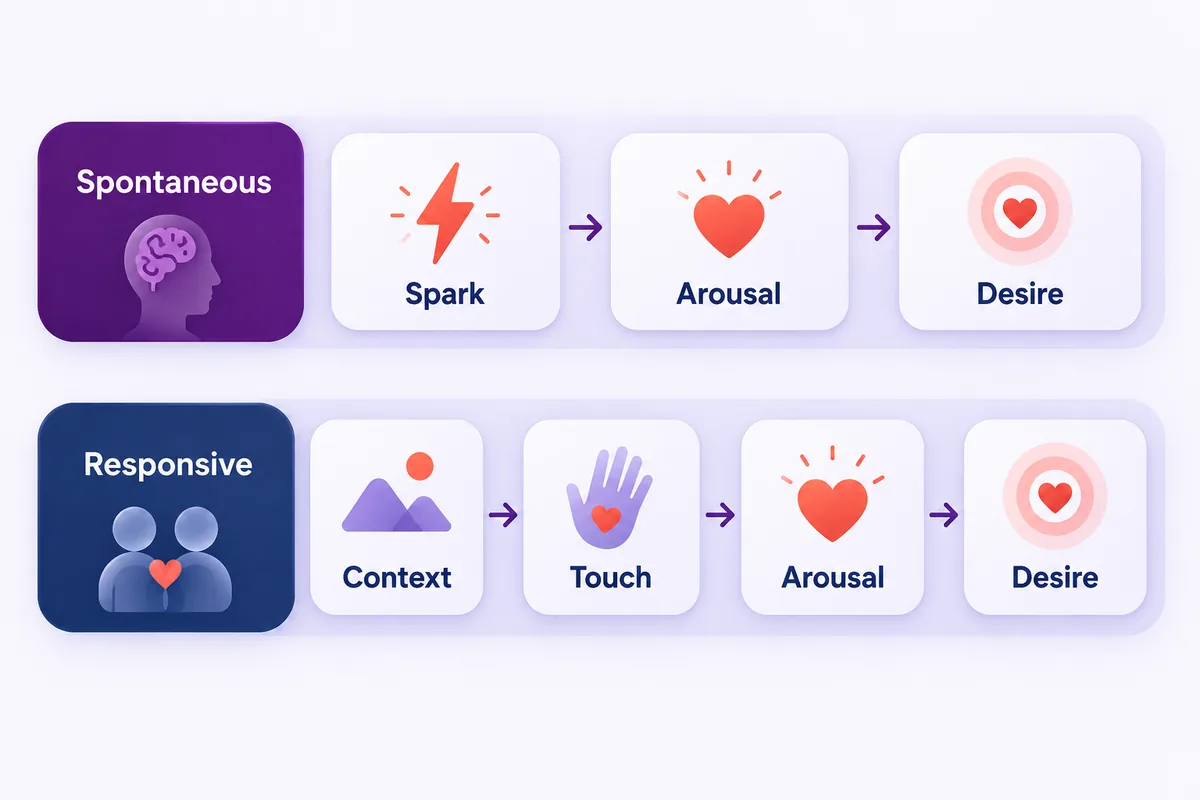
| Spontaneous desire | Responsive desire | |
|---|---|---|
| How it starts | Arises internally, before anything begins | Arises after sexual activity or stimulation begins |
| Where it matters most | The pattern most people picture | Especially important in long-term relationships |
| What to keep in mind | Changes with life circumstances | Cannot be expected to take effect every time |
Not being in the mood at the start is a completely normal feeling.
Arousal without desire, and desire without arousal
Clinical sources do not treat them identically. Cleveland Clinic lists low interest in sex and inability to become aroused as two different symptoms. The Merck Manual groups them in one diagnosis for women.
| Pattern | What it can look like |
|---|---|
| Arousal without desire | The body responds, but the person does not want sex. Physical response and desire for sex are not always connected. |
| Trouble becoming aroused | Becoming or staying aroused is difficult. Planned Parenthood calls this genital arousal disorder when it causes sadness or worry. Cleveland Clinic lists it apart from low interest in sex. |
| Low desire that bothers you | Planned Parenthood names hypoactive sexual desire disorder for a low sex drive that bothers or upsets you. |
Both kinds of problem have many possible causes, including stress, medicines, health conditions and relationships.
Attraction, which points toward a person, is a third idea. See arousal vs. attraction.
Which comes first?
A common picture of the sexual response cycle puts desire first, then arousal. Cleveland Clinic lists four phases: desire, arousal, orgasm and resolution. The same page says the order and timing can vary, and that the desire phase may come after arousal.
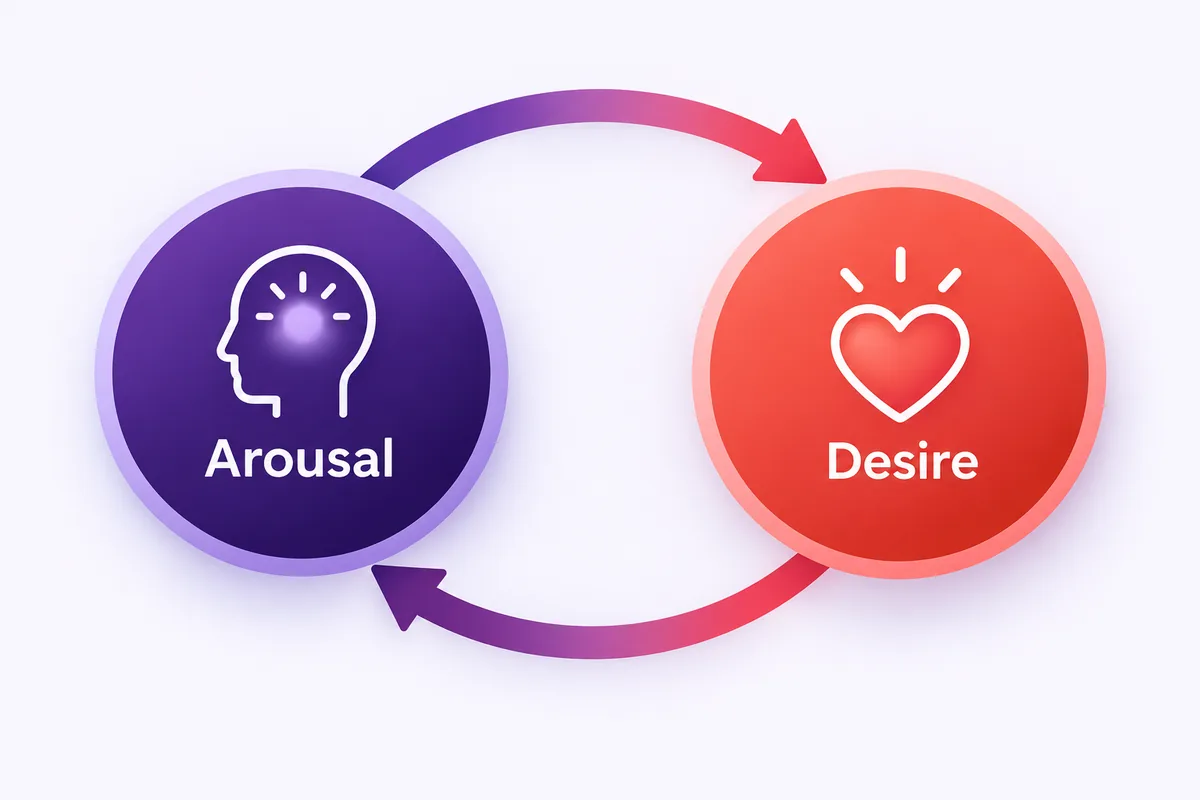
The International Society for Sexual Medicine adds that qualitative studies note women often experience arousal before desire. That pattern appears in some research and is no rule for any one person.
Classic and modern models
Different models answer the order question differently.
| Model | How it describes the sequence |
|---|---|
| Masters and Johnson (1966) | Four phases in a line: excitement, plateau, orgasm and resolution |
| Cleveland Clinic’s description | Desire, arousal, orgasm and resolution, with order and timing that can vary |
| Basson’s model | A circular model of overlapping phases of variable order |
Many sexual medicine experts say the process is not always linear, particularly for women. The nonlinear model that Rosemary Basson developed in the early 2000s is generally accepted in the female sexual medicine community. Models give a point of reference, not a rule.
The page on the sexual response cycle sets these models out in more detail.
What research suggests
One online study tested whether sexual stimuli raise desire. It randomly assigned 128 women and 98 men to an erotic story, an unstructured fantasy, an imagined sexual encounter, or a neutral task. All three sexual conditions raised self-reported arousal and positive mood compared with the neutral one. They also raised state sexual desire.
The authors drew two conclusions. Desire responds to stimuli, and desire is hard to measure as a fixed trait. Because the study was online and relied on self-report, it describes what participants said about themselves. It does not show that stimulation will create desire in everyone.
What this means in a relationship
No one should feel pressured to have sex, and not being in the mood is a normal feeling. On some occasions, starting a sexual activity may spark responsive desire, and that can sometimes improve desire later. Responsive desire cannot be expected every time.

Life circumstances can change desire. The International Society for Sexual Medicine names these examples:
- New parenthood, with its responsibilities and lack of sleep.
- A serious medical condition in one partner.
- Some medications.
- Changes in hormones.
- Other medical conditions.
Planned Parenthood says there is no normal amount of desire for sex.
If low interest or difficulty with arousal causes you distress, see difficulty getting aroused.
A hypothetical example
Suppose a couple has had a long week. One partner says they are not in the mood. They agree to start with a massage and see how it goes, with no pressure to continue. Twenty minutes in, the first partner notices interest building.
This is responsive desire in everyday terms. Nothing in the story is guaranteed, and either partner can stop at any point.
When to talk to a clinician
Changes in desire or arousal are common and often temporary. For women, the Merck Manual sets two conditions. Lack of interest and inability to be aroused count as a disorder only if they cause distress and interest is absent throughout the sexual experience.
Cleveland Clinic suggests contacting a provider if sexual problems last three months or longer, or if they begin to interfere with relationships or cause distress. A provider will ask about medical history, medications and supplements to look for the cause.
Frequently asked questions
Can you be aroused without desire?
It can happen. A clinical psychologist who works with trauma survivors writes that physical sexual response and desire for sex are not always connected. A physical response alone does not show that someone wants sex, and it does not show agreement either. This point is covered in arousal and consent.
Is it normal to have low desire?
Desire varies between people and over time, and Planned Parenthood says there is no normal amount. For women, the Merck Manual says lack of sexual interest is considered a disorder only if it causes distress and interest is absent throughout the sexual experience.
Is desire the same as libido?
Planned Parenthood uses “sex drive” and “libido” for the same idea: feeling desire to be sexual. Arousal is the response once something turns you on.
What is responsive desire?
Desire that arises in response to starting sexual activity or stimulation, rather than before it. The International Society for Sexual Medicine calls it an important idea for intimacy between partners, especially in long-term relationships.
Do men and women differ in how desire and arousal relate?
Qualitative studies note that women often experience arousal before desire. That is a pattern across studies and no rule for any one person. The sources used here do not compare men and women directly on the order of desire and arousal.
Living with the difference
Not feeling desire first is a recognized pattern and no fault. The International Society for Sexual Medicine says it may be useful for partners to try sexual activity occasionally even when not in the mood, because responsive desire may kick in. No one should feel pressured to have sex.
If low interest or trouble with arousal bothers you, difficulty getting aroused covers causes and when to get help. The overview of sexual arousal shows how the pieces fit.
Sources
- Arousal - Planned Parenthood
- Sexual Response Cycle: Order, Phases & What To Know - Cleveland Clinic
- What Is Responsive Sexual Desire? - International Society for Sexual Medicine
- Human sexual response - Handbook of Clinical Neurology (PubMed)
- Arousal Non-concordance and Involuntary Sexual Response - Psychology Professional Development (psychpd.com.au)
- Study of Sexual Concordance in Men and Women with Different Typologies of Adherence to the Sexual Double Standard - International Journal of Clinical and Health Psychology (PMC)
- Agreement of self-reported and genital measures of sexual arousal in men and women: a meta-analysis - Archives of Sexual Behavior (PubMed)
- Sexual Interest/Arousal Disorder - Merck Manual Consumer Version
- Sexual Dysfunction: Disorders, Causes, Types & Treatment - Cleveland Clinic
- Genital Arousal Disorder - Planned Parenthood
- An Overview of the Sexual Response Cycle - Sexual Medicine Society of North America (SMSNA)
- Sexual arousal and desire: interrelations and responses to three modalities of sexual stimuli - Journal of Sexual Medicine (PubMed)
- What is sexual consent? - Rape Crisis England & Wales