Male Sexual Arousal
Male sexual arousal involves the mind and body, and an erection alone does not always mean someone is aroused. Learn how arousal works and why it varies.

General education, not medical advice. If something here worries you, talk with a clinician.
Table of Contents
Male sexual arousal is a response of the mind and body together. The Merck Manual says the nervous, circulatory and hormonal systems all interact with the mind to produce it.
The erection is the best-known sign. In research, an erection in a sexual context is treated as the most reliable indicator of arousal. Even so, agreement between genital response and how aroused a man says he feels is far from perfect. For the general definition, see what sexual arousal is.
How arousal is usually recognized
Researchers do not share one definition of sexual arousal. A 2007 paper in Hormones and Behavior says arousal is a construct without a widely shared definition, and that the links between arousal, motivation, emotion and erection are disputed.
Two ideas appear in the literature:
- Context matters. An erection in the presence of erotic stimuli is treated as a reliable indicator. An erection outside a sexual context, such as during REM sleep, is not grounds for inferring arousal.
- Arousal and motivation can be separated. A 2024 review proposes a narrow research definition: an autonomic nervous system response that leads to erection when sexual cues trigger it. It keeps sexual motivation as a separate idea.
The 2024 review draws largely on animal models, mainly rats. Its definition is a proposal for research and is not a clinical standard.
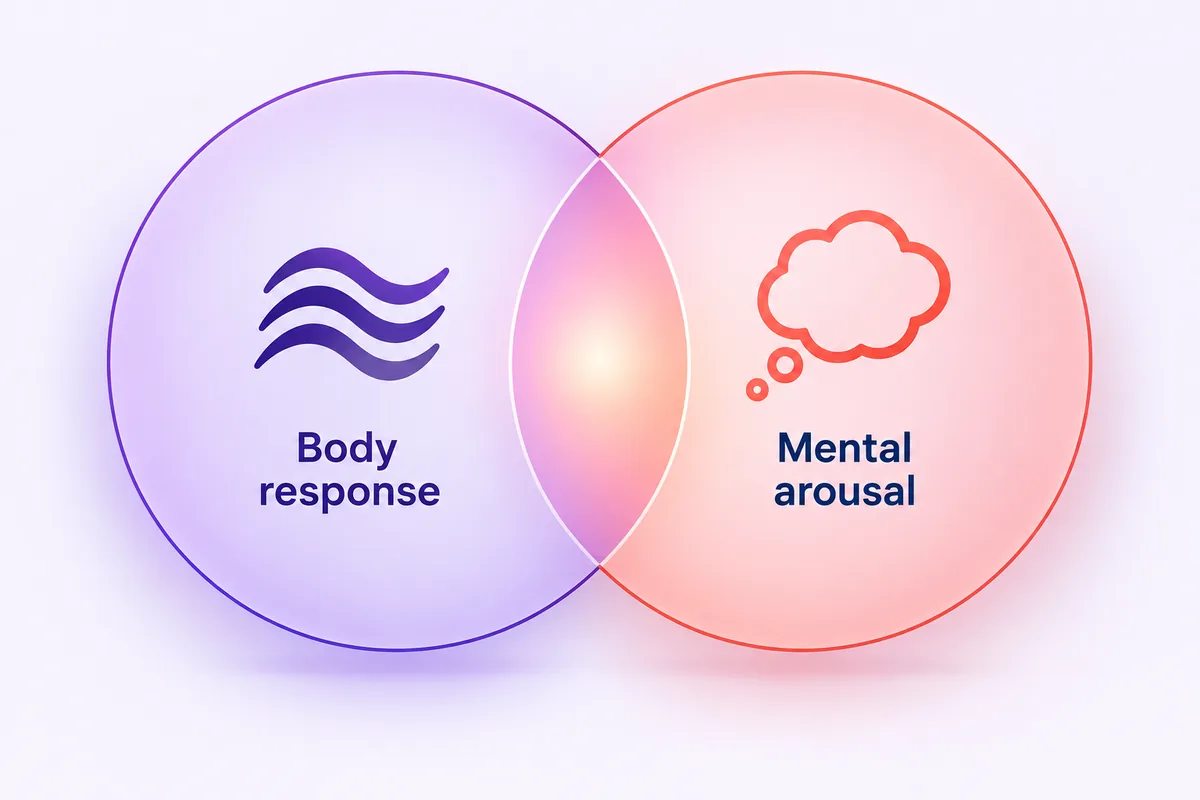
It is also a physiological definition. ATSA describes arousal as both a mental state and a physical state, and says either can occur without the other.
What happens in the body
The Merck Manual describes the sequence in the penis like this:
- Desire. The wish for sexual activity may be triggered by thoughts, words, sights, smell or touch.
- Signals. During excitement, the brain sends nerve signals down the spinal cord to the penis.
- More blood flow. The arteries to the erectile tissue open wider, blood flow increases dramatically, and the tissue becomes engorged and expands.
- Pressure builds. The expansion compresses the veins that drain blood, so outflow slows and pressure rises, which produces rigidity and erection.
- Whole-body tension. Muscle tension increases throughout the body, and it intensifies in the plateau stage.
Cleveland Clinic lists other changes that may come with arousal. These include a faster heart rate and breathing, skin flushing, hardening nipples, a tightening scrotum, and fluid at the tip of the penis. As arousal continues, the testicles withdraw up into the scrotum.
What the brain does
Most detailed work on the brain’s role in male arousal comes from animal studies, mainly in rats. In that work, a 2024 review names the amygdala, hypothalamus and several brainstem regions as structures that control the level of arousal. It names cortical areas such as the insula and anterior cingulate cortex as regulators of the autonomic nervous system.
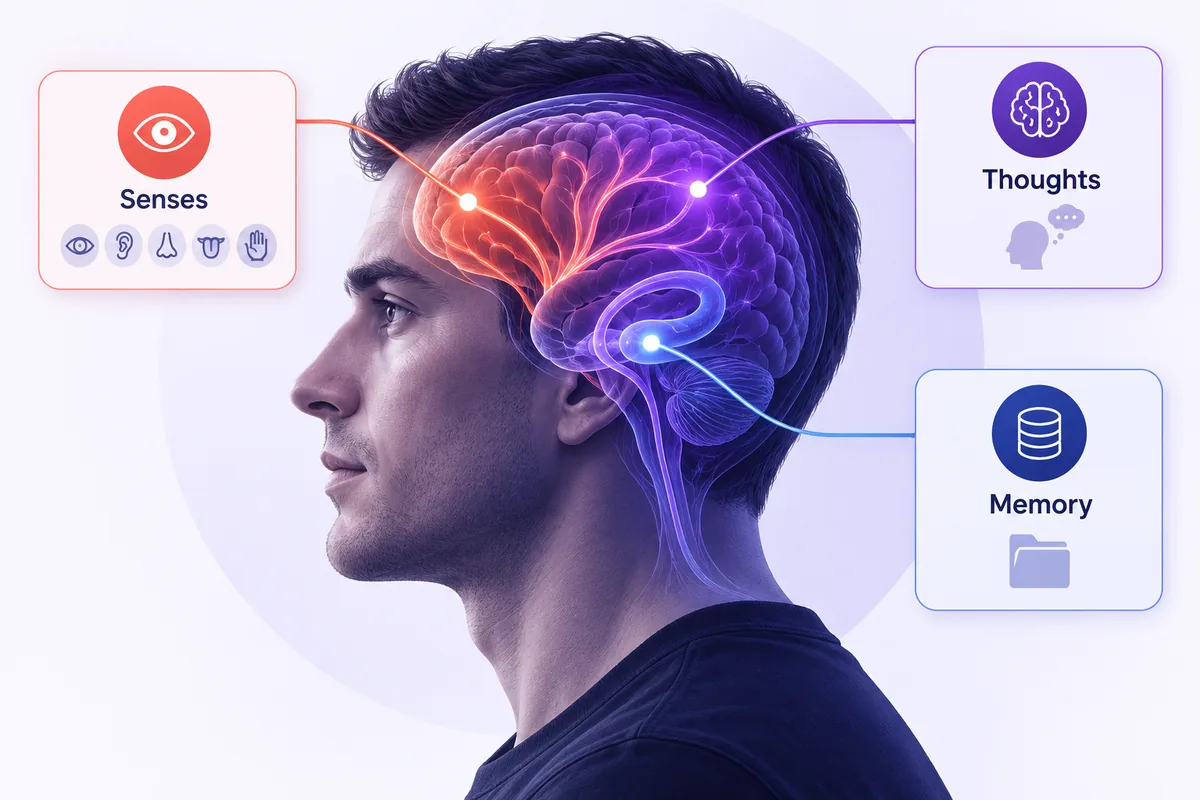
These are likely pathways in animals and not settled facts about people. A review of human studies says sexual behavior is regulated by subcortical structures such as the hypothalamus, brainstem and spinal cord, and by several cortical areas. It also says the systems involved are not fully understood.
Erection without arousal, and arousal without erection
A hard penis and a feeling of being turned on usually go together. Research shows they can come apart.
| Situation | What the sources say |
|---|---|
| Erection outside a sexual context, such as REM sleep | Not grounds for inferring arousal |
| Feeling aroused without genital change | A summary of a meta-analysis reports that some men feel aroused without genital change |
| Mental arousal with no physical sign | Possible, as is physical arousal with no mental arousal |
| Typical agreement between the two | Greater in men (r = .66) than in women (r = .26), but far from perfect |
This gap has a name, arousal non-concordance. It can also matter after an unwanted sexual experience, because a physical response does not show that a person wanted or agreed to what happened. See arousal and consent.
Arousal, ejaculation and recovery
Arousal, orgasm and ejaculation are related but separate. The Merck Manual says ejaculation and orgasm often occur nearly together, yet they are separate events, and either can happen without the other.
After orgasm there is a refractory period, a time when another erection cannot be obtained. It is often as short as 20 minutes or less in young men and longer in older men, and the time between erections generally increases as men age. Cleveland Clinic likewise says the refractory period varies and changes with age.
Factors that can affect erections
Sexual function depends on the mind, nervous system, blood vessels and hormones working together. The Merck Manual’s list of factors that cause or contribute to erection problems is therefore long. These are causes of erection problems, and not tested causes of arousal itself:

- Blood vessels and nerves. The Merck Manual says most cases of erectile dysfunction come from abnormalities of the blood vessels or nerves of the penis.
- Hormones. Low testosterone tends to decrease sex drive and can also result in erection problems.
- Medicines. Drugs for high blood pressure, for an enlarged prostate, and for depression are named.
- Alcohol and drugs. Alcohol, cocaine and amphetamines can cause or contribute to erection problems.
- Mind and energy. Performance anxiety, depression, illness, fatigue and stress can contribute, and erection problems may be situational, involving a particular place, time or partner.
- Performance worry. Cleveland Clinic estimates that up to 25% of men are affected by sexual performance anxiety.
See stress and anxiety and medications for more detail.
When to talk to a clinician
Every man occasionally has trouble achieving an erection, and the Merck Manual considers this normal. It advises men who are consistently unable to achieve or maintain an erection to see a doctor, because the problem may be a sign of a serious health problem.
NIDDK says erectile dysfunction is not a routine part of aging. Erections during sleep are not grounds for inferring arousal. Even so, the Merck Manual lists absence of erections during the night or on waking among the signs that are cause for concern. For causes and treatment, see difficulty getting aroused.
Frequently asked questions
What are the signs a man is aroused?
Common signs include a harder penis, a faster heart rate and breathing, flushing, and more muscle tension. Planned Parenthood says arousal can bring many physical reactions or none at all.
A body sign is not proof of how someone feels or whether they want sex.
What turns a man on?
It varies. Planned Parenthood lists sexual stimulation, fantasy or sexual thoughts, and reading, watching or listening to erotic material. The Merck Manual adds that desire may be triggered by thoughts, words, sights, smell or touch.
Everyone’s erogenous zones are different, and not everyone is aroused by touch.
Does an erection always mean arousal?
No. An erection outside a sexual context, such as during REM sleep, is not grounds for inferring arousal. Mental and physical arousal can each occur without the other.
Can a man be aroused without an erection?
It appears so, though the evidence here is indirect. A professional-development article summarizing a large meta-analysis reports that some men feel aroused without genital change. ATSA says mental arousal can occur without a physical sign. The meta-analysis itself found that agreement between genital response and felt arousal in men (r = .66) was far from perfect.
How long before a man can have another erection?
It varies. The refractory period is often as short as 20 minutes or less in young men and longer in older men.
What to take from this
Male arousal is more than an erection. It is a response of the mind and body, and the two do not always agree. An erection in a sexual context is a useful research indicator, but it does not settle how a person feels or what they want.
If lasting changes bother you, a doctor can look for physical or psychological causes. For how arousal differs from wanting sex, see arousal vs. desire. The matching page on the female body is female sexual arousal.
Sources
- Overview of Sexual Function and Dysfunction in Men - Merck Manual Consumer Version
- A contextual definition of male sexual arousal - Hormones and Behavior (PubMed)
- Agreement of self-reported and genital measures of sexual arousal in men and women: a meta-analysis - Archives of Sexual Behavior (PubMed)
- Neurophysiology of male sexual arousal-Behavioral perspective - Frontiers in Behavioral Neuroscience (PMC)
- Sexual Arousal, Sexual Abuse, and Consent - Association for the Treatment of Sexual Abusers (ATSA)
- Sexual Response Cycle: Order, Phases & What To Know - Cleveland Clinic
- Neuroanatomy and function of human sexual behavior: A neglected or unknown issue? - Brain and Behavior (PMC)
- Arousal Non-concordance and Involuntary Sexual Response - Psychology Professional Development (psychpd.com.au)
- What is sexual consent? - Rape Crisis England & Wales
- Erectile Dysfunction (ED) - Merck Manual Consumer Version
- How To Overcome Sexual Performance Anxiety - Cleveland Clinic
- Definition & Facts for Erectile Dysfunction - NIDDK, National Institutes of Health
- Arousal - Planned Parenthood