The Sexual Response Cycle
The sexual response cycle describes how body and mind respond to stimulation. Compare the four stages with Basson's circular model and their limits.
General education, not medical advice. If something here worries you, talk with a clinician.
Table of Contents
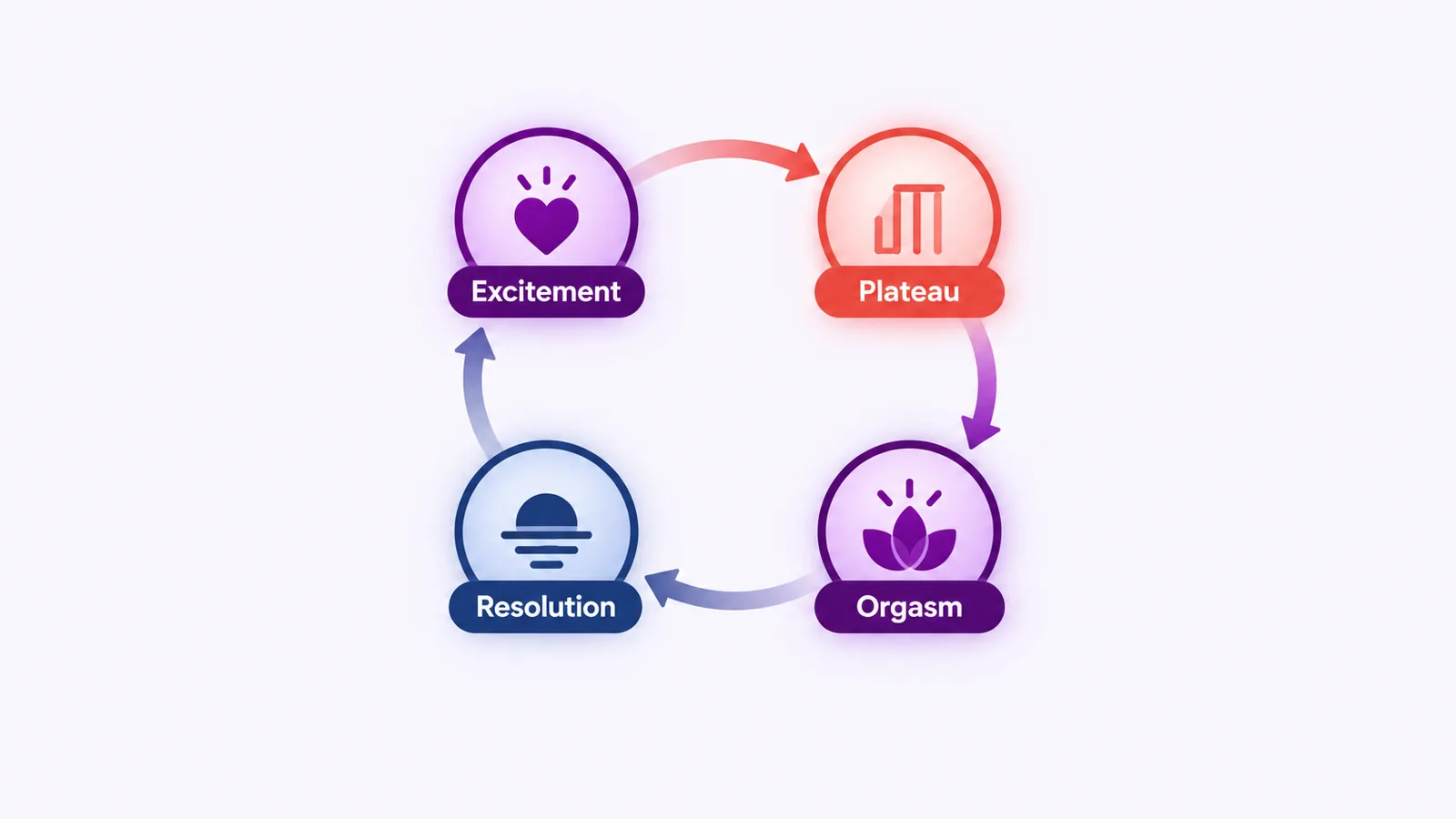
The sexual response cycle is a model of the physical and emotional changes that happen during sexual activity. The best-known version has four phases. They were outlined by William Masters and Virginia Johnson in 1966.
Many people ask about the four stages of arousal. Those four stages belong to the response cycle, and arousal is only one part of it. The cycle is also a model, which is a point of reference and not a rule. For arousal on its own, see what sexual arousal is.
How sources name the stages
Sources do not use the same names for the phases. Even two pages from one hospital differ.
| Source | Phases |
|---|---|
| Masters and Johnson (1966), as described by SMSNA | Excitement, plateau, orgasm and resolution |
| Cleveland Clinic, response cycle page | Desire, arousal, orgasm and resolution |
| Cleveland Clinic, sexual dysfunction page | Excitement, plateau, orgasm and resolution |
| Merck Manual, men’s overview | Excitement, plateau, orgasm and resolution, with desire leading into the first stage |
The names overlap. Cleveland Clinic’s response page calls its first phase desire, also called libido or excitement, and its second arousal, sometimes called plateau. Its dysfunction page says excitement includes desiring sex and becoming aroused. The response page also says the desire phase may come after arousal.
What may happen in each stage
Descriptions of the changes are drawn from medical sources. Not everyone notices each one, and Cleveland Clinic says a person may not consistently notice changes in the early phase.
| Stage | What may happen |
|---|---|
| Desire or excitement | Faster heart rate and breathing, skin flushing, nipples hardening, and more blood flow to the genitals, which can cause clitoral swelling or an erection |
| Arousal or plateau | The earlier changes intensify. Muscle tension keeps rising, and muscle spasms may begin in the feet, face and hands. Excitement and muscle tension intensify in the plateau stage |
| Orgasm | The peak of sexual excitement. Muscle tension increases throughout the body and the pelvic muscles contract. In women, the muscles around the vagina contract rhythmically |
| Resolution | The body returns to its normal state, and swollen or erect parts return to their previous size. People may feel satisfaction and often fatigue |
After resolution, some females can return to orgasm with further stimulation. Males typically need a recovery period called the refractory period.
How long each stage lasts
Few sources give times. Cleveland Clinic says the desire phase can last from a few minutes to several hours. It says orgasm is the shortest phase and lasts only a few seconds.
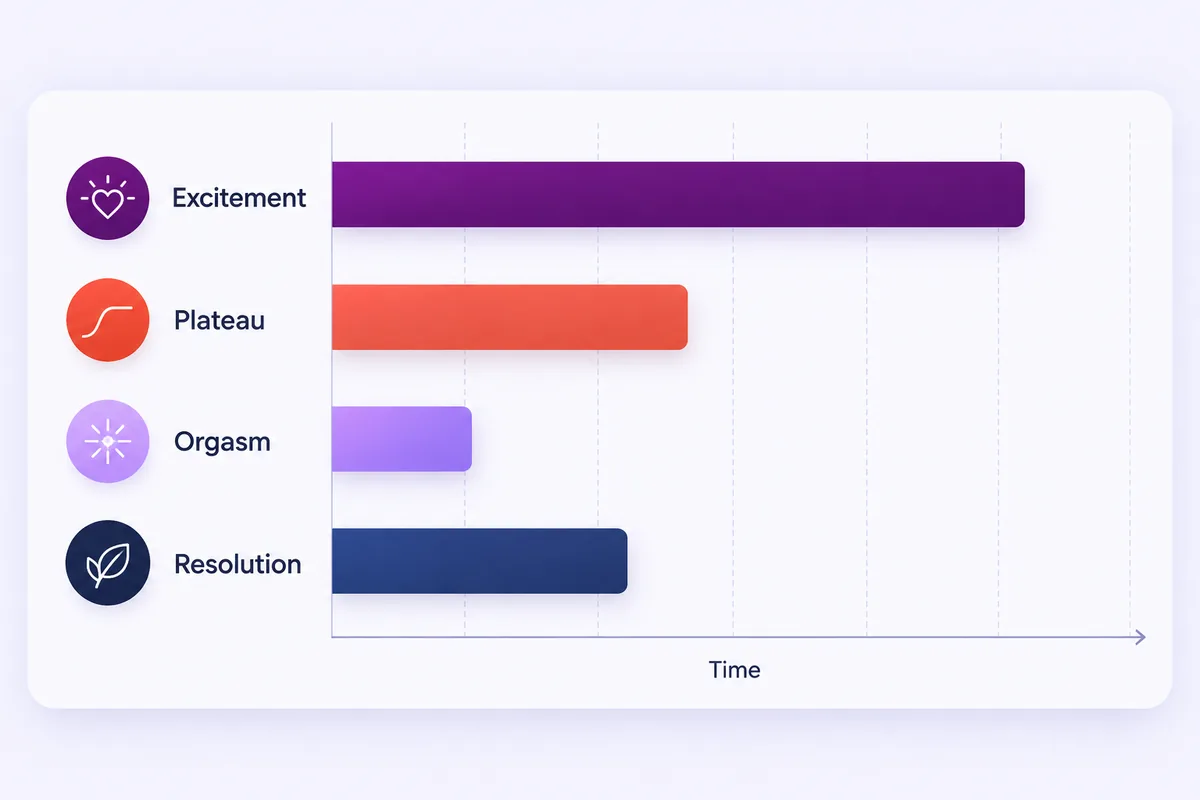
It gives no duration for the arousal phase, which it says lasts until just before orgasm. For the refractory period in men, the Merck Manual says it is often as short as 20 minutes or less in young men and longer in older men.
Basson’s circular model
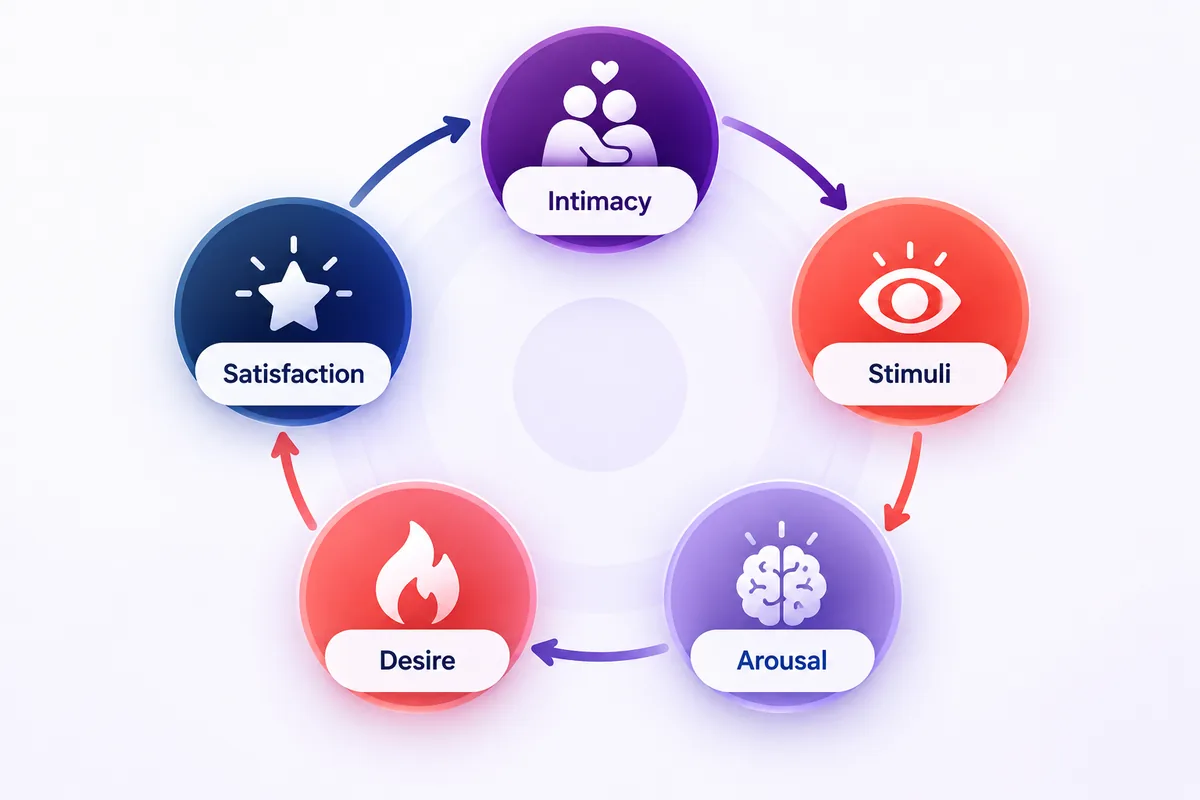
Rosemary Basson developed a nonlinear model in the early 2000s, and the female sexual medicine community generally accepts it. In a 2015 chapter in the Handbook of Clinical Neurology, Basson describes human sexual response as a circular model of overlapping phases of variable order.
Three ideas stand out in the sources:
- Order can change. Basson’s model has overlapping phases of variable order. Qualitative studies note that women often experience arousal before desire.
- Outcomes feed back. The sexual and non-sexual results of an encounter influence motivation for future intimacy.
- Context shapes the path. Variability is marked between people and within one person’s life, and is shaped by life stage, mental health and relationship happiness.
The International Society for Sexual Medicine calls this pattern responsive desire. It says motivation for sex often arises after sexual activity or stimulation begins. See arousal vs. desire.
Limits of the models
Models help, and they also mislead if treated as a script. SMSNA says models give a point of reference, not a rule, and that this can ease anxiety about performance and orgasm.

Four limits stand out:
- Not everyone follows the order. Planned Parenthood says people do not always go through every stage. Cleveland Clinic says order and timing can vary, and some people skip a phase.
- Partners differ. Partners rarely go through the phases at the same time.
- Not always linear. Many sexual medicine experts note the process is not always linear, particularly for women.
- Body and feelings can differ. In a meta-analysis, agreement between genital and self-reported arousal was greater in men (r = .66) than in women (r = .26). See arousal non-concordance.
Using the cycle to find a problem
Clinicians use the cycle to locate a problem. Cleveland Clinic says sexual dysfunction can occur at any point of the sexual response cycle. Its examples include low libido, inability to become aroused, inability to reach orgasm, and pain with intercourse.
Treatment addresses the underlying physical or psychological problem, and it depends on the cause. For a full guide, see difficulty getting aroused.
Frequently asked questions
What are the four stages of sexual arousal?
The four stages people have in mind belong to the sexual response cycle, not to arousal alone. In the Masters and Johnson description they are excitement, plateau, orgasm and resolution. Cleveland Clinic’s response cycle page lists desire, arousal, orgasm and resolution.
How long does each stage last?
Sources give few times. The desire phase can last a few minutes to several hours, and orgasm lasts only a few seconds. No duration is given for the arousal phase.
Do men and women go through the same stages?
Cleveland Clinic says males and females can experience these phases, although the timing may be different. Many experts say the process is not always linear, particularly for women.
Do people skip stages?
Some people do. Cleveland Clinic says the order and timing can vary and some people skip a phase. Planned Parenthood says people do not always go through every stage.
Is the response cycle the same as arousal?
No. In Cleveland Clinic’s description, arousal is one phase of four, alongside desire, orgasm and resolution. The Masters and Johnson cycle has no separate desire phase.
How to use the models
Use the stages as a map, not a timetable. Partners rarely go through the phases at the same time, and variability is marked within one person’s life as well as between people.
If you want more on the first stage, read arousal vs. desire. For how it feels, see what sexual arousal feels like.
Sources
- Sexual Response Cycle: Order, Phases & What To Know - Cleveland Clinic
- An Overview of the Sexual Response Cycle - Sexual Medicine Society of North America (SMSNA)
- Sexual Dysfunction: Disorders, Causes, Types & Treatment - Cleveland Clinic
- Overview of Sexual Function and Dysfunction in Men - Merck Manual Consumer Version
- Overview of Sexual Function and Dysfunction in Women - Merck Manual Consumer Version
- Human sexual response - Handbook of Clinical Neurology (PubMed)
- What Is Responsive Sexual Desire? - International Society for Sexual Medicine
- Arousal - Planned Parenthood
- Agreement of self-reported and genital measures of sexual arousal in men and women: a meta-analysis - Archives of Sexual Behavior (PubMed)