What Does Sexual Arousal Feel Like?
Sexual arousal can feel different from person to person. Learn the physical and emotional sensations people commonly describe, and why some feel very little.

General education, not medical advice. If something here worries you, talk with a clinician.
Table of Contents
There is no single feeling. For one person, arousal is a flush of warmth and a quickened pulse. For another, it is a quiet sense of interest with almost nothing happening in the body. Planned Parenthood notes that arousal can bring many physical reactions or none at all.
Health sources do agree on a short list of common changes, set out below, and on why your own experience may differ from it. For the broader definition, see what sexual arousal is.
Common physical sensations
The changes below are the ones that Planned Parenthood and Cleveland Clinic describe. None of them is guaranteed, and a person may notice only some.

| Where | What may happen |
|---|---|
| Whole body | Heart rate and breathing speed up and the skin may flush. Blood pressure and body temperature can rise. |
| Nipples | Nipples may become hard. They can fill with blood and become more sensitive. |
| Vulva and vagina | The clitoris and labia fill with blood and become more sensitive. The vagina may lubricate and expand. |
| Penis and scrotum | The penis may become erect. The scrotum may tighten. |
Sensitivity to touch
Some body parts have many nerve endings, and touching them can feel exciting. These are often called erogenous zones. Everyone’s zones are different, and not everyone is aroused by touch at all.
The physical response differs by body. See female sexual arousal and male sexual arousal.
How sensations build as arousal continues
Arousal is not a single moment. Cleveland Clinic describes changes that build over time.
| Phase (Cleveland Clinic’s name) | What may happen |
|---|---|
| Desire, also called excitement | Heart rate and breathing speed up, skin may flush, nipples harden, and blood flow to the genitals increases. This first phase can last from a few minutes to several hours. |
| Arousal | The earlier changes intensify. The vagina swells further, the clitoris becomes highly sensitive, the testicles withdraw up into the scrotum, and muscle tension rises. It lasts until just before orgasm. |
| Orgasm | The shortest phase, lasting only a few seconds. |
| Resolution | The body returns to its usual state. People may feel satisfaction and often fatigue. |
Order and timing vary, and some people skip a phase. The desire phase may even come after arousal. Use the table as a rough map, not a schedule.
The mental and emotional side
Arousal is also a mental state. ATSA, a professional association for sexual-abuse treatment, describes a mental side and a physical side. Laboratory research also finds that the two can diverge. The mental side includes emotions, thoughts and fantasy. The physical side includes more genital blood flow and a stronger sense of touch.
In a welcome sexual experience, the two usually happen together.
How long does arousal last?
There is no fixed length. Cleveland Clinic says its first phase, which it calls desire or excitement, can last from a few minutes to several hours. The arousal phase runs until just before orgasm, and orgasm lasts only a few seconds.
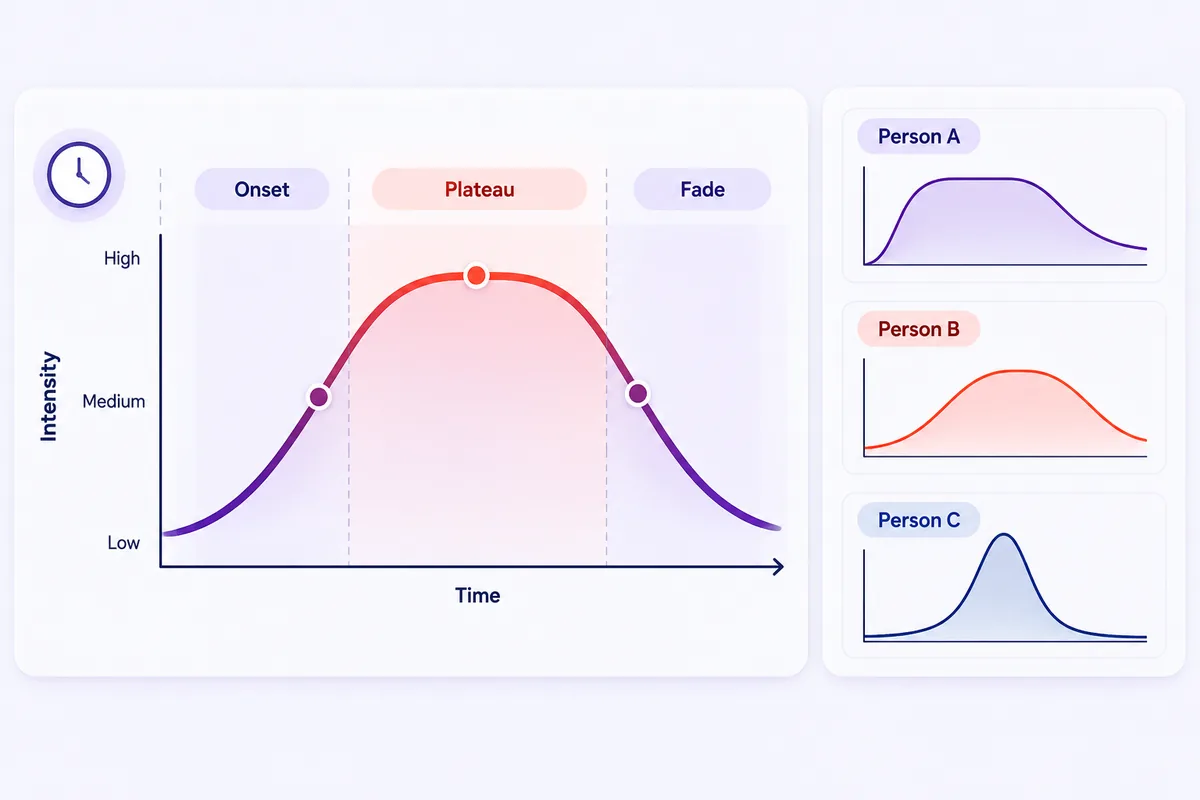
Recovery differs too. Some females can return to orgasm with further stimulation, while males typically need a recovery period, called the refractory period, that varies and changes with age.
Why it feels different for different people
Responses vary between people and within one person’s life. A review of sexual response notes that variation is marked, and that it is shaped by life stage, mental health and relationship happiness.
Day-to-day factors matter too. Stress, medicines and other physical, emotional or lifestyle factors can change sex drive. Cleveland Clinic also points out that a person may not consistently notice any changes when they enter the desire phase.
Suppose two friends watch the same film. One notices a racing pulse and warmth. The other notices nothing in the body but feels growing interest. Both fall within the range of responses described above.
So there is no single correct sensation to look for. If your experience differs from a description you read, that alone says little. If a low sex drive bothers or upsets you, Planned Parenthood says it may be hypoactive sexual desire disorder, and there are things you can do about it. See difficulty getting aroused.
Arousal or anxiety?
Excitement and fear can raise the pulse much as sexual arousal does. Psychology Today describes misattribution of arousal, in which people confuse non-sexual arousal for sexual arousal, such as after crossing a scary bridge or riding a roller-coaster together.
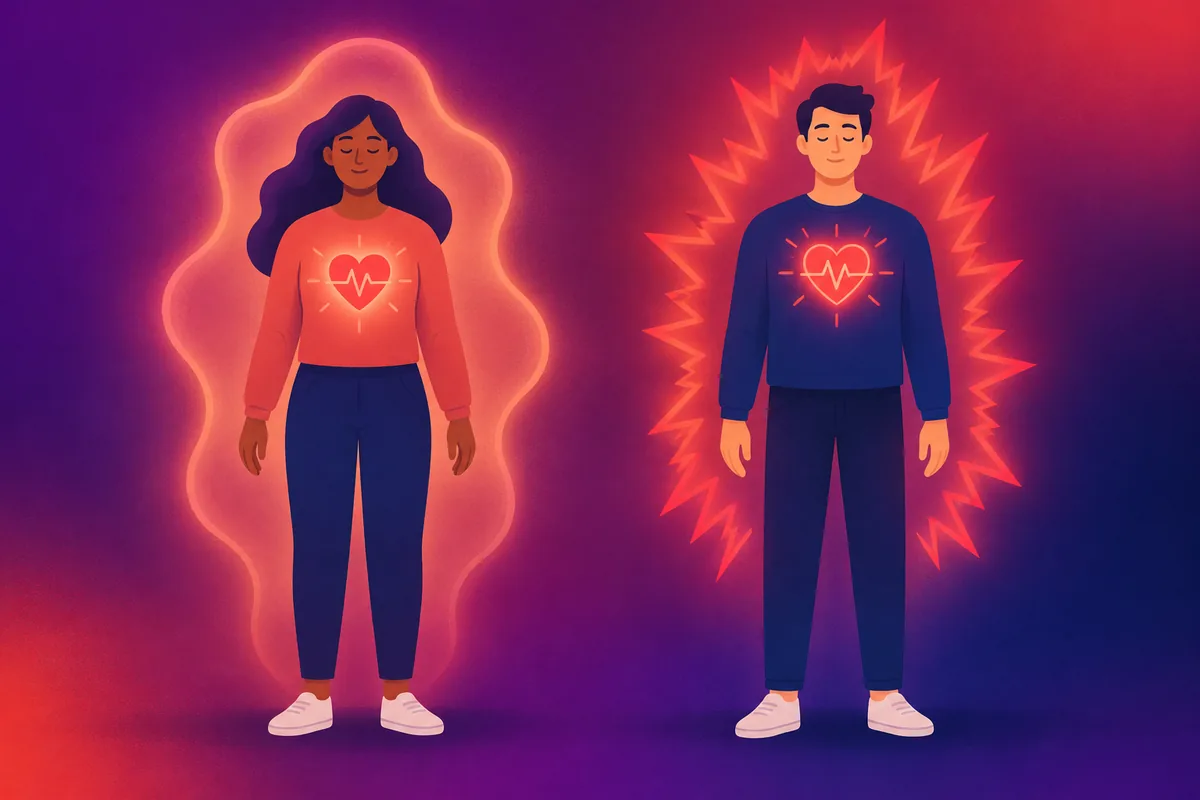
Anxiety may play a part too. One study of women without a clinical diagnosis found a curved relationship between state anxiety and physical arousal, so more anxiety did not simply mean less arousal. Cleveland Clinic adds that when someone is in their head, worrying about performance, it is harder to enjoy sex.
Research on stress is covered in stress, anxiety and sexual arousal. The difference between being drawn to a person and being turned on is covered in arousal vs. attraction.
When your body and mind do not match
Body and mind do not always agree. The Association for the Treatment of Sexual Abusers describes how mental and physical arousal can relate. Laboratory research points the same way. A meta-analysis of 132 studies found that agreement between self-reported and genital arousal was greater in men (r = .66) than in women (r = .26). It was far from perfect in both.
| Pattern | What it means |
|---|---|
| Both together | In a mutually enjoyable experience, mental and physical arousal usually happen at the same time. |
| Mind without body | A person can be mentally aroused without showing physical signs. |
| Body without mind | A person can be physically aroused without experiencing mental arousal. |
| Disgust | A person can feel disgust at the physical signs when they respond to unwelcome stimuli. |
A clinical psychologist who works with trauma survivors notes that physical sexual response and desire for sex are not always connected. A related idea, arousal non-concordance, describes a gap between genital response and how turned on a person feels. Rape Crisis England & Wales is clear that feelings of arousal do not change whether sexual activity without consent is sexual violence. Arousal and consent covers that in detail.
Frequently asked questions
How do you know if you are aroused?
Look at the whole picture. A faster pulse, flushing and more blood flow to the genitals are common physical signs. Mentally, you may notice emotions, thoughts or fantasy. A person may notice only some of these.
Can you be aroused without any physical signs?
It happens. Planned Parenthood notes that arousal can bring many physical reactions or none at all. A person can also be mentally aroused without showing physical signs.
Can your body respond when you do not feel turned on?
That can happen too. Sources describe physical arousal that occurs without mental arousal. A clinical psychologist who works with trauma survivors writes that a physical response does not show that someone wanted what happened.
Is there a normal way to feel?
Not really. Planned Parenthood says there is no normal amount of desire for sex and that it changes over time. Researchers describe marked differences between people and across a lifetime, so the changes in the table above are possibilities, not a checklist.
Can non-sexual excitement be mistaken for sexual arousal?
It can. Psychology Today describes misattribution of arousal, in which people mistake non-sexual arousal, such as the fear of a scary bridge or a roller-coaster ride, for sexual arousal.
Using this information
Treat the lists above as a vocabulary, not a test. The lists above describe possibilities, and Planned Parenthood notes that arousal can bring many physical reactions or none at all. If your body and your feelings seem to disagree, a related idea called arousal non-concordance covers that gap.
For the reasons arousal starts at all, read what causes sexual arousal.
Sources
- Arousal - Planned Parenthood
- Sexual Response Cycle: Order, Phases & What To Know - Cleveland Clinic
- Sexual Arousal, Sexual Abuse, and Consent - Association for the Treatment of Sexual Abusers (ATSA)
- Agreement of self-reported and genital measures of sexual arousal in men and women: a meta-analysis - Archives of Sexual Behavior (PubMed)
- Human sexual response - Handbook of Clinical Neurology (PubMed)
- Sexual Attraction and Desire - Psychology Today
- The impact of anxiety on sexual arousal in women - Behaviour Research and Therapy (PMC)
- How To Overcome Sexual Performance Anxiety - Cleveland Clinic
- Arousal Non-concordance and Involuntary Sexual Response - Psychology Professional Development (psychpd.com.au)
- What is sexual consent? - Rape Crisis England & Wales