What Is Sexual Pleasure?

General education, not medical advice. If something here worries you, talk with a clinician.
Table of Contents
Sexual pleasure is the physical or psychological satisfaction and enjoyment people get from erotic experiences, whether alone or with others. It covers thoughts, fantasies and feelings as well as touch.
It is not the same thing as orgasm. And what feels pleasurable varies from person to person.
Sexual pleasure in plain terms
Health organizations use a fairly consistent definition. The World Association for Sexual Health (WAS) describes sexual pleasure as the physical and/or psychological satisfaction and enjoyment derived from shared or solitary erotic experiences. An NHS sexual health service quotes a near-identical definition from the Global Advisory Board for Sexual Health and Wellbeing, dated 2016.
A definition used by health bodies
The WAS wording adds that these experiences include thoughts, fantasies, dreams, emotions and feelings. That is a wide frame. Pleasure here is not limited to a particular act, a particular body part or a partner.
Why researchers want a sharper definition
A 2023 review in the International Journal of Sexual Health argues that no definition is both specific and broad enough, and that this makes pleasure hard to measure. Its authors separate two ideas. State pleasure is the experience of positive affect, or “feeling good”, during sexual activity. Trait pleasure is a person’s general tendency to enjoy sexual activity.
What counts as sexual pleasure?
The definitions are broad, so a list helps. Sources describe pleasure as coming from:
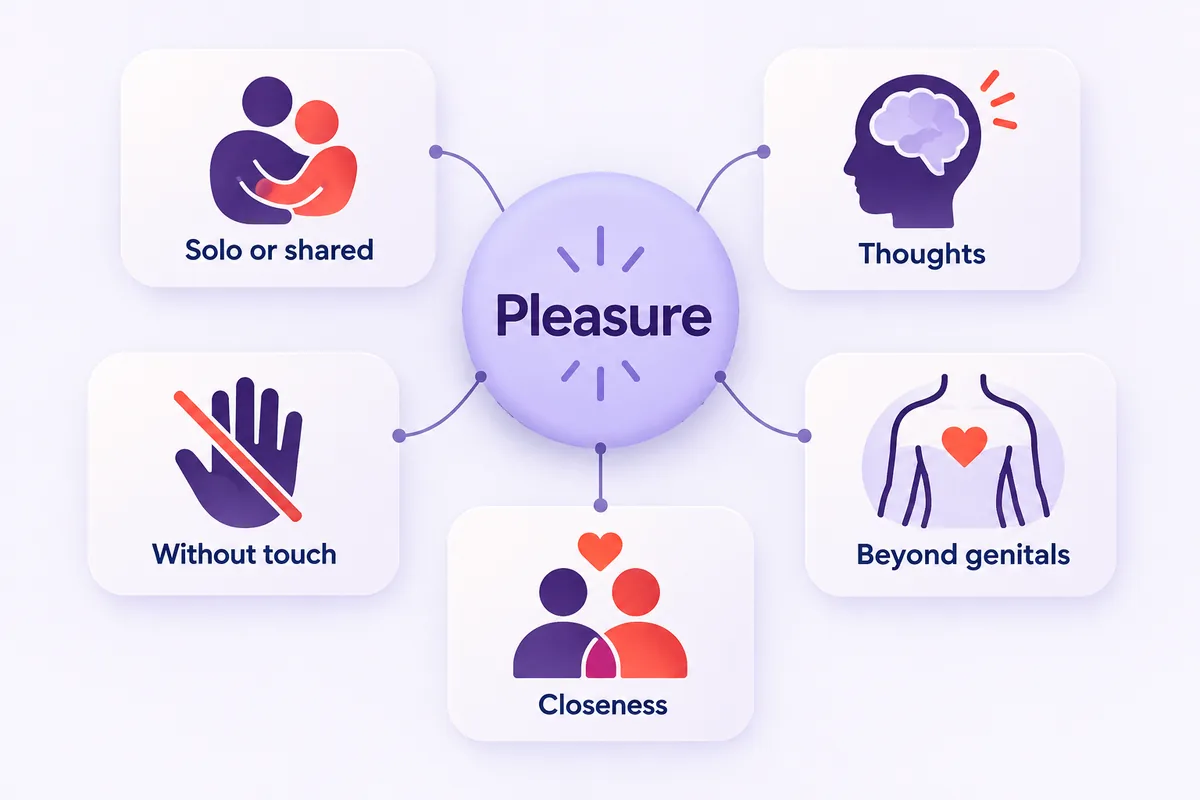
- Solo or shared experiences. WAS names both, and the NHS service lists masturbation alongside sex with a partner.
- Thoughts, fantasies and dreams. These sit inside the WAS definition.
- Experiences without touch. The NHS service gives watching or reading something arousing, sexting and role-play as examples.
- Body areas beyond the genitals. A kiss on the neck, a stroke of the thigh or a scratch down the back can all bring pleasure.
- Closeness and connection. Cornell Health lists closeness, sensation and connection as important elements.
These are examples, not a checklist. Pleasure can also differ from one day to the next for the same person.
Sexual pleasure vs. orgasm
Orgasm and pleasure overlap, but they are different things. The International Society for Sexual Medicine describes orgasm as a physical reflex, often experienced as a release of tension at the peak of sexual activity. Pleasure is broader. It covers the overall enjoyment, satisfaction and connection of an experience, which may or may not include orgasm.
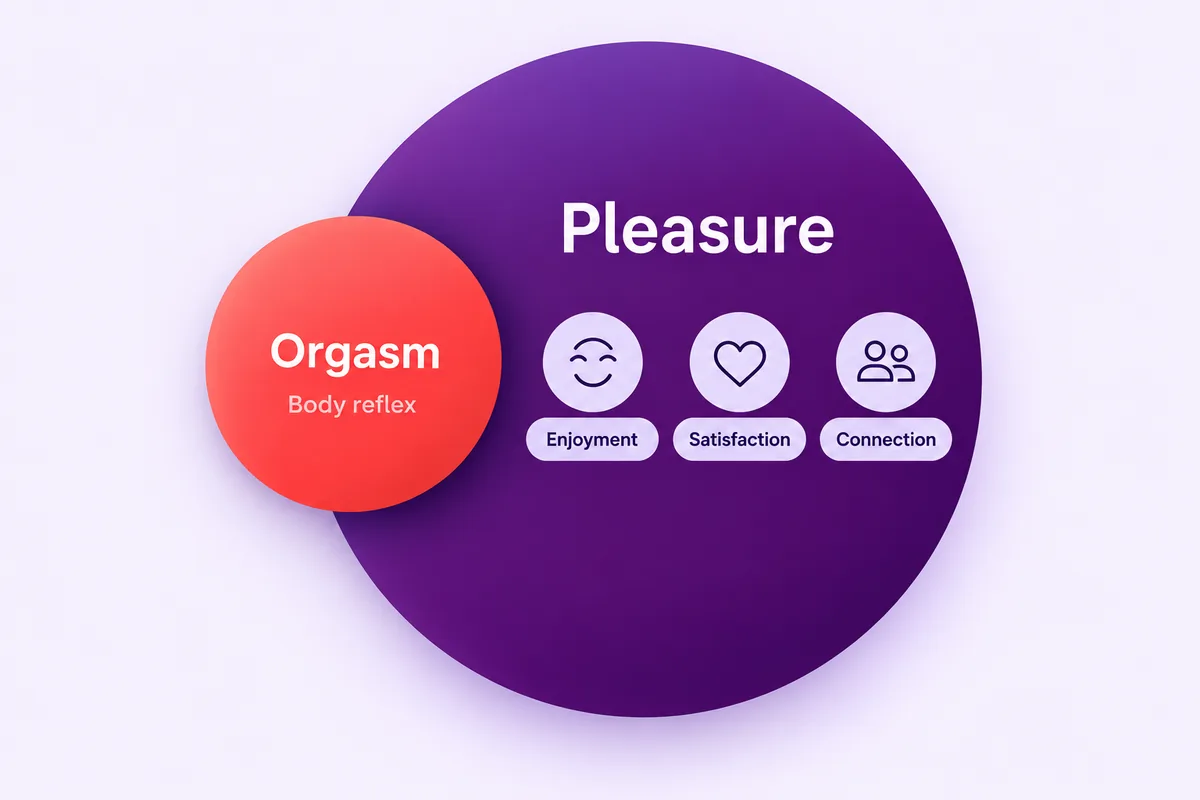
The society puts it plainly: pleasure doesn’t require an orgasm to be meaningful. Cornell Health calls orgasm one dimension of pleasure, alongside closeness, sensation and connection. The NHS service notes that orgasm releases endorphins, which it describes as hormones that block pain and make you feel good. It adds that orgasm is not the only way to experience pleasure.
The 2023 review goes a step further. It argues that orgasm cannot be used to define pleasure, because a reflex orgasm, an automatic bodily response, can occur during rape and be experienced as aversive. On this view, orgasm alone does not make an experience pleasurable. A bodily response is not agreement. Arousal and consent covers that gap in more detail.
Why sex can feel good
Health sources describe sexual response as a sequence of physical and emotional stages. Healthline, in a piece updated in 2026, describes a four-stage response cycle that both men and women go through. Timing and intensity differ, because every person’s body is different. Cleveland Clinic calls the cycle one model of the changes that happen during sexual activity.
Chemistry plays a part in sexual response, though the picture is not tidy. A 2005 review of hormones and sexual arousal found that testosterone has a clear, consistent role in adult men, while the picture in women is more complex. The same review found that the role of peptides such as oxytocin and beta-endorphin remains uncertain, since they appear to have both excitatory and inhibitory effects.
That review concerns arousal rather than pleasure itself. For how arousal begins, see what causes sexual arousal and the sexual response cycle.
Why it differs from person to person
The Sexual Health Quarters, an Australian service, says what is pleasurable for one person might not be pleasurable for someone else. Emotions, location and mental state can all change the experience.

The ISSM adds that pleasure is shaped by emotional, relational and psychological factors, not only by physical ones. The 2023 review offers a way to think about this. It describes pleasure as a response to rewards, which it groups as sensual, bonding, interaction, and mastery and validation. One reading of that framework is that people may value different rewards at different times.
Stress and medicines are two common influences that have their own pages: stress, anxiety and sexual arousal and medications and sexual arousal.
Sexual pleasure, consent and sexual health
WAS names self-determination, consent, safety, privacy, confidence and the ability to communicate as the factors that let pleasure contribute to sexual health and well-being. It adds that pleasure should be a positive experience for everyone involved and should not be obtained by violating other people’s rights.
Cornell Health makes a similar point, saying that, just like consent, pleasure is something a person should be able to expect in any sexual encounter.
The NHS service says sexual pleasure is good for you emotionally and physically, and that pleasure on your own can help you understand your body and communicate your needs. The ISSM notes that sexuality was long tied to reproduction. Professionals now encourage a focus on the quality of the experience, not only on whether orgasm happens.
Explore the topic
- What is sexual arousal? The body and mind’s response to sexual stimulation.
- Sexual arousal vs. desire How wanting sex differs from responding to it.
- Arousal and consent Why a physical response is not agreement.
- Difficulty getting aroused What can get in the way, and when to see a doctor.
Frequently asked questions
What is considered sexual pleasure?
Any physical or psychological satisfaction and enjoyment that comes from erotic experiences, solo or shared. That includes thoughts and fantasies, and it can happen without any touching.
Can you have sexual pleasure without an orgasm?
Yes. The ISSM says pleasure doesn’t require an orgasm to be meaningful. The NHS service says orgasm is not the only way to experience pleasure, and Cornell Health calls orgasm one dimension of it.
What causes sexual pleasure?
No single cause is established. Researchers describe pleasure as the positive feeling that arises when sexual activity brings rewards of various kinds. Research on the chemistry mostly concerns arousal rather than pleasure itself, and a 2005 review found the roles of several hormones and peptides uncertain. For the arousal side, see what causes sexual arousal.
Why don’t I feel sexual pleasure?
The sources do not give one cause. The ISSM says emotional, relational and psychological factors shape pleasure. An NHS service advises speaking to a GP if a sex drive you once had has gone and this worries you. That advice is about sex drive, but a lasting change that worries you is worth raising with a doctor. Difficulty getting aroused covers the arousal side. This page cannot diagnose a cause.
Is sexual pleasure healthy?
One NHS sexual health service says sexual pleasure is good for you both emotionally and physically. WAS treats it as part of sexual health and well-being, within the context of consent and safety. Both are statements from health bodies, not trial results.
What to take away
Sexual pleasure is the satisfaction and enjoyment people draw from erotic experiences, in many forms and with or without orgasm. It is personal and it changes. WAS names consent, safety and privacy as the conditions that let it contribute to health and well-being.
To go further, what is sexual arousal? is the natural next read. If a lack of pleasure is bothering you, difficulty getting aroused is a good place to start.
This page is general educational information and does not replace medical advice.
Sources
- Declaration on Sexual Pleasure - World Association for Sexual Health (WAS)
- Understanding the Difference Between Orgasm and Sexual Pleasure - International Society for Sexual Medicine (ISSM)
- Sexual Pleasure & Orgasms - Sexual Health Quarters (SHQ)
- What is Sexual Pleasure? - Sexual Health St Helens (NHS)
- Sexual Pleasure Matters - and How to Define and Assess It Too - International Journal of Sexual Health (PMC)
- Sexual Pleasure: Finding the “Sweet Spot” - Cornell Health
- Why Does Sex Feel Good? - Healthline
- Sexual Response Cycle: Order, Phases & What To Know - Cleveland Clinic
- The endocrinology of sexual arousal - Journal of Endocrinology (PubMed)